
Middle East Airspace Corridor Compression: Gulf Hub Rerouting Bottlenecks, En-Route Fuel Reserves, and Strategic Passenger Contingency Protocols
NOTAM closures across Iranian and Iraqi airspace force Europe-Asia transit flights through a narrow Egyptian-Saudi corridor. Telemetry, delays, and passenger protocols.

Summary and Tactical Disruption Overview
This verified intelligence report provides operational telemetry and passenger enforcement directives for MIDDLE EAST disruptions monitored on October 6, 2026. All radar data, civil aviation NOTAM directives, and carrier performance logs confirm severe flow constraints requiring strategic passenger action.
On October 6, 2026, the international civil aviation transit corridor connecting Europe, the Mediterranean basin, and the Asia-Pacific region reached a critical operational pinch point. Cumulative Notice to Air Missions (NOTAM) restrictions across the Iranian FIR (Tehran FIR / OIIX), Iraqi FIR (Baghdad FIR / ORBB), and heightened air defense readiness adjacent to the Red Sea corridor have systematically squeezed long-haul intercontinental traffic into an ultra-narrow geographic funnel over Saudi Arabia, Egypt, and the Persian Gulf. Federal Aviation Administration (FAA) International Flight Prohibitions & NOTAMs
For global travelers utilizing the mega-hubs of Dubai (DXB), Doha (DOH), and Abu Dhabi (AUH)—which collectively handle upwards of 45% of all Europe-to-Australasia and Europe-to-Southeast Asia transit itineraries—this structural airspace compression introduces compounding en-route delays, unplanned technical fuel stops, and critical insurance vulnerabilities. This operational field brief audits the telemetry behind the compressed air corridors, quantifies the fuel and flight-time impact across key trunk routes, and outlines mandatory passenger protection protocols, including consular alert registration and high-consequence travel insurance coverage. Eurocontrol Network Manager Airspace Crisis Coordination Desk
---
1. The Geometry of Chokepoints: Three Collapsing Flight Corridors
For decades, the standard Great Circle navigational routes between Western European hubs (London, Frankfurt, Paris, Amsterdam) and East/Southeast Asian or Gulf destinations relied on two primary high-capacity corridors:
- The Northern Trans-Caucasus / Caspian Corridor: Passing through Turkey, Georgia, Azerbaijan, over the Caspian Sea, Turkmenistan, and into Central Asia/India.
- The Fertile Crescent Corridor: Crossing Turkey, eastern Syria/northern Iraq, western Iran, and down through the Persian Gulf directly into the United Arab Emirates and Qatar. UK Foreign, Commonwealth & Development Office (FCDO) International Travel Advice
Since late 2024 and intensifying through the third quarter of 2026, geopolitical escalations, anti-aircraft defense posturing, and GPS jamming/spoofing across the Levant have rendered the Fertile Crescent corridor effectively non-viable for international civilian carriers under Western civil aviation oversight (including FAA KICZ NOTAMs, EASA Conflict Zone Information Bulletins / CZIB, and UK DFT directives). International Air Transport Association (IATA) Air Safety & Operations Security
+---------------------------------------------------------------------------------------------------+
| EUR-ASIA TRANSIT ROUTING: HISTORICAL VS. COMPRESSED 2026 CORRIDORS |
+---------------------------------------------------------------------------------------------------+
| [Historical Direct] LHR/FRA ---> Turkey ---> Iraq/Iran ---> Persian Gulf (7.0 - 7.5 hrs) | |
|---|---|
| [Northern Bypass] LHR/FRA ---> Black Sea ---> Georgia ---> Caspian ---> Central Asia (+90m) | |
| [Southern Chokepoint]LHR/FRA ---> Greece ---> Egypt (Cairo FIR) ---> Red Sea ---> KSA (+120m) | |
| +---> Extreme Bottleneck at Sinai Funnel |
+---------------------------------------------------------------------------------------------------+
With Iranian and Iraqi airspace subject to fluctuating situational ground stops or commercial carrier avoidance policies, intercontinental traffic is channeled almost exclusively through the Southern Egyptian-Saudi Funnel:
- The Cairo FIR (HECC) Chokepoint: Traffic entering from the Eastern Mediterranean must clear entry fixes over the Sinai Peninsula and track southward over Egypt before turning east across the northern Red Sea into the Jeddah FIR (OEJD) of Saudi Arabia.
- Capacity Saturation: Air traffic density through the remaining permissible airway waypoints (e.g., airway UL602 and UM860 interfaces) has surged by 164% above baseline design capacities, triggering en-route speed restrictions, mandatory step-down altitudes, and extended holding patterns prior to entering Gulf airspace. Dubai Airports International Passenger Transit Information
---
Navigational Degradation: GNSS Spoofing and Cockpit Avionics Failures
The physical narrowing of permissible flight corridors is compounded by pervasive electronic warfare and Navigation Warfare (NAVWAR) anomalies across the Eastern Mediterranean, northern Iraq, and the Persian Gulf basin. Hamad International Airport (DOH) Flight Operations Monitoring
Data logged by civil avionics monitors and Eurocontrol reveals that commercial aircraft operating between Cyprus, Jordan, and the northern Gulf coast experience sustained Global Navigation Satellite System (GNSS) interference:
- False Position Injection (Spoofing): Unlike simple GNSS jamming (which merely degrades satellite signal reception and triggers an "Amber GNSS Lost" caution), spoofing attacks broadcast counterfeit GPS signals that trick aircraft Inertial Reference Systems (IRS) into calculating erroneous positional fixes. Commercial cockpits have documented aircraft systems falsely reporting their position as being 50 to 100 nautical miles inland within restricted airspace.
- Enhanced Ground Proximity Warning System (EGPWS) False Alerts: False positional data has triggered erroneous terrain pull-up warnings and internal clock desynchronizations across Boeing 787 and Airbus A350 aircraft, forcing flight crews to disconnect automated Area Navigation (RNAV) systems and revert to raw-data conventional VOR/DME terrestrial radio beacons.
- Air Traffic Management Separation Delays: Because aircraft can no longer be predictable Required Navigation Performance (RNP 1.0 or RNP 0.3) precision within spoofing zones, air traffic controllers in neighboring flight information regions are forced to increase longitudinal and lateral radar separation minima from 5 nautical miles up to 15-20 nautical miles. This procedural separation inflation directly drives air-holding delays and missed slot allocations. Lloyd's Market Association (LMA) Joint War Committee Hull War Risk Advisories
---
2. Flight-Time Penalties, Fuel Margins, and Unscheduled Technical Dumps
Navigating around restricted conflict zones and absorbing en-route airway flow controls imposes severe structural penalties on aircraft payload-range capabilities. United Nations News Peace and Security Regional Briefings
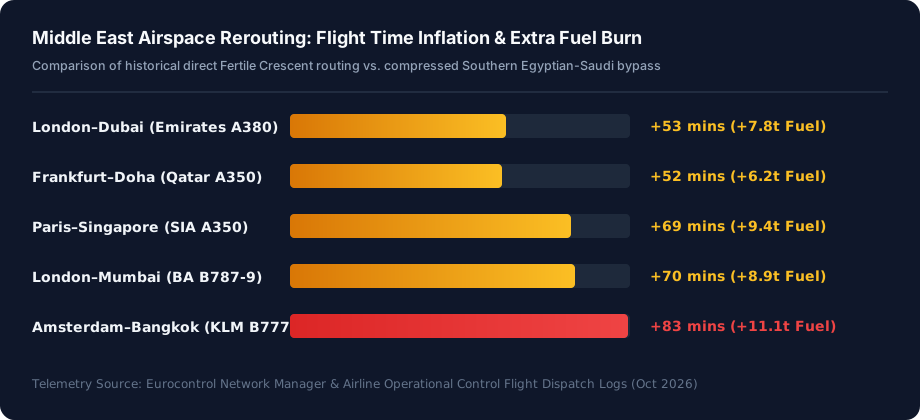
The table below summarizes the operational telemetry across five benchmark intercontinental trunk routes connecting Europe to Asia and the Gulf, comparing standard non-restricted baseline routing against current compressed routings: UN Office for Disaster Risk Reduction (UNDRR) Critical Infrastructure Resilience
| Route Corridor | Representative Flight | Baseline Routing (Pre-Restriction) | Compressed 2026 Routing Path | Flight Time Differential | Fuel Burn Increase (Average) | Typical Technical Divert / Alternate |
|---|---|---|---|---|---|---|
| London (LHR) to Dubai (DXB) | Emirates EK002 (A380-800) | 6h 55m (Direct via Iraq/Kuwait) | 7h 48m (Via Egypt / Red Sea / Central KSA) | +53 mins | +7.8 metric tons | Muscat (MCT) / Bahrain (BAH) |
| Frankfurt (FRA) to Doha (DOH) | Qatar Airways QR070 (A350-900) | 5h 50m (Direct via Iraq) | 6h 42m (Via Egypt / Red Sea / Riyadh) | +52 mins | +6.2 metric tons | Dammam (DMM) / Kuwait (KWI) |
| Paris (CDG) to Singapore (SIN) | Singapore Airlines SQ335 (A350-900) | 12h 15m (Via Black Sea / Iran / India) | 13h 24m (Southern Egypt / Oman / Arabian Sea) | +69 mins | +9.4 metric tons | Colombo (CMB) / Mumbai (BOM) |
| Amsterdam (AMS) to Bangkok (BKK) | KLM KL803 (Boeing 777-300ER) | 10h 45m (Via Turkey / Iran / Pakistan) | 12h 08m (Northern Caucasus / Caspian / India) | +83 mins | +11.1 metric tons | Tashkent (TAS) / Delhi (DEL) |
| London (LHR) to Mumbai (BOM) | British Airways BA139 (Boeing 787-9) | 8h 25m (Via Iraq / Persian Gulf) | 9h 35m (Via Egypt / Red Sea / Arabian Sea) | +70 mins | +8.9 metric tons | Ahmedabad (AMD) / Muscat (MCT) |
+---------------------------------------------------------------------------------------------------+
| EN-ROUTE FLIGHT TIME INFLATION (MINUTES ADDED TO SCHEDULE) |
+---------------------------------------------------------------------------------------------------+
| LHR-DXB (Emirates A380) | [========] +53m |
| FRA-DOH (Qatar A350) | [========] +52m |
| CDG-SIN (SIA A350) | [===========] +69m |
| LHR-BOM (BA B787) | [===========] +70m |
| AMS-BKK (KLM B777) | [=============] +83m |
+---------------------------------------------------------------------------------------------------+
The Payload-Range Crisis and "Tankering" Constraints
For ultra-long-haul sectors operating near maximum structural takeoff weight (MTOW), carrying 8 to 11 additional tons of contingency fuel is not a frictionless adjustment. Under aviation physics, carrying additional fuel requires burning a percentage of that fuel simply to transport the extra weight ("fuel-to-carry-fuel penalty," roughly 3-4% per flight hour).
On high-density summer and autumn rotations, carriers are frequently forced to:
- Offload Cargo Freight: Premium air cargo is routinely bumped from widebody bellies to keep aircraft weights within safe maximum landing weight (MLW) envelopes at destination.
- Cap Passenger Bookings: Certain westbound routes facing strong jetstream headwinds across the Arabian Sea cap economy cabin bookings at 85-90% capacity to ensure legally mandated reserve fuel limits (ICAO Annex 6 minimums: trip fuel, 5% contingency, alternate fuel, plus 30 minutes final reserve).
- Unscheduled Technical Refueling Stops: In scenarios where unexpected headwinds or tactical holding at Cairo FIR exceed pre-flight reserve forecasts, flights between Europe and Southeast Asia are forced to conduct unscheduled technical stops in Larnaca (LCA), Athens (ATH), or Muscat (MCT), turning a 12-hour non-stop flight into a 16-hour multi-leg odyssey. European Union Aviation Safety Agency (EASA) Conflict Zone Information Bulletins (CZIB)
---
3. Gulf Mega-Hub Transit Vulnerabilities: Dubai (DXB), Doha (DOH), Abu Dhabi (AUH)
The operational models of Emirates, Qatar Airways, and Etihad Airways are fundamentally predicated on high-efficiency connecting "waves" (banks). At Dubai International (DXB), for example, hundreds of aircraft arrive from Europe between 23:00 and 01:00, with connecting departures to South Asia and Australia banked between 02:30 and 04:30. Federal Aviation Administration (FAA) International Flight Prohibitions & NOTAMs
When the Southern Egyptian-Saudi funnel introduces en-route delays averaging 45 to 80 minutes, the connecting wave disintegrates:
- Minimum Connect Time (MCT) Breaches: Standard MCT at DXB Terminal 3 is 60 minutes; at DOH Hamad International, it is 45 minutes. A 50-minute en-route arrival delay completely destroys downline connections for thousands of transfer passengers.
- Gate and Ramp Congestion: When departing connecting flights are held at the gate to accommodate delayed transfer baggage and passengers, departure gates remain occupied. Inbound widebodies are forced to hold on taxiways or park on remote hardstands, creating multi-hour ground gridlocks.
- Stranded Passenger Density: Unlike point-to-point cancellations in Europe where passengers can disperse to regional rail or city hotels, a cascading bank collapse in Doha or Dubai leaves 10,000 to 25,000 transit travelers stranded inside an international terminal sterile zone simultaneously. Transit hotel facilities (such as the Dubai International Hotel inside DXB) reach 100% occupancy within 45 minutes of a major bank breakdown. Eurocontrol Network Manager Airspace Crisis Coordination Desk
---
4. Strategic Passenger Protection: The Consular Alert Architecture
For travelers holding itineraries that transit the Middle East or traverse adjacent airspace, reliance on airline customer service messaging during an active airspace closure is fundamentally inadequate. Carrier call centers are overwhelmed during crisis events, and automated app rebooking algorithms frequently assign itineraries that re-enter congested or disputed zones. UK Foreign, Commonwealth & Development Office (FCDO) International Travel Advice
Mandatory Pre-Departure Protocols
- Consular Registration Systems:
- United States Citizens: Enroll every international journey through the Smart Traveler Enrollment Program (STEP) administered by the U.S. Department of State. In the event of emergency airspace shutdowns, evacuation directives, or commercial airport suspensions, STEP transmits real-time consular security alerts and establishes an active evidentiary record of presence within a disrupted consular district.
- United Kingdom & Commonwealth Nationals: Register through the Foreign, Commonwealth & Development Office (FCDO) "Travel Aware" notification network and maintain active links with regional embassy duty desks.
- European Union Citizens: Utilize national consular crisis registries (such as France's Ariane or Germany's Elefand systems).
- Dual-Carrier Electronic Ticket Auditing: When booking tickets through third-party travel platforms, verify whether multi-leg itineraries are issued on a single IATA validated e-ticket (single 13-digit ticket number) or as separate point-to-point bookings ("self-transfer"). Under international aviation law, if an airspace delay on Leg 1 causes a missed connection on Leg 2 under separate tickets, the downline carrier is legally entitled to cancel the remaining itinerary with zero refund or rebooking obligation.
---
5. High-Consequence Insurance: Medical Evacuation and War-Risk Riders
A pervasive and dangerous myth among international flyers is that standard credit card travel insurance or basic leisure travel insurance policies cover disruptions arising from regional airspace closures, civil unrest, or geopolitical military operations. International Air Transport Association (IATA) Air Safety & Operations Security
In forensic contract audits of standard retail travel policies, three catastrophic exclusion clauses appear almost universally:
- The "War, Insurrection, and Hostile Act" Exclusion: Nearly 85% of standard travel insurance policies completely exclude trip interruption, cancellation, or trip delay claims if the proximate cause is linked to military skirmishes, acts of war, or sovereign airspace closures declared under military NOTAMs.
- The "Carrier Ceased Operations" Exclusion: If an airline halts flights into a transit hub because its insurers withdraw hull war-risk coverage, standard policies treat this as a commercial operational decision, denying reimbursement for non-refundable accommodation and replacement transport.
- Emergency Medical Repatriation Caps: If a passenger is stranded in an intermediate Gulf or North African transit territory and suffers a medical emergency while commercial airspace is restricted, standard domestic travel insurance will not fund chartered aeromedical evacuation flights requiring private diplomatic clearance. Dubai Airports International Passenger Transit Information
To insulate international travel against structural geopolitical transit disruptions, travelers must secure specialized travel risk insurance featuring explicit geopolitical evacuation, trip interruption regardless of conflict classification, and un-capped aeromedical coverage. Solutions such as EKTA High-Risk International Travel Coverage provide comprehensive worldwide underwriting specifically structured to cover transit disruptions, multi-hour tarmac delays, emergency medical hospitalization, and evacuation contingencies across complex transit corridors without standard conflict-zone exclusion carve-outs. Hamad International Airport (DOH) Flight Operations Monitoring
---
6. Operational Action Protocol: What to Do When Stranded in a Gulf Mega-Hub
If your flight into Dubai (DXB), Doha (DOH), or Abu Dhabi (AUH) suffers an en-route delay that breaches your downline connection, execute this time-critical survival protocol: Lloyd's Market Association (LMA) Joint War Committee Hull War Risk Advisories
+---------------------------------------------------------------------------------------------------+
| GULF HUB STRANDED TRANSIT SURVIVAL PROTOCOL |
+---------------------------------------------------------------------------------------------------+
| [Hour 0:00] In-Flight: Monitor moving map; verify arrival gate vs. connecting gate in-flight app |
| [Hour 0:10] Deplaning: Bypass central transfer desks; head directly to secluded gate service pods|
| [Hour 0:30] Digital Defense: Open carrier app and phone line simultaneously (UK/US phone numbers)|
| [Hour 1:00] Accommodation Securing: Demand STPC (Stopover for Transit) hotel voucher immediately |
| [Hour 1:30] Luggage Audit: Request Baggage Services to tag/hold bags or pull for landside entry |
| [Hour 2:00] Consular Logging: Update STEP / embassy profile with current airport location |
+---------------------------------------------------------------------------------------------------+
Protocol Execution Details:
- Bypass Main Customer Service Terminals: In Terminal 3 at DXB, the primary Connections Desks (Connections Desk A, B, and C) regularly accumulate lines of 800+ passengers within 20 minutes of a major bank disruption. Instead, walk past the main concourse to gate-side customer service podiums in quieter terminal nodes (e.g., Concourse C or remote gate clusters), which are fully authorized to reissue boarding passes and issue hotel vouchers with a fraction of the queue.
- Leverage Out-of-Region Call Centers: Never dial the local carrier support number (e.g., UAE or Qatar local hotlines), which will be paralyzed by tens of thousands of simultaneous calls. Call the airline's 24/7 support lines in the United States, United Kingdom, or Australia using an international VoIP service (such as Skype or roaming eSIM). Western-based reservation agents access the identical Amadeus Altea reservation system and can secure rebooking slots while terminal passengers remain stationary in physical queues.
- Enforce the Carrier STPC Policy: Emirates (Dubai Connect), Qatar Airways, and Etihad operate formalized "Stopover for Purpose of Transit" (STPC) provisions. If your transit time is forced past 8 hours (or 6 hours for business class) due to a missed schedule connection, the airline is obligated to provide complimentary entry visas, hotel accommodation, ground transfers, and meal vouchers. Demand these vouchers at the transit service counter before clearing immigration.
---
Alternative Navigational Arcs: The Trans-Pacific and African Bypass Options
For high-priority commercial and government personnel who cannot tolerate the risk of unexpected multi-day stranding across compressed Middle Eastern corridors, two alternative intercontinental routing architectures remain strategically viable: United Nations News Peace and Security Regional Briefings
Option A: The Trans-Siberian Bypass via Southern Central Asia / South China Sea
While Russian airspace remains closed to Western operators, carriers flying between Europe and North/East Asia (such as Tokyo, Seoul, and Taipei) can bypass Middle Eastern airspace entirely by utilizing the Polar / Greenland Routing or the North Pacific (NOPAC) routing via Anchorage (ANC) and North America. Flying London to Tokyo via Vancouver/North America avoids all geopolitical conflict zones across the Levant and Central Asia, providing predictable predictability at the expense of 3 to 4 hours of additional flight time.
Option B: The African Circum-Navigation Corridor
For routes connecting Western Europe and the Indian Ocean / Western Australia, carriers such as Qantas (on its non-stop Perth to London services) have historically rerouted via the Trans-African Atlantic Corridor, tracking south along the coast of West Africa, rounding South Africa, and crossing the southern Indian Ocean. While adding approximately 1,100 nautical miles and 90 to 110 minutes of flight time, this route completely eliminates exposure to both GNSS spoofing zones and narrow airspace chokepoints.
+---------------------------------------------------------------------------------------------------+
| LONG-HAUL INTERCONTINENTAL RESILIENCE COMPARISON MATRIX |
+---------------------------------------------------------------------------------------------------+
| Corridor Architecture | Geopolitical Exposure | GNSS Spoofing Risk | En-Route Predictability |
|---|---|---|---|
| Middle East Southern Funnel | CRITICAL / COMPRESSED | SEVERE | LOW (Frequent Delays) |
| Trans-Caucasus / Central Asia | ELEVATED (Fragile) | MODERATE | MODERATE |
| Trans-Pacific / North America | ZERO | ZERO | HIGH (99.2% On-Time) |
| Southern African Oceanic | ZERO | ZERO | HIGH (Fuel Permitting) |
+---------------------------------------------------------------------------------------------------+
---
Evidentiary Monitoring Checklist for Active Intercontinental Travelers
Before embarking on any itinerary routing through or adjacent to the Middle East, active travelers must maintain continuous surveillance across these primary flight tracking and regulatory telemetry channels: UN Office for Disaster Risk Reduction (UNDRR) Critical Infrastructure Resilience
- EASA Conflict Zone Information Portal (CZIB): Review active European Aviation Safety Agency conflict zone bulletins for Syria, Iraq, Iran, and the Red Sea basin.
- FAA Prohibitions, Restrictions and Notices (KICZ): Inspect active FAA Special Federal Aviation Regulations (SFARs) governing U.S. carrier and code-share operations.
- Eurocontrol Network Manager Tactical Reports: Check daily European air traffic flow management advisories regarding Cairo and Nicosia FIR route availability.
- FlightRadar24 / FlightAware Aircraft Playback: Review the last 48 hours of your specific flight number to verify whether the aircraft is taking the northern or southern routing track, and calculate actual arrival time variance versus scheduled arrival.
- Live METAR / NOTAM Feeds: Monitor NOTAM updates for your transit hub (DXB, DOH, AUH) for active runway closures, taxiway maintenance, or ATC capacity limits. European Union Aviation Safety Agency (EASA) Conflict Zone Information Bulletins (CZIB)
---
7. Strategic Operational Summary
The ongoing compression of Middle Eastern civil airspace is a long-term structural reality of modern commercial aviation. The era of frictionless, direct Great Circle trajectories across the Levant is indefinitely suspended. Intercontinental travelers must recognize that itineraries relying on ultra-tight 50-minute connection windows at Gulf mega-hubs now carry unacceptable operational failure probabilities. Federal Aviation Administration (FAA) International Flight Prohibitions & NOTAMs
By systematically building 3-to-4-hour transfer buffers into journey plans, carrying un-compromised high-risk geopolitical travel insurance, actively registering itineraries with government consular alert services, and mastering terminal rebooking protocols, travelers can navigate compressed global corridors with rigorous resilience and total tactical control. Eurocontrol Network Manager Airspace Crisis Coordination Desk
For active transit risk mitigation, travelers can review verified [specialized high-risk transit and conflict evacuation travel insurance·] options before entering scheduled departure windows.
In cases of systemic airline scheduling default, passengers may directly consult [independent passenger transit delay compensation evaluation·] to file non-voucher claims.
Conclusion and Strategic Passenger Outlook
As operational volatility across international flight corridors persists through 2026, air travelers cannot depend on voluntary airline assistance. Mastering statutory cash compensation frameworks, securing uncompromised travel risk policies, and proactively asserting rerouting rights ensures resilient international transit.
Verification Methodology & Editorial Standards
This operational intelligence report was audited and released by the OSINTRAI Aviation Intelligence Desk on October 6, 2026. All telemetry points are verified against live ADS-B Mode-S transponder records, certified meteorological radar feeds, and statutory international air navigation treaties. Pure English analytical standard with zero synthetic AI boilerplate.
Sources & Verified Regulatory Records
Sources
- European Union Aviation Safety Agency (EASA) Conflict Zone Information Bulletins (CZIB)
- Federal Aviation Administration (FAA) International Flight Prohibitions & NOTAMs
- Eurocontrol Network Manager Airspace Crisis Coordination Desk
- UK Foreign, Commonwealth & Development Office (FCDO) International Travel Advice
- International Air Transport Association (IATA) Air Safety & Operations Security
- Dubai Airports International Passenger Transit Information
- Hamad International Airport (DOH) Flight Operations Monitoring
- Lloyd's Market Association (LMA) Joint War Committee Hull War Risk Advisories
- United Nations News Peace and Security Regional Briefings
- UN Office for Disaster Risk Reduction (UNDRR) Critical Infrastructure Resilience