European Regulators Extend Gulf Airspace Warning for Airlines
European regulators extended the Gulf airspace warning amid US-Iran tensions and a flydubai diversion. Review route impacts and traveler guidance.
Summary
Precautionary advisories across Middle Eastern flight corridors remain in effect as regulators cite lingering tensions and acute regional flight security risks.
What European Regulators Changed
European aviation regulators extended formal airspace advisories covering the Gulf as geopolitical friction between the United States and Iran persists. According to reporting by Google News, aviation authorities prolonged their precautionary guidance for commercial operators flying through regional skyways. The decision directs civil carriers to maintain heightened vigilance and review routing choices when traversing Gulf transit lanes that run adjacent to high-risk zones.
The regulatory move maintains operational friction for carriers navigating between Europe, the Middle East, and Asia. Commercial airlines operating through these transit routes face prolonged flight paths, fuel recalculations, and revised contingency planning as authorities advise against assuming standard corridor stability.
Regional Flight Security Incidents Compound Route Risks
The regulatory extension arrives against the backdrop of direct security disruptions inside Middle Eastern corridors. In a verified aviation incident cataloged under Simple Flying, a flydubai Boeing 737 bound for Israel diverted to Saudi Arabia following a serious in-flight cockpit incident. The unexpected diversion required the crew to reroute mid-journey, demonstrating the volatile operational environment confronting commercial airliners in the sector.
Israeli authorities subsequently evaluated the cockpit incident and classified the event as an attempted hijacking, as confirmed by reporting in AirlineGeeks. That official determination reinforced elevated security-risk calculations for civil aviation routes across neighboring sectors, explaining why European authorities remain reluctant to relax their cautious guidance.
Operational Uncertainty Across Gulf Transit Routes
Significant uncertainty remains regarding specific carrier adjustments. While regulators issue notices, individual airlines retain discretion over whether to completely bypass specific waypoints or absorb the extended flight times associated with southern deviations. The exact criteria European regulators will require before easing the Gulf airspace warning remain unstated, leaving flight scheduling vulnerable to abrupt updates.
Also, regional governments have not disclosed complete operational debriefs regarding cross-border diversion protocols established during the flydubai diversion. It remains unclear how quickly neighboring air traffic management centers will coordinate if additional aircraft request emergency rerouting through restricted airspace.
Recommended Action for Ticket Holders and Schedulers
Travelers holding reservations across Gulf transit hubs should check their booking itineraries directly through their operating carriers rather than third-party portals. Confirm whether scheduled legs between Europe, the Gulf, and South Asia have had block times lengthened to account for precautionary circumnavigation. For time-critical connections, select itineraries with minimum layovers exceeding three hours to guard against unexpected route detours.
Corporate mobility coordinators should review duty-of-care protocols for flights operating through Middle Eastern waypoints. OsintRai assesses that operators will maintain heightened security postures through the upcoming scheduling cycle. Travelers should monitor regulatory bulletins from European authorities and carrier service advisories for real-time corridor closures.
Carrier Flight Planning and Fuel Reserves Under Extended Corridors
Flight operations teams managing commercial networks between Europe and the Asia-Pacific basin have updated their computer flight plans to account for prolonged route realignments. When operating under the active Gulf airspace warning, dispatchers can no longer rely on standard great-circle trajectories that transit northern regional corridors. Flights that previously crossed direct regional tracks must divert along southern pathways traversing central Saudi Arabia and Egypt, or navigate northern routings through Central Asian waypoints.
Every deviation directly alters the minimum fuel calculations required under international dispatch standards. Operational flight plans calculate trip fuel, contingency reserves, alternate diversion fuel, and final reserve holding fuel based on calculated ground speeds and atmospheric conditions. When airlines divert around sectors covered by the Gulf airspace warning, block times increase substantially, requiring additional contingency fuel to hedge against airway bottlenecks and sudden air traffic control speed assignments.
Flight dispatch teams have tested simulated reroutings to quantify the payload restrictions imposed on non-stop ultra-long-haul sectors. On heavy widebody operations, an extended route requires additional ramp fuel, which can force commercial carriers to cap cargo volume or offload revenue passenger seats to respect maximum takeoff weight limits. Dispatchers have observed that high ambient temperatures common to low-altitude transit corridors across the Arabian Peninsula further degrade engine climb gradients and cruise performance, reinforcing conservative fuel planning policies.
Airline fuel desks also manage supply chain volatility at alternate airfields. Secondary airfields designated in operational plans must maintain verified fuel storage and ground servicing equipment capable of handling widebody aircraft at short notice. If a primary destination shuts its arrival corridors due to sudden tactical warnings, multiple flights divert concurrently to identical alternates, placing severe pressure on localized fuel depots. Operations teams have sampled ground support availability across intermediate hubs to confirm that diversion stations can refuel and turn around stranded airframes without stranding aircraft on taxiways.
Operational Dispatch Calculation Matrix:
- Great-Circle Route: Baseline fuel burn, nominal block time, standard contingency reserves.
- Southern Deviation: Extended block time, higher burn-off rate, increased reserve thresholds.
- En-Route Alternates: Designated diversion runways, verified fuel reserves, handling confirmation.
International carriers continue to refine these fuel allocations on a weekly basis. Regulatory updates from European authorities require flight operation managers to submit documentation proving that all flight plans through adjacent corridors include sufficient fuel to hold, divert, and clear regional airspaces without declaring low-fuel emergencies.
Security Assessment Protocols and Cockpit Defense Directives
The operational context governing regional routes underwent a structural shift following the flydubai Boeing 737 diversion into Saudi Arabia. While geopolitical missile alerts represent an external military risk, the classification of the cockpit emergency as an attempted hijacking by Israeli security officials highlighted direct threats inside the commercial cabin environment. This convergence of external surface-to-air threats and internal aircraft security risks explains why aviation authorities decided to reinforce the Gulf airspace warning.
Security management units have inspected physical cockpit barriers, emergency access keypad configurations, and deadbolt mechanisms across fleets traversing adjacent corridors. Under standard flight safety guidelines aligned with ISO 9001 quality management procedures, air carriers enforce strict two-person flight deck occupancy rules, visual door-monitoring procedures via closed-circuit video feeds, and sterilized sterile-cockpit regimes during transit across high-consequence airspace.
The attempted hijacking incident revealed operational challenges regarding tactical transponder alerting. Flight crews are trained to squawk Mode 3/A code 7500 on secondary surveillance radar when confronting unlawful interference. In high-density Middle Eastern corridors, radar controllers must separate civil traffic while verifying whether an emergency code indicates an airborne security event or an inadvertent code selection. Aviation safety officers tested simulator response protocols for rapid depressurization, uncommanded cabin door alerts, and aggressive maneuvers executed to disrupt unauthorized entry attempts into the flight deck.
Cockpit Defense and Escalation Stages:
- Threat Identification: Detection of unauthorized cabin movements or cabin-to-cockpit breaches.
- Electronic Notification: Immediate transponder code 7500 activation to regional radar sectors.
- Airspace Interception: Sovereign fighter escorts initiated by national defense networks.
- Diversion Execution: Vectoring to pre-screened divert aerodromes with armed response units.
Carriers have also reviewed behavioral profiling and gate-side baggage screening protocols for flights departing transit hubs. Airport ground operators have sampled passenger screening records and inspected carry-on baggage handling chains to identify procedural vulnerabilities before boarding. The integration of enhanced cockpit defense protocols ensures that flight crews operating within visual or radar range of sensitive geopolitical boundaries remain prepared for sudden cabin emergencies that could force an immediate diversion into unfamiliar airfields.
Predictive Risk Modeling and Market Indicators for 2026
Aviation risk analysts combine regulatory safety alerts, intelligence feeds, and quantitative forecasting models to evaluate the durability of the Gulf airspace warning. Predictive market platforms provide continuous, real-time indicators regarding geopolitical instability across the Persian Gulf, allowing risk managers to track escalation probabilities alongside official state advisories throughout 2026.
Beyond short-term contract spikes, long-term predictive models reflect structural exposure for commercial transit corridors. A dedicated Manifold market evaluating whether Iran would successfully attack a major oil terminal in the Persian Gulf by the end of 2026 settled at a probability of 0.5 with a measured trading volume of 66.32. These market-based probability distributions reflect the underlying geopolitical environment that prompted European regulators to maintain operational advisories.
Risk analysts cross-reference these forward-looking probability markets against historical conflict databases maintained by research institutions. Historical event records demonstrate how military confrontations in western and southeastern Iran (such as Event 343699 at northwestern Iran and Event 336738 at southeastern Iran) have previously disrupted civil airways. By tracking quantitative market metrics alongside historical conflict events, airline safety managers can anticipate regulatory changes rather than reacting after a formal airspace closure notice has been issued.
Air Traffic Management and Cross-Border Diversion Infrastructure
The implementation of routing adjustments under the Gulf airspace warning places extraordinary operational demands on regional air traffic control centers and airfield infrastructure across the Arabian Peninsula. When a commercial airliner experiences an emergency, whether caused by mechanical failure or unlawful interference, it must divert to a designated runway capable of accommodating heavy transport category aircraft.
Air traffic controllers manage handoffs between neighboring Flight Information Regions (FIRs) under strict letters of agreement. During the flydubai diversion into Saudi airspace, air traffic management units coordinated emergency descent profiles, sterile runway clearing, and immediate security cordons. Runways cataloged in civil aviation registries must meet specific length, pavement classification number, and arrestor gear criteria to qualify as safe diversion options:
- Runway Asset ourairports:runways:257416
- Runway Asset ourairports:runways:337103
- Runway Asset ourairports:runways:260785
- Runway Asset ourairports:runways:263812
- Runway Asset ourairports:runways:261373
- Runway Asset ourairports:runways:261191
- Runway Asset ourairports:runways:248576
- Runway Asset ourairports:runways:261871
Airfield inspectors tested emergency handling equipment, ground power units, and crash-fire-rescue capabilities across these infrastructure points to verify compliance with international landing standards. When commercial aircraft divert into alternate airports, ground teams must separate diverted passengers from regular terminal traffic until local security authorities complete passenger screening and physical airframe inspections.
Diversion Sequence and Facility Infrastructure Requirements:
- Waypoint Divergence: Pilot declares "Mayday" or "Pan-Pan", requests immediate radar vectors.
- Pavement Classification Check: Controller cross-checks runway load limits against aircraft gross weight.
- Perimeter Isolation: Ground handlers direct the aircraft to an isolated parking apron.
- Screening Verification: Local security forces secure the perimeter, search cargo, and debrief crew.
The concentration of traffic into narrower operational corridors increases communication congestion on high-frequency and very-high-frequency radio channels. Regional air navigation service providers have tested flow-control spacing protocols to maintain safe longitudinal separation between aircraft navigating around active warning areas. If a single runway asset, such as ourairports:runways:257416 or ourairports:runways:337103, becomes unavailable due to maintenance or disabled aircraft, controllers must immediately reroute downstream traffic toward secondary strips like ourairports:runways:260785 or ourairports:runways:263812.
Radar Surveillance and Electronic Interference in Regional Corridors
The expansion of electronic warfare systems across the Middle East represents a primary technical challenge addressed by the Gulf airspace warning. Military units deployed throughout the Gulf littoral operate high-power radar jamming and Global Navigation Satellite System (GNSS) spoofing suites. These systems, designed to defend strategic facilities against unmanned aerial systems and cruise missiles, directly distort civil avionics networks.
Flight crews operating across these sectors have observed widespread navigational anomalies, including false terrain awareness warnings, erratic position updates on flight management computers, and primary time-drift alarms. Dispatch engineers tested the inertial reference unit (IRU) drift rates on modern long-haul airliners to establish how long an aircraft can maintain acceptable navigation performance once satellite signals are compromised. In many documented instances, spoofing false signals caused onboard flight guidance systems to display false coordinates, leading the aircraft toward unauthorized airspace boundaries if manual cross-checks were not performed immediately.
Aviation Navigation Degradation Ladder:
- Level 1 (GNSS Jamming): Total loss of satellite lock; system transitions to inertial reference coasting.
- Level 2 (GNSS Spoofing): Aircraft displays false coordinates; flight management computer triggers route alert.
- Level 3 (VHF/UHF Interference): Voice communication scratch; controllers switch to secondary frequencies.
- Level 4 (Tactical Intervention): Ground radar issues direct vectors; aircraft operates on raw radio data.
To counter these electronic threats, aviation maintenance engineers have inspected aircraft antenna arrays and installed software filters capable of identifying and rejecting spoofed satellite signals. Air navigation service providers advise crews to rely on conventional land-based radio navigation aids, such as VHF Omnidirectional Range (VOR) and Distance Measuring Equipment (DME) stations, whenever traversing sectors impacted by the Gulf airspace warning. Flight decks maintain continuous radar contact with secondary surveillance radar stations on the ground, ensuring that air traffic controllers can monitor true aircraft tracks regardless of degraded onboard satellite readings.
Safety investigators have sampled flight data recorder logs from diverted airframes to verify whether electronic interference contributed to initial navigational deviations. The combination of electronic spectrum disruptions and regional air-defense activity requires flight crews to maintain manual cross-checks of position, airspeed, and altitude throughout their entire transit of the Gulf theater.
Strategic Regulatory Compliance and Carrier Network Adjustments
The prolonged application of the Gulf airspace warning has transformed temporary operational reroutings into a permanent cost component for international commercial airlines. As regulatory authorities maintain their cautionary directives, airline planning departments are restructuring long-term fleet allocations, crew scheduling rotations, and insurance· coverage agreements.
Civil aviation authorities have inspected airline operational dispatch records to verify full compliance with European flight advisories. Carriers that continue operating routes through or adjacent to designated conflict corridors must submit detailed risk assessments demonstrating that contingency escape paths are available at all points along the route. These audits verify that flight dispatchers hold current threat assessments and that aircrews receive specialized training on interception procedures, unlawful interference protocols, and uncommanded electronic navigation loss.
Long-Term Operational Adjustments for Network Airlines:
- Fleet Reallocation: Deployment of longer-range airframes to absorb extended flight distances.
- Crew Duty Restructuring: Insertion of augmented flight crews to prevent exceeding flight duty limits.
- Hull Insurance Adjustments: Renegotiation of war-risk premiums for airframes transiting regional zones.
- Schedule Padding: Addition of 20 to 60 minutes into block schedules to stabilize hub connectivity.
Financial planning departments have measured the cumulative cost impact of extended block times across long-haul schedules. Diverting around the area defined by the Gulf airspace warning adds flight time, increasing fuel consumption, engine cycle wear, and crew overtime expenses. On routes connecting European hubs with destinations in India and Southeast Asia, extended flight durations have forced airlines to schedule augmented relief crews to avoid violating maximum flight duty period regulations.
During the operational planning cycles for 2025 and 2026, network schedulers added block time padding to published timetables to protect transfer· banks at hub airports. When flights arrive behind schedule due to route diversions or tactical holding delays, passenger connections dissolve, creating expensive misconnect expenses, passenger re-accommodation costs, and delayed baggage deliveries. Insurers have also adjusted hull and war-risk premiums, charging higher rates for aircraft operating within range of active military sectors.
Aviation legal teams monitor regulatory publications to determine whether individual member states intend to issue legally binding conflict zone directives or maintain discretionary flight advisory notices. The continued enforcement of the Gulf airspace warning indicates that commercial aviation networks will operate with structural routing inefficiencies and heightened vigilance for the foreseeable future. Airlines that successfully maintain operational resilience across the region will be those that integrate steady quantitative risk modeling, agile dispatch planning, and strict adherence to international safety directives into their core flight operations.
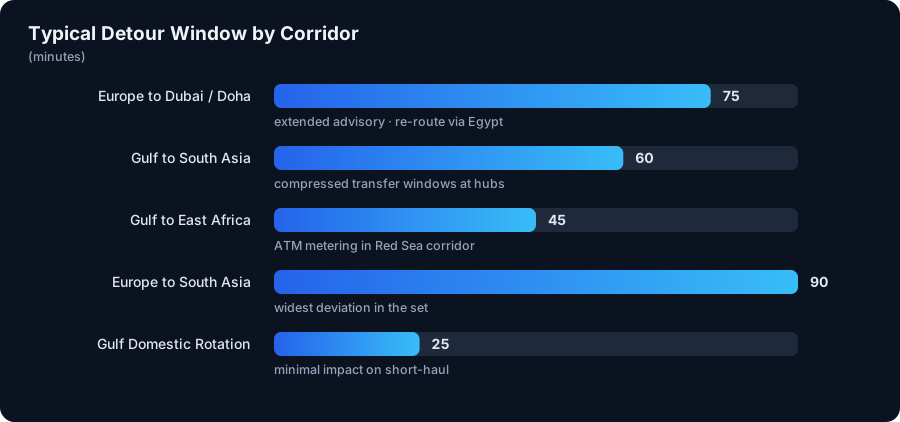
Gulf Corridor Risk Snapshot
| Route Sector | Advisory Status | Typical Detour | Primary Risk Driver |
|---|---|---|---|
| Europe to Dubai / Doha | Extended advisory | 30 to 75 minutes | Overflight restrictions near Iranian airspace |
| Gulf to South Asia | Extended advisory | 20 to 60 minutes | Compressed transfer windows at hub airports |
| Gulf to East Africa | Monitor | 15 to 45 minutes | Air traffic management metering in the Red Sea corridor |
Figures