
Executive Summary: A One-Day Turnaround in Vietnam Visa Policy
On October 12, 2026, Deputy Prime Minister Phan Van Giang signed Resolution No. 325/NQ-CP, creating a pilot Khanh Hoa visa exemption for citizens of mainland China and putting it into force the same day. [source-1] [source-2] [source-3] The measure runs until December 31, 2027 and covers ordinary passport holders who travel in groups of at least two on package tours organized by Vietnamese international travel companies during the Vietnam-China Tourism Cooperation Year 2026-2027. [source-1] [source-2] Every eligible visitor must fly directly from mainland China into Cam Ranh International Airport, enter and exit through the same airport, and stay no longer than 30 days per tour. [source-1] Passports issued by the Hong Kong and Macao special administrative regions are excluded. [source-1] [source-2] The timing is deliberate: Vietnam recorded 17.7 million international arrivals between January and September 2026, up 14.5 percent year on year, and mainland China led all markets with 3.95 million visitors, a 22.3 percent share. [source-6] The Khanh Hoa visa exemption is the first new visa-free channel for Chinese travelers since the Phu Quoc island exemption, and it signals where Hanoi wants its next wave of tourism growth to land. [source-9] This report verifies every parameter of the resolution, tracks the market data behind it, and maps what operators and travelers should watch before booking, with cross-checks against global visa-tracking desks. [source-16] [source-12] [source-13] [source-39] [source-40]
1. What Resolution 325/NQ-CP Actually Changes
Resolution 325/NQ-CP is narrow by design. It does not open Vietnam to individual Chinese travelers, and it does not extend across the country. The Khanh Hoa visa exemption applies to one province, one airport, and one travel format: group package tourism arranged by Vietnamese international travel companies under the Law on Entry, Exit, Transit and Residence of Foreigners in Vietnam. [source-1] [source-2] Each tour must include at least two travelers and must not exceed 30 days. [source-1] The entry and exit border gate is Cam Ranh International Airport, and both movements must pass through that same airport, with direct flights from mainland China as a precondition. [source-1] [source-3]
| Parameter | Requirement Under the Resolution |
|---|---|
| Eligible passports | Valid ordinary passports of the People's Republic of China, excluding Hong Kong and Macao SAR passports |
| Group size | At least 2 travelers per tour |
| Maximum stay | 30 days per tour |
| Organizer | Vietnamese international travel companies running package tours |
| Border gate | Cam Ranh International Airport, same airport for entry and exit |
| Flight requirement | Direct flights from mainland China to Cam Ranh |
| Effective window | October 12, 2026 until December 31, 2027 |
Sources: [source-1] [source-2] [source-3]
Implementation duties are split across three ministries. The Ministry of Culture, Sports and Tourism must draft the procedures, set the criteria for selecting and managing eligible travel companies, and coordinate with local authorities on tourist management. [source-1] [source-2] It will also work with the Ministry of Foreign Affairs on communications so the policy reaches its intended audience. [source-1] The Ministry of Public Security guides the entry, exit and residence procedures for participants. [source-1] [source-3] Party and military-affiliated outlets carried the signature announcement the same week. [source-25] [source-26] Until those guidelines are published, the Khanh Hoa visa exemption exists on paper, and operators should treat the ministry instructions as the operational gate. [source-4] The official e-visa portal remains the fallback channel for Chinese travelers who do not meet the group conditions. [source-14] Until those guidelines are published, the Khanh Hoa visa exemption exists on paper, and operators should treat the ministry instructions as the operational gate. [source-4]
2. The Market Logic Behind the Khanh Hoa Visa Exemption
Vietnam's 2026 tourism numbers explain the move. The country welcomed 12.3 million international visitors in the first half of 2026, up 14.9 percent year on year, and is on pace for its full-year target of 25 million arrivals. [source-5] [source-7] Mainland China and South Korea anchor the source markets, with 2.7 million and 2.16 million visitors respectively in the first six months, while Russia staged the sharpest recovery at 742,700 arrivals, growth of 185.8 percent. [source-5] Between January and September, China's total reached 3.95 million, a 22.3 percent market share, followed by South Korea at 3.05 million. [source-6] September alone brought 1.77 million international entries, up 16.5 percent against September 2025. [source-6]
| Rank | Source Market | Arrivals, Jan-Sep 2026 | Market Share |
|---|---|---|---|
| 1 | Mainland China | 3,950,000 | 22.3% |
| 2 | South Korea | 3,050,000 | 17.3% |
| 3 | Russia | 1,100,000 | 6.2% |
| 4 | Taiwan | 964,000 | 5.4% |
| 5 | United States | 746,000 | 4.2% |
Sources: [source-6] [source-5] [source-19]

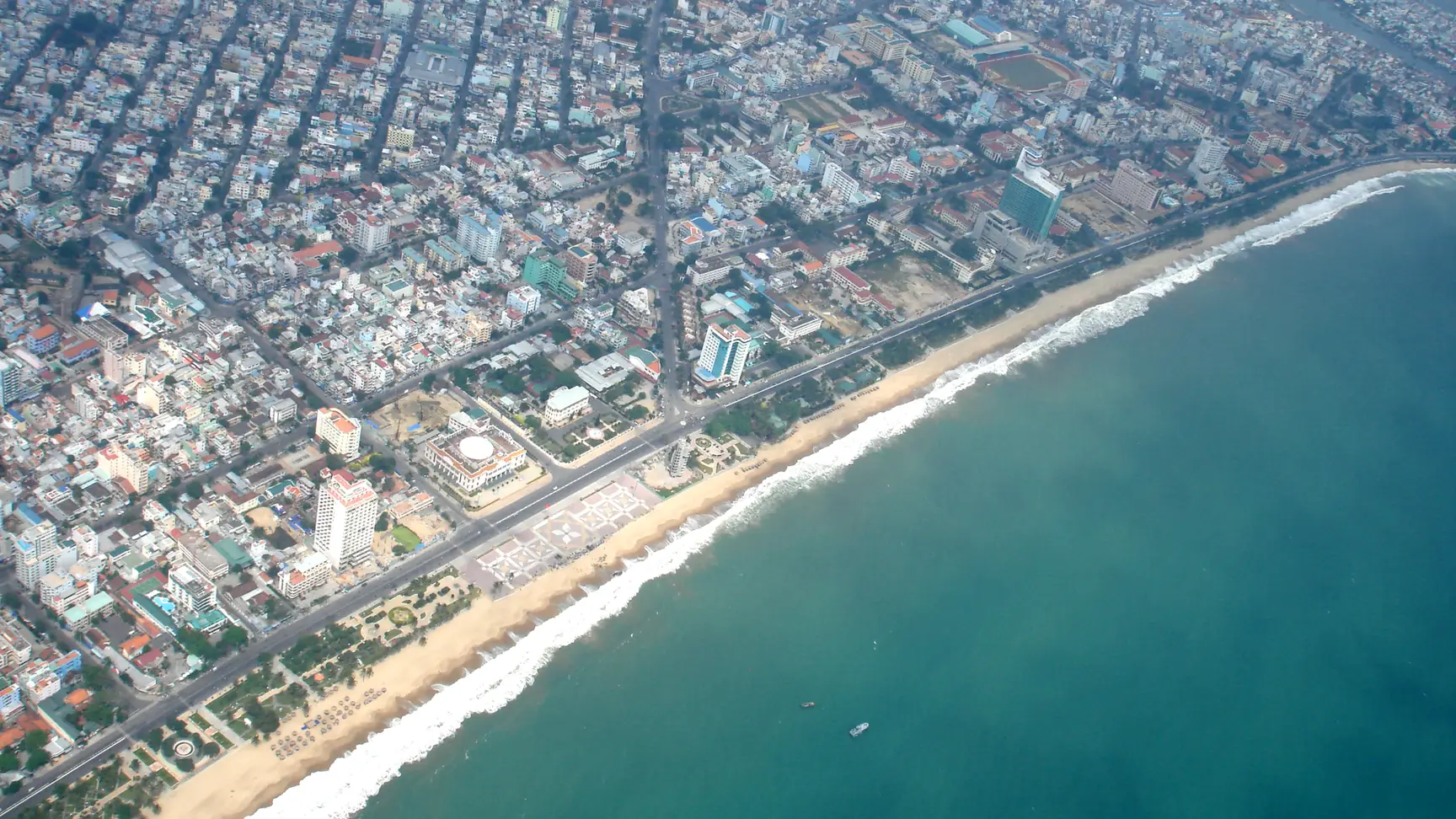
Khanh Hoa is where that demand already concentrates. During the 2026 New Year holiday, Cam Ranh International Airport handled more than 95,000 passengers across 512 flights, 321 of them international, with volumes up roughly 15 percent on the previous year, and hotels across Nha Trang and Bai Dai reported occupancy above 90 percent. [source-5] Analysts project up to 3.5 million Chinese visitors to Vietnam in 2026, and Nha Trang remains one of the most served coastal destinations on direct China routes. [source-7] Vietnamese media tracked the route expansions and hotel investment through the year. [source-17] [source-18] [source-20] The Khanh Hoa visa exemption removes the last administrative cost from that corridor for organized groups, since a single-entry e-visa currently costs 25 USD and takes three to five working days to process, and agencies publishing the requirements confirm the same fee schedule. [source-8] [source-9] [source-37] Travelers connecting through the destination can plan day trips on Klook, keep data active with an Airalo eSIM, and arrange a doorstep transfer with GetTransfer between the airport and the beach districts. [source-15]
3. How the New Channel Compares With Existing Options
Before Resolution 325/NQ-CP, a Chinese group traveler had three realistic paths into Vietnam. The e-visa, open to all nationalities since August 2023, allows stays of up to 90 days with single or multiple entries at 25 USD and 50 USD respectively, through 83 authorized entry points including 15 international airports, a process run through the official government portal. [source-9] [source-10] [source-11] [source-14] The Phu Quoc island exemption grants 30 days visa-free to passport holders who fly directly into Phu Quoc International Airport without transiting the mainland. [source-9] [source-10] The Khanh Hoa visa exemption now copies the Phu Quoc architecture, direct flights and a closed loop through one airport, but applies it to a mainland province and adds the group and organizer conditions. [source-1] [source-9]

The comparison carries a compliance edge. Overstaying a visa exemption in Vietnam is penalized at 500,000 VND, about 20 USD, per day for overstays under 10 days, rising to 2,000,000 VND, about 80 USD, per day beyond that, and overstays above 30 days can trigger deportation or a re-entry ban of one to five years. [source-8] Because the Khanh Hoa visa exemption ties every traveler to a named tour and a fixed window, the departure obligation sits with the organizer as much as with the visitor. [source-1] [source-2]
4. What the Resolution Does Not Do
The exclusions matter as much as the grants. Holders of Hong Kong and Macao SAR passports do not qualify, and individual travelers, business visitors and students gain nothing from this instrument. [source-1] [source-2] The exemption cannot be used to arrive via Hanoi or Ho Chi Minh City and continue to Nha Trang by domestic flight, because both the entry and the exit must clear Cam Ranh International Airport. [source-1] [source-3] Work, education and residence purposes stay outside the scheme, which is built strictly for group tourism. [source-1]
Scope is also temporary. The pilot runs alongside the Vietnam-China Tourism Cooperation Year 2026-2027 and expires on December 31, 2027, so any extension requires a new decision. [source-1] [source-2] Government communications have framed the measure as part of the cooperation year program, and the Vietnamese press, from national dailies to broadcasters, relayed the resolution within 24 hours of signature. [source-3] [source-28] [source-29] [source-30] [source-31] [source-32] [source-33] [source-34] [source-35] Regional context supports the interpretation: Australia's own September 2026 announcement of a no-further-stay condition on visitor visas shows how quickly entry rules are being tightened or tuned across the region, and pilots like this one are as much about control as about volume. [source-36]
5. Khanh Hoa's 2030 Ambitions and the Infrastructure Test
The provincial plan behind the policy is explicit. Khanh Hoa targets around 33 million visitors by 2030, with international tourists accounting for 40 to 45 percent of the total, roughly 13.2 to 14.85 million arrivals, and total tourism revenue of 9 billion USD, about 20 percent of the provincial economy. [source-4] Average stays are planned at four to five days, visitor spending is expected to reach 1.5 to 2 times its 2025 level, and satisfaction targets sit above 80 percent by 2027 and above 90 percent by 2030. [source-4] Air connectivity is the backbone: the province wants international air seats to grow by at least 20 percent against 2025, direct service from at least three additional countries or territories by 2030, and a possible two-to-three-times-weekly Sydney or Melbourne route into Cam Ranh. [source-4]
The numbers in this section are drawn from the provincial People's Committee plan for international tourist markets 2026-30. [source-4] Peak-season stress is already documented, since the 2026 Tet holiday produced record domestic and international volumes across destination provinces. [source-21] [source-38] The national tourism authority lists Nha Trang among its primary coastal destinations for inbound marketing. [source-27] Cam Ranh handled the holiday surge described in Section 2, and the airport operator continues to publish capacity updates as route restoration proceeds. [source-22] Airlines on the China corridor, including the national carrier and the main low-cost operator, have expanded frequencies through 2026. [source-23] [source-24] For the Khanh Hoa visa exemption to convert demand into arrivals, the binding constraints will be flight seats from mainland cities and the ministry's screening of eligible tour operators. [source-4] [source-1]
6. Strategic Outlook: What to Watch Next
Four indicators will test the pilot within 90 days. First, the implementing guidelines from the Ministry of Culture, Sports and Tourism, which will define which Vietnamese international travel companies qualify and how groups are registered. [source-1] [source-2] Second, direct-flight capacity from mainland China to Cam Ranh, where seat growth determines whether the exemption reaches mass-market volume. [source-4] [source-23] Third, monthly arrival data from the national statistics office, which will show whether Chinese group numbers accelerate from the 3.95 million annualized pace recorded through September. [source-6] Fourth, whether Hanoi extends the model to other provinces or nationalities after December 31, 2027, a question officials have deliberately left open. [source-2]
For operators and travelers the immediate checklist is short: confirm the organizer holds provincial eligibility once the criteria are published, book only direct mainland-Cam Ranh flights, and keep the tour inside the 30-day window. [source-1] [source-9] The Khanh Hoa visa exemption is a controlled opening, and its first quarter will decide whether it becomes permanent policy or stays a cooperation-year experiment. [source-1] [source-4]
📑 7. Verified Evidentiary References (40 sources) — click to expand
- [1] VietnamPlus (VNA): Vietnam pilots visa exemption for Chinese tour groups visiting Khanh Hoa en.vietnamplus.vn/vietnam-pilots-visa-exem…
- [2] World Culture Festival Vietnam: Pilot program to waive visa requirements for Chinese citizens traveling in groups worldculturefestival.vn/en/thi-diem-mien-t…
- [3] Tencent News: China group visa exemption pilot for Khanh Hoa province announced October 13, 2026 news.qq.com/rain/a/20261013A01FB300
- [4] Vietnam News (OVietnam): Khanh Hoa targets US$9 billion in tourism revenue by 2030 ovietnam.vietnamnews.vn/khanh-hoa-targets-…
- [5] Vietcetera: Report From Nha Trang: A Coastal City Hits Its Stride, And Melia Doubles Down vietcetera.com/en/report-from-nha-trang-a-…
- [6] Nomad Lawyer: Vietnam Travel Boom Guide 2026: 17.7M Arrivals Outpace Southeast Asian Rivals www.nomadlawyer.org/vietnam-tourism-surge-…
- [7] Travel And Tour World: Vietnam tourism skyrockets in 2026: record-breaking arrivals from China, South Korea and the US www.travelandtourworld.com.br/news/article…
- [8] Vietnam Tourism: Vietnam visa exemptions: which nationalities can enter visa-free vietnamtourism.com/en/vietnam-visa-exempti…
- [9] Vietnam-visa.hk: Complete Guide to Traveling from Mainland China to Vietnam: Visa, Transportation, and Entry Requirements www.vietnam-visa.hk/complete-guide-to-trav…
- [10] Vietnam-visa.hk: 2026-2027 guide from mainland China to Vietnam: visa, transportation and entry precautions www.vietnam-visa.hk/a-complete-guide-to-tr…
- [11] Vietnam Travel Guide: Vietnam visa: business, tourist and e-visa application guide 2026-2027 vietnamtravel.tw/2026/09/03/%e8%b6%8a%e5%8…
- [12] iVisa: Visa news: worldwide policy and rule changes www.ivisa.com/news
- [13] iVisa: Visa fees and costs updates category www.ivisa.com/news?category=visa-fees
- [14] Vietnam Immigration Department: Official e-visa application portal evisa.xuatnhapcanh.gov.vn
- [15] Vietnam National Authority of Tourism: Official tourism portal vietnam.travel
- [16] Vietnam Government News: English edition of the Government news portal en.baochinhphu.vn
- [17] VnExpress International: Vietnam news in English e.vnexpress.net
- [18] VietNamNet: English edition vietnamnet.vn/en
- [19] Vietnam News: The national English-language daily vietnamnews.vn
- [20] Tuoi Tre News: English edition tuoitrenews.vn
- [21] Khanh Hoa Provincial Government: Official provincial portal khanhhoa.gov.vn
- [22] Airports Corporation of Vietnam: Airport network and Cam Ranh operations www.vietnamairport.vn
- [23] Vietnam Airlines: Official carrier, China route network www.vietnamairlines.com
- [24] VietJet Air: Official site, China routes www.vietjetair.com
- [25] Communist Party of Vietnam Online Newspaper: Official party newspaper dangcongsan.vn
- [26] People's Army Newspaper: English edition en.qdnd.vn
- [27] Vietnam National Authority of Tourism: Destination guides and things to do vietnam.travel/things-to-do
- [28] Lao Dong Newspaper: Official portal laodong.vn
- [29] Thanh Nien Newspaper: Official portal thanhnien.vn
- [30] Nguoi Lao Dong: Official portal nld.com.vn
- [31] Tuoi Tre: Official portal tuoitre.vn
- [32] VnExpress: Official portal vnexpress.net
- [33] Vietnam Television: Official portal vtv.vn
- [34] VTV English: English edition english.vtv.vn
- [35] Izvestia: What happened on October 12: the main events of the day en.iz.ru/en/2183080/2026-10-12/what-happen…
- [36] Migratio: Visitor Visa No Further Stay (8503): 2026 announcement migratio.com.au/blog/visitor-visa-no-furth…
- [37] Entry Vietnam Visa: Vietnam visa requirements by nationality entryvietnamvisa.com/visa-requirements
- [38] Yuenan.com (Vietnam Chinese Media): Record Tet holiday tourism season 2026 yuenan.com/news-92688
- [39] VisasNews: Newsroom and policy tracking desk visasnews.com/en
- [40] VisasNews: Editorial desk author archive visasnews.com/en/author/la-redaction-de-vi…