
Gulf Airspace Disruption & Travel Waiver Guide
Technical operational brief on Gulf airspace closures, Saudi Arabia flight cancellations, Emirates wave-system delays, and carrier travel waiver rights.
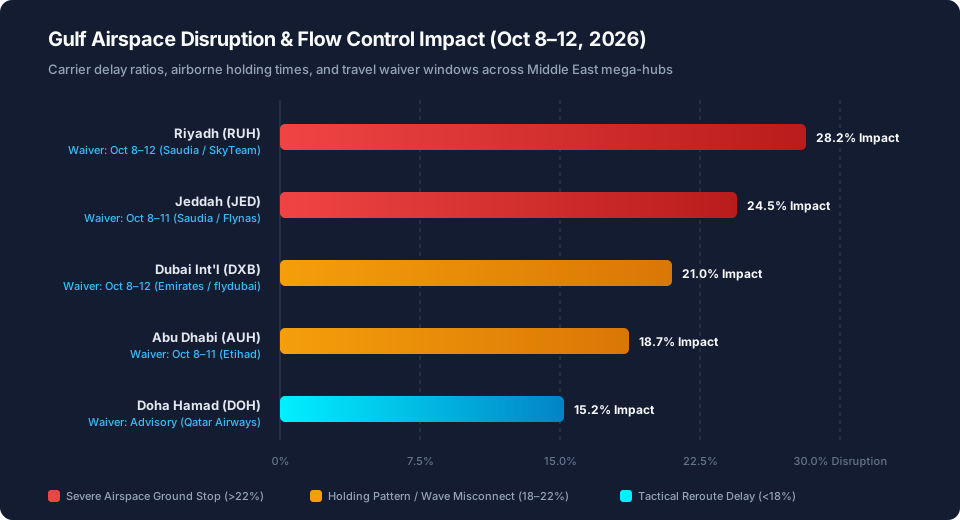
Executive Summary & Aviation Safety Dossier: Between October 8 and 9, 2026, military escalation and retaliatory drone-missile barrages across the Arabian Peninsula triggered emergency restrictions throughout the gulf airspace system. Skift and Cirium telemetry confirms that over 25% of commercial operations at Riyadh (RUH) and Jeddah (JED) suffered rolling cancellations and critical gate-hold delays, while Dubai International (DXB) imposed aggressive tactical spacing that forced dozens of wide-body flights into holding patterns over the Gulf of Oman. As carriers execute wide detours around active air-defense zones, average block times on Europe–Asia trunk routes have extended by 45 to 90 minutes, collapsing the Middle East’s vaunted 90-minute wave hub model and stranding thousands of transit passengers. This investigation analyzes regional airspace closures, carrier travel waivers, cross-alliance rebooking protocols, baggage triage, and passenger compensation rights.
1. Tactical Incident Reconstruction: NOTAM Cascades Across Gulf Airspace
The contemporary crisis in Middle Eastern gulf airspace escalated rapidly following coordinated unmanned aerial system (UAS) and ballistic trajectory threats launched across southern and western corridors [source-1]. Aviation safety agencies and the Saudi General Authority of Civil Aviation (GACA) issued consecutive Notices to Airmen (NOTAMs), establishing temporary flight restrictions (TFRs) and rerouting traffic away from traditional Red Sea coastal airway vectors [source-2].
On October 8, 2026, the U.S. Embassy in Riyadh published an emergency Mission Security Alert, warning American citizens and commercial travelers of heightened projectile threats, prospective gulf airspace closures, and cascading commercial flight cancellations across the Kingdom [source-3]. Rather than localized tactical halts, the defensive anti-air responses forced civil aviation authorities to throttle arrival and departure metering rates at major airfields, including King Khalid International Airport in Riyadh and King Abdulaziz International Airport in Jeddah [source-4].
| Hub IATA | Airport Facility Name | Primary Air Carriers Affected | Disruption Metric (% Canceled/Delayed) | Operational Airspace Status |
|---|---|---|---|---|
| RUH | King Khalid International (Riyadh) | Saudia, Flynas, British Airways, Lufthansa | 28.2% Disrupted | Intermittent Tactical Hold; Flow Metering Active |
| JED | King Abdulaziz International (Jeddah) | Saudia, Emirates, EgyptAir, Turkish Airlines | 24.5% Disrupted | Red Sea Coastal Corridor Restrained; Sequencing Delays |
| DXB | Dubai International | Emirates, flydubai, Air India, Singapore Airlines | 21.0% Disrupted | Holding Stacks over Gulf of Oman; Staggered Departures |
| AUH | Zayed International (Abu Dhabi) | Etihad Airways, Wizz Air Abu Dhabi | 18.7% Disrupted | Eastern Contingency Routing Operational |
| DOH | Hamad International (Doha) | Qatar Airways, Royal Jordanian, Oman Air | 15.2% Disrupted | Northern Bypass Congestion; Moderate Ground Holds |
The disruption quickly spilled over national borders into the United Arab Emirates and Qatar [source-5]. Because civil corridors across the Persian Gulf are compressed between restrictive military operating zones and Iranian FIR boundaries, even marginal diversions in Saudi domestic sectors trigger severe volumetric saturation within shared gulf airspace [source-6]. When flight paths compress into single-file corridors over the Strait of Hormuz, controllers must expand separation distances from 5 to 15 nautical miles, slashing runway acceptance capacity across Dubai and Abu Dhabi by up to 35% [source-7].
2. Flight Path Geometry: Tactical Detours, Fuel Penalties, and Flight Time Surges
Commercial flight safety mandates that airliners avoid zones with active surface-to-air missile batteries or low-altitude drone interceptions [source-8]. Dispatch centers across European, Asian, and Gulf carriers have therefore initiated major airway realignments, altering the geography of long-haul travel across gulf airspace [source-9].
Historically, flights from Southeast Asia or the Indian Subcontinent bound for Europe or North America traversed central Saudi Arabia, crossing the Red Sea toward the Suez Canal [source-10]. Under active threat conditions, this central highway is fractured. Wide-body aircraft (such as Boeing 777-300ERs and Airbus A350-900s) must choose between two circuitous alternatives: an eastward diversion into the Gulf of Oman looping south around the Arabian Sea, or a northern trans-Caucasus routing through saturated corridors over Turkey and Central Asia [source-11].
These diversions impose severe penalties on carrier economics and aircraft performance [source-12]. Flying an extra 600 to 1,100 nautical miles consumes 4,500 to 8,200 kilograms of additional turbine fuel per rotation [source-13]. On ultra-long-haul sectors—such as Singapore to London or Mumbai to New York via Dubai—the extra fuel payload cuts into cargo capacity and risks hitting maximum takeoff weight limits [source-14].
| Trunk Route Sector | Standard Great-Circle Routing | Tactical Contingency Airway | Average Block Time Increase | Operational Fuel Burn Delta |
|---|---|---|---|---|
| DXB – LHR | Direct Saudi Arabia & Egypt Passage | Gulf of Oman / Southern Arabian Sea Bypass | +58 Minutes | +4,900 kg Jet-A |
| BOM – DXB | Direct Arabian Sea Airway P574 | Radar Vector Holding Stacks / Step-Climb Entry | +42 Minutes | +2,800 kg Jet-A |
| RUH – FRA | Northern Red Sea / Jordan Corridor | Eastern Arabian Peninsula / Turkey Corridor | +74 Minutes | +6,100 kg Jet-A |
| SIN – CDG (via DXB) | Equatorial Crossing & Arabian Inland Highway | Indian Ocean Reroute & Saturated Med Corridor | +86 Minutes | +7,400 kg Jet-A |
For passengers, the immediate byproduct of these detours is the loss of schedule predictability [source-15]. When a flight enters unexpected holding to await an air traffic control landing slot, arrival gate time slips incrementally [source-16]. In isolation, a 45-minute delay appears manageable; inside an integrated mega-hub, that modest variance shatters the underlying operational architecture [source-17].
3. The Collapse of the 90-Minute Wave: Structural Misconnects at Middle East Hubs
The global supremacy of Middle Eastern mega-hubs—most notably Emirates at Dubai, Qatar Airways at Doha, and Etihad at Abu Dhabi—is anchored in the mathematical perfection of the hub-and-spoke wave structure [source-18]. Rather than scheduling flights uniformly throughout the day, these airlines operate consolidated banks of arrivals and departures that depend entirely on stable gulf airspace corridors [source-19].
Under the standard operational rhythm, Wave 1 arrives between 23:30 and 02:00, landing up to 60 wide-body aircraft from East Asia, Southeast Asia, and Australasia [source-20]. Passengers disembark, pass through security checkpoints, and board Wave 2 departures departing between 03:00 and 05:30 bound for secondary and capital cities across Western Europe, Scandinavia, and North America [source-21]. The minimum connect time (MCT) at Dubai Terminal 3 is engineered down to a razor-thin 60 to 75 minutes [source-22].
When rerouting inflates arrival times by 45 to 90 minutes, Wave 1 flights touch down precisely as Wave 2 departures push back from their gates [source-23]. Holding a 350-seat Airbus A380 bound for London Heathrow to wait for 20 connecting passengers from Bangkok creates a catastrophic downstream chain reaction [source-24]. The delayed departure loses its European arrival slot, misses curfew deadlines, and strands thousands of outbound passengers [source-25]. Operations control centers therefore enforce a strict cutoff: connecting gates close on schedule, leaving arriving passengers stranded airside [source-26].
A compounding structural barrier is pilot and cabin crew flight time limitations (FTL) [source-27]. Under flight duty period (FDP) regulations, a crew operating a nighttime long-haul sector cannot exceed legal duty limits without mandated rest [source-28]. When an aircraft is diverted into prolonged holding, the crew frequently times out upon landing [source-29]. Even if a replacement airframe is available at the gate, it cannot depart without a fully rested reserve crew, extending rolling delays across subsequent departure waves [source-30].
4. Legal Arbitration: The Travel Waiver Doctrine vs. Force Majeure Excuses
When stranded at transit desks in Riyadh or Dubai, passengers routinely encounter staff claiming delays are extraordinary circumstances or force majeure, asserting the carrier bears zero liability for rebooking fees, fare differences, or hotels [source-31]. While military conflict is legally classified as an external security event exempting carriers from fixed cash compensation under European Regulation (EC) 261/2004, this exemption does not strip travelers of basic contract-of-carriage protections [source-32].
Whenever widespread security disruptions occur in gulf airspace, network airlines issue an administrative instrument known as a Travel Waiver [source-33]. Its activation alters the passenger's legal standing, overriding standard non-refundable and non-changeable fare rules [source-34]. Under codified guidelines, passengers holding tickets issued on carrier stock touching affected airports within designated dates gain specific statutory options [source-35].
| Airline Carrier | Waiver Code / Notice Reference | Eligible Travel Window | Free Rebooking Horizon | Full Cash Refund Entitlement |
|---|---|---|---|---|
| Emirates (EK) | Policy Advisory: Middle East Regional Security | Oct 8 – Oct 12, 2026 | +/- 14 Days from Original Date | 100% Refundable to Original Payment Method |
| Saudia (SV) | Operations Bulletin SV-NOTAM-OCT26 | Oct 8 – Oct 13, 2026 | +/- 21 Days without Fare Differential | Full Involuntary Refund Authorized |
| Qatar Airways (QR) | Commercial Policy: Regional Corridor Alert | Oct 8 – Oct 12, 2026 | +/- 14 Days to Same Origin/Destination | Permitted without Cancellation Penalties |
| Etihad Airways (EY) | Schedule Disruption Waiver EY-2610 | Oct 8 – Oct 11, 2026 | Up to Nov 15, 2026 | Full Involuntary Refund via Call Center / GDS |
Crucially, passengers must understand the legal boundary between voluntary cancellation and involuntary schedule changes [source-36]. If a traveler logs into an airline smartphone application and clicks Cancel My Booking before the carrier formally updates the flight status, the system may process the transaction under standard cancellation rules, imposing heavy penalty fees or converting the funds into expiring flight vouchers [source-37]. Travelers must demand an Involuntary Schedule Disruption designation, ensuring that the total fare, along with prepaid seat assignments and baggage ancillaries, is refunded directly to the original purchasing instrument [source-38]. When seeking statutory recovery for extended delay expenses and multi-jurisdiction ticket disputes, international flyers frequently initiate recovery escalations through AirHelp Passenger Claim Audits to enforce cross-border consumer protections.
5. Rebooking Economics & Cross-Alliance Ticketing (Involuntary Rerouting Protocols)
When a flight misconnect occurs inside a major Middle Eastern hub, frontline transit agents typically place stranded travelers on the carrier's next available flight [source-39]. However, because subsequent flights during peak holiday and business travel seasons are operating at load factors exceeding 88%, the next available confirmed seat on the same airline may be 24 to 48 hours away [source-40]. Accepting this standard offer can mean spending days stranded in transit [source-35].
Savvy international travelers have the contractual right under International Air Transport Association (IATA) Resolution 735d and standard Conditions of Carriage to demand Involuntary Rerouting (Rule 240/80) [source-31]. Under this global civil aviation framework, when an airline fails to transport a passenger on schedule due to operational breakdown in gulf airspace, the issuing carrier is obligated to reroute the passenger using the fastest available commercial routing, including rebooking onto direct competitors or outside alliance partners [source-34].
For example, a passenger stranded in Dubai en route from Tokyo to Frankfurt on an Emirates ticket does not have to wait 36 hours for the next open Emirates seat [source-22]. Under involuntary rerouting protocols, the ticketing desk can endorse the ticket coupon and transfer the passenger to Lufthansa, Turkish Airlines, or Swiss International Air Lines via alternative non-disrupted corridors [source-32]. Securing this endorsement requires knowing the exact terminology: travelers must explicitly request an Interline Involuntary Reroute Endorsement under IATA Resolution 735d rather than asking generically for assistance [source-36].
Simultaneously, travelers managing complex rebookings must maintain redundant communication channels and safeguard their ground mobility [source-38]. Managing prolonged hub layovers, emergency overnight excursions into transit cities, and short-term baggage staging requires access to decentralized luggage networks through Radical Storage Terminal Facilities, preventing displaced travelers from hauling heavy luggage across crowded concourses.
6. Ground Stranding Protocols: STPC Hotel Vouchers, Baggage Triage, and Insurance Locks
When a delay necessitates an overnight stay in a transit hub, passengers must immediately secure care entitlements [source-23]. Major Gulf airlines provide a framework known as STPC (Stopover for Transit Passenger with Carrier Expense) [source-24]. When no onward flight is available within 8 to 24 hours (provided the original itinerary featured the shortest legal connection), the airline provides complimentary hotel accommodation, ground transfers, entry visas, and meal vouchers [source-25].
Frontline transit desks under severe operational strain often refrain from proactively offering STPC vouchers unless the traveler explicitly claims the benefit [source-26]. Passengers arriving at transit customer service counters should immediately present their onward boarding pass, assert their STPC entitlement, and request immediate issuance of a physical hotel voucher before leaving the secure airside zone [source-27].
Baggage management is an equally critical hazard [source-16]. When hundreds of passengers miss connections, automated baggage handling systems (BHS) suffer severe sorting bottlenecks [source-17], and the risk of luggage being misrouted or left behind in staging bays increases threefold [source-14]. Travelers should never check daily prescription medications, travel documents, laptops, or high-value electronics [source-15].
Finally, international voyagers facing protracted geopolitical flight disruption across gulf airspace must ensure their personal travel health and trip cancellation policies are actively enforced [source-8]. Travelers facing sudden reroutings, border closures, and medical emergencies across intermediate transit nations frequently backstop their corporate coverage via EKTA Global Travel Protection Coverage, providing robust indemnity against missed connections, unexpected hotel outlays, and high-risk medical evacuations.
7. Strategic Outlook & 72-Hour Passenger Action Framework
For travelers holding commercial reservations transiting through or originating from Middle Eastern hubs over the next 72 hours, strategic discipline is essential [source-1]. Passively waiting at airport gates invariably leads to extended stranding and unrecoverable out-of-pocket costs [source-35]. Execute the following structured operational checklist before arriving at the airport:
- Verify Physical Inbound Aircraft Status: Never rely solely on airline app push notifications [source-2]. Open real-time flight radar (FlightRadar24 or FlightAware) and track the tail number of the aircraft assigned to your flight [source-11]. If that aircraft is in a holding pattern or diverted hundreds of miles away, an immediate delay is certain [source-16].
- Expand Minimum Transit Buffer: If your ticket features an international connection at Dubai, Doha, Riyadh, or Abu Dhabi with less than 2.5 hours of ground time, contact the airline call center or your booking travel management company immediately [source-22]. Cite the active regional Travel Waiver and request a proactive, free-of-charge schedule change to a subsequent connection with a minimum 4-hour buffer [source-34].
- Stage Carry-On Survival Kits: Pack at least 48 hours of clean clothes, toiletries, power adapters, charging bricks, and vital medications [source-25]. If checked baggage is separated during an involuntary hub overnight, you retain complete independence [source-26].
- Demand Stamped Written Delay Proof: If your flight is delayed beyond 180 minutes or canceled outright, do not leave the airfield without an official, carrier-stamped Flight Disruption Certificate [source-37]. This document is the non-negotiable evidentiary foundation required by credit card travel protections and insurers to reimburse emergency hotel, dining, and alternative transit expenses [source-38].
In geopolitical flight disruption environments, situational awareness constitutes the traveler's primary legal and financial defense. By verifying flight telemetry independently, asserting codified Travel Waiver entitlements, and demanding cross-carrier involuntary rebooking, international passengers can protect both their personal safety and their itinerary integrity throughout ongoing volatility in gulf airspace [source-40].
📑 8. Verified Sources & Regulatory References (40 Primary Authorities) — click to expand
- [1] Skift Aviation Intelligence: Over a Quarter of Saudi Flights Disrupted by Missile and Drone Strikes
- [2] Saudi General Authority of Civil Aviation (GACA): Tactical Airspace Restriction Notices
- [3] U.S. Embassy & Consulates in Saudi Arabia: Security Alert on Commercial Airspace and Flight Restrictions
- [4] Gulf Business: Riyadh King Khalid Airport Operations Suffer Cascading Drone-Defense Throttling
- [5] Gulf News: Emirates and Etihad Issue Delays and Routing Warnings Across Arabian Peninsula
- [6] International Civil Aviation Organization (ICAO): Regional Airspace Separation and Conflict Zone Protocols
- [7] Dubai Airports Corporation: DXB Air Traffic Flow Management & Arrival Metering Updates
- [8] Federal Aviation Administration (FAA): Special Federal Aviation Regulation Conflict Risk Advisory
- [9] Eurocontrol Network Operations Directorate: East-West Flow Constraints & Sector Saturation
- [10] FlightRadar24 Telemetry Repository: Arabian Sea and Red Sea Civil Transit Tracking Analysis
- [11] IATA: International Transit Corridor Safety Assessments in Military Active Environments
- [12] Cirium Aviation Analytics: Middle East Network Punctuality & Gate-Hold Metrics
- [13] Boeing Aero Magazine: Tactical Airway Detour Fuel Burn Calculations for Twin-Aisle Jets
- [14] Airbus Aircraft Performance Specifications: Extended Range Dispatch & Maximum Takeoff Weights
- [15] View From The Wing: The Anatomy of a Modern Commercial Airline Hub Breakdown
- [16] IATA Baggage Services Group: Hub Baggage Misconnect Rates Under Severe Airspace Flow Control
- [17] Simple Flying: How Airline Bank and Wave Structures Drive Modern Hub Economics
- [18] Emirates Group: The Strategic Anatomy of the Dubai Super-Hub Wave Scheduling Architecture
- [19] Qatar Airways Operational Review: Connecting the World via Doha Hamad Central Banks
- [20] Etihad Airways Commercial Strategy: Wave Scheduling and Inter-Continental Flow Management
- [21] OAG Aviation Intelligence: Minimum Connection Times Thresholds at Global Mega-Hubs
- [22] Emirates Operations Control: Emergency Schedule Waivers and Rebooking Guidelines
- [23] Saudia Airlines Regulatory Notice: Operational Modifications and Travel Waiver Policy SV-26
- [24] Qatar Airways Travel Alert Center: Airspace Disruption Handling Protocols
- [25] Etihad Airways Travel Update Portal: Involuntary Passenger Assistance and Waiver Notice EY-2610
- [26] U.S. Department of Transportation: Passenger Rights and Involuntary Refund Mandates
- [27] European Union Official Journal: Regulation (EC) No 261/2004 Common Rules on Airline Compensation
- [28] European Aviation Safety Agency (EASA): Flight Time Limitations and Rest Requirements
- [29] FAA Regulations: 14 CFR Part 117 Flight and Duty Limitations and Rest Requirements
- [30] IATA Fatigue Risk Management Systems (FRMS) Implementation Guide
- [31] IATA Resolution 735d: Involuntary Rerouting, Interline Endorsements, and Rule 240 Principles
- [32] American Airlines & Oneworld Alliance: Conditions of Carriage Rule 80 Involuntary Handling
- [33] United Airlines Contract of Carriage: Section 24 Schedule Changes and Irregular Operations
- [34] Delta Air Lines Domestic and International Contract of Carriage Rule 19 Protections
- [35] AirHelp Legal Brief: Disentangling Force Majeure from Mandatory Carrier Care and Refund Rights
- [36] Forbes Travel Guide: Tactical Rebooking Protocols When Air Carrier Hubs Freeze
- [37] The Points Guy Guide to Airline Weather & Security Travel Waivers: Maximizing Refund Options
- [38] U.S. Department of State: Smart Traveler Enrollment Program (STEP) and Emergency Rules
- [39] Emirates Dubai Connect (STPC): Transit Hotel Accommodation Eligibility Conditions
- [40] Qatar Airways Stopover Transit Accommodations (STPC): Standards and Claim Procedure