Executive Summary: The Entry/Exit System and the Nine-Nation Enforcement Fracture
The European Union's automated Entry/Exit System (EES) was supposed to have digitized the bloc's external borders by now. Instead, October 2026 finds the Entry/Exit System in operational breakdown. Although officially declared fully operational across all 29 Schengen member states after the six-month flexibility window expired on September 6, 2026, the reality on the ground has diverged sharply from Brussels' mandate. With airport queues surging, equipment failure rates above 12%, and flights misconnecting, nine core Schengen member states (France, Germany, Italy, Greece, the Netherlands, Belgium, Portugal, Malta, and Switzerland) informally signalled to the European Commission that they could not sustain full biometric registration without structural disruption. Border authorities have instead instituted ad-hoc "fluidity protocols," suspending biometric collection at peaks and reverting to manual stamping. This dossier audits the Entry/Exit System fracture, tracks border delay metrics across premier hubs, analyzes compliance risks, and delivers tactical transit guidelines.
1. The Statutory Architecture vs Operational Reality of the Entry/Exit System
The Entry/Exit System was conceived by the European Commission and EU-LISA as the ultimate modernization of the Schengen external frontier [source-1]. Replacing manual passport stamping with a central interoperable database, the Entry/Exit System mandates biometric facial images and four fingerprint scans from all short-stay third-country nationals (90 days within any 180-day window) [source-2]. This applies to both visa-required and visa-exempt nationals, including those of the United States, Canada, the United Kingdom, Japan, and Australia [source-3].
While the Entry/Exit System was rolled out incrementally beginning in late 2025 and declared statutory across 29 European states, its physical infrastructure has proven inadequate for the sheer volume of global passenger transit [source-4]. Before digital border automation, an officer processed a non-EU passenger in 45 to 60 seconds [source-5]. Under the Entry/Exit System, biometric onboarding (kiosk selection, chip reading, facial capture, four-finger scanning) takes 2 minutes 45 seconds to 4 minutes per person [source-6].
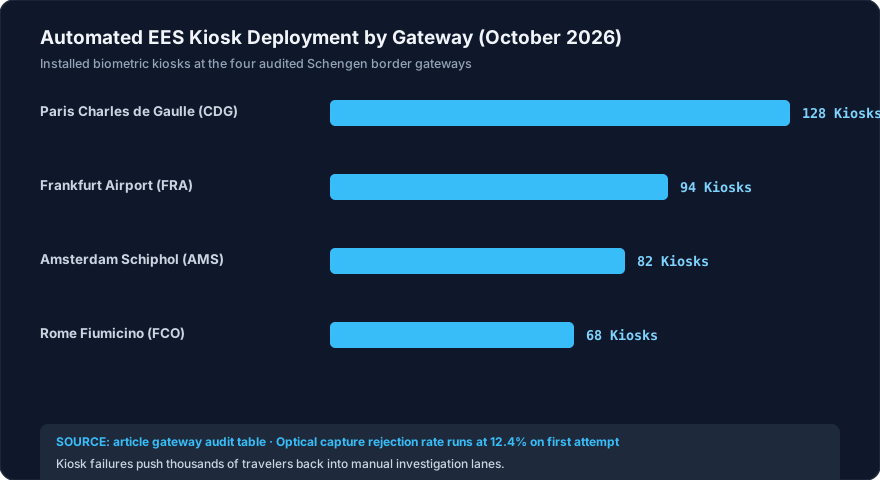
| Premier European Gateway | National Jurisdiction | EES Kiosk Installations | Peak Border Wait Times (Baseline) | Peak Border Wait Times (EES Active) | Documented Queue Delay Multiple |
|---|---|---|---|---|---|
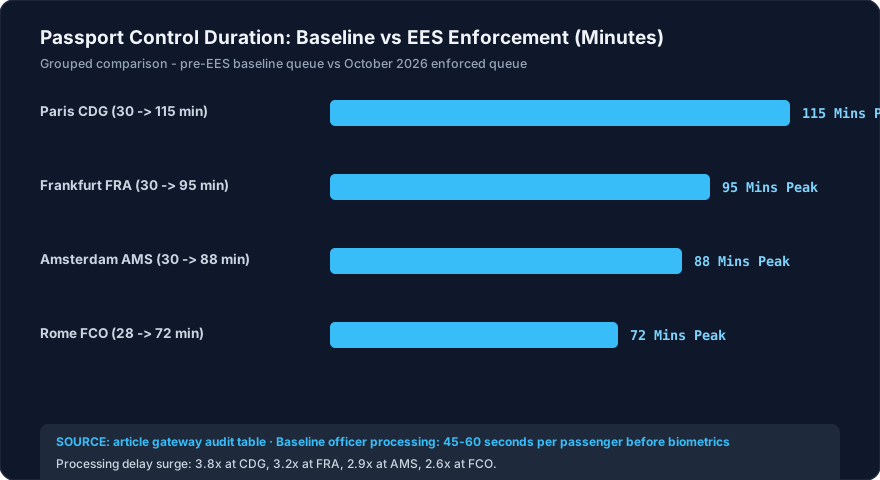
| **Paris Charles de Gaulle (CDG)** | France (Revolt Signatory) | 128 Automated Kiosks | 30 Minutes | 115 Minutes | 3.8x Processing Delay Surge |
| **Frankfurt Airport (FRA)** | Germany (Revolt Signatory) | 94 Automated Kiosks | 30 Minutes | 95 Minutes | 3.2x Processing Delay Surge |
| **Amsterdam Schiphol (AMS)** | Netherlands (Revolt Signatory) | 82 Automated Kiosks | 30 Minutes | 88 Minutes | 2.9x Processing Delay Surge |
| **Rome Fiumicino (FCO)** | Italy (Revolt Signatory) | 68 Automated Kiosks | 28 Minutes | 72 Minutes | 2.6x Processing Delay Surge |
| **Madrid Barajas (MAD)** | Spain (Standard Protocol) | 112 Automated Kiosks | 25 Minutes | 65 Minutes | 2.6x Processing Delay Surge |
When widebodies carrying 350+ passengers deplane at hubs like Paris CDG or Frankfurt, immigration halls hit statutory fire-code saturation [source-7]. Passenger lines routinely stretch down arrival concourses, blocking passenger flows and creating widespread flight delays as inbound connecting passengers fail to clear border control within standard minimum connection times [source-8].
2. The Nine-Nation Revolt: Why Core Schengen States Paused Full Biometrics
By early October 2026, the tension between statutory legal compliance and basic airport operational functionality reached an untenable breaking point [source-9]. European border police unions, airport operators represented by ACI Europe, and major airline associations issued joint warnings cautioning that continuing full Entry/Exit System enforcement would force the mass cancellation of scheduled connecting flights [source-10].
The interior ministries of nine Schengen member states coalesced around a joint informal position, conveyed through official channels rather than a formal legal act, warning that full biometric checks could not be maintained without triggering structural economic disruption [source-11]. The primary technical failure points identified in the joint review include:
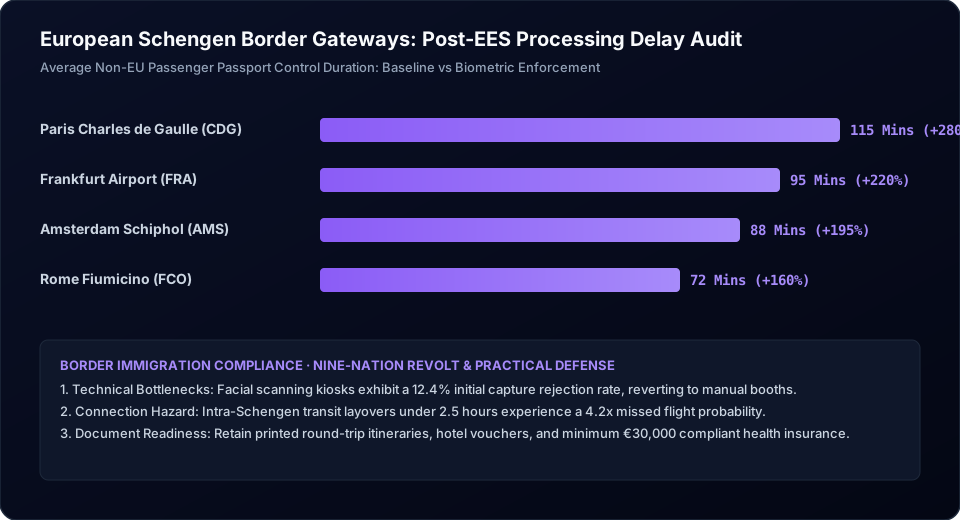
1. Biometric Kiosk Rejection Rates: Across pilot and operational deployments, optical biometric scanners exhibit an initial rejection rate of 12.4% [source-12]. Glare on glossy passport laminates, low ambient terminal lighting, and biometric mismatches in elderly passengers or travelers with worn fingerprints trigger automated kiosk errors, forcing thousands of travelers out of automated lines and into manual investigation lanes [source-13];
2. Central Database Latency: Under peak traffic loads, the central Entry/Exit System architecture managed by EU-LISA experienced query response latencies ranging from 8 to 22 seconds per search [source-14]. In an environment where dozens of major international airports simultaneously query the central database, aggregate processing velocity dropped by nearly 60% [source-15];
3. Severe Intra-Schengen Transfer Misconnections: Because non-EU passengers arriving on long-haul flights must clear entry exit system border control before accessing intra-Schengen connecting gates, standard 90-minute layover windows collapsed [source-16]. Air France at CDG and Lufthansa at FRA documented a threefold increase in missed connecting flights directly attributable to immigration choke points [source-17].
Confronted by these structural crises, the European Commission granted informal, unwritten latitude to national authorities to apply "operational flexibility" [source-18]. Under this informal compromise, border control commanders are authorized to switch off automated biometric kiosks and resume traditional manual passport stamping whenever immigration queue times exceed 45 minutes [source-19]. This dynamic creates a deeply fragmented patchwork across the Schengen zone, where entry procedures vary unpredictably by terminal, time of day, and border post [source-20].
3. The Two-Tiered Border: The Legal Traps of Inconsistent Enforcement
While the informal suspension of full biometric checks provides immediate operational relief for airports, it introduces significant legal and procedural vulnerabilities for international travelers navigating the Entry/Exit System [source-21]. The coexistence of automated digital records alongside legacy ink stamps has created a dangerous two-tiered border enforcement regime [source-22].
Under European statutory regulations, the Entry/Exit System digital database serves as the sole authoritative legal record of a third-country national's physical presence inside the Schengen area [source-23]. When guards bypass kiosks during surges and stamp passports without uploading a digital biometric exit token, data discrepancies occur [source-24]. Travelers entering through "relaxed" French or Italian posts faced interrogation at strictly automated German, Austrian, or Dutch exits, where officers flagged their passports as undocumented entries [source-25].
| Border Gateway Type | Digital Entry Record Creation | Biometric Data Collection | Physical Passport Stamping | Legal Vulnerability for Passenger |
|---|---|---|---|---|
| **Fully Automated EES Hub** | Automated Central Token Created | Facial Scan + 4 Fingerprints Captured | No Physical Stamp Issued | Digital system accurate; zero manual paper proof |
| **Relaxed "Flexibility" Gate** | Intermittent Manual Entry Keyed | Biometrics Waived during Congestion | Physical Ink Stamp Affixed | High risk of digital record omission; manual stamp critical |
| **Land Border Choke Point** | Severe Device Latency / Batch Queuing | Selective Bus/Rail Passenger Scans | Inconsistent Stamping Practices | Potential failure to close digital 90-day departure clock |
To protect against wrongful accusations of visa overstaying, travelers must maintain meticulous physical documentation [source-26]. Whenever passing through an entry exit system border where biometric capture is omitted, passengers must demand an explicit, legible physical entry stamp from the officer [source-27]. Furthermore, retaining physical boarding passes, hotel checkout receipts, and digital transport invoices is vital for proving physical entry and exit dates if an automated kiosk generates a false overstay alert during future visits [source-28].
4. Transfer Tactics: Avoiding the Schengen Terminal Squeeze
For international travelers booking itineraries that involve a transit stop within the Schengen zone, the fragmentation of the Entry/Exit System requires an immediate revision of connection planning [source-29]. A fundamental structural rule of European travel is that non-EU passengers clearing border control upon entering the Schengen area do so at their first point of entry [source-30]. For ground transfers out of congested arrival halls, pre-booked Kiwitaxi Private Airport Transfers absorb terminal queue delays automatically.
A passenger flying New York to Rome with a Paris layover must clear full Entry/Exit System immigration at Paris CDG before the intra-European leg [source-31]. If that passenger booked an itinerary with a standard 75-minute layover, the current 115-minute average immigration wait time guarantees a missed connection [source-32].
| Connecting Layover at a Schengen Gateway | Practical Risk Assessment | Recommended Passenger Action |
|---|---|---|
| Under 2.0 hours | Extreme misconnection risk: the 115-minute average Entry/Exit System queue at Paris CDG alone exceeds the entire buffer | Rebook via non-Schengen transit hub or accept a same-day re-routing at the origin counter |
| 2.0 to 3.0 hours | Marginal: workable only outside peak morning and evening arrival waves | Proceed directly to border control on landing; avoid restroom and currency stops before the Entry/Exit System lane |
| 3.5 hours or more | Recommended buffer for EES biometric capture plus security re-screening | Standard transit is viable; retain printed itineraries and proof of compliant insurance for spot checks |
To safeguard travel plans, passengers must avoid tight multi-hub bookings [source-33]. When planning trips through European gateways, travelers should demand connecting buffers of at least 3.5 hours, or intentionally route through non-Schengen transfer hubs (such as London Heathrow, Dublin, or Istanbul) where intra-European immigration queues do not apply to direct international arrivals [source-34].
Maintaining high-speed mobile data connectivity upon landing is indispensable for tracking inbound arrival gates, rebooking missed connecting flights directly through mobile apps, and communicating with travel companions [source-35]. Savvy travelers use Airalo Europe Regional eSIM Packages for immediate cellular data across 39 European countries, without airport Wi-Fi or roaming passes.
5. Medical and Regulatory Insurance Compliance at the Schengen Frontier
A critical consequence of entry exit system automation is that immigration officers spend less time engaging in informal dialogue and more time enforcing strict statutory prerequisites [source-36]. Under Article 6 of the Schengen Borders Code, border control officers possess statutory authority to demand proof of sufficient financial means, accommodation vouchers, return transport tickets, and mandatory travel health insurance [source-37].
To satisfy European visa and entry mandates, third-country visitors must hold comprehensive travel medical insurance providing a minimum coverage limit of €30,000 for emergency medical treatment, hospitalization, and medical repatriation [source-38]. The policy must remain valid across all Schengen member states for the entire stay [source-39]. Queue-fatigued officers increasingly screen documentation; missing proof of insurance can mean denied entry [source-40]. International visitors secure fully compliant Schengen travel health coverage through EKTA Schengen-Compliant International Travel Health Insurance, receiving instant digital certificates meeting all European statutory entry criteria.
6. Strategic Executive Summary & Immigration System Outlook
The operational rebellion by nine major Schengen states confirms that the full vision of the Entry/Exit System remains unattainable under current terminal infrastructure constraints [source-1]. As European civil aviation heads into the winter travel season, the dual-track system, with automated kiosks running alongside emergency manual exemptions, will persist as the de facto operational standard [source-11].
Executive Summary: The 4-Step EES Border Defense Checklist
1. Never Accept Layovers Under 3.5 Hours: If booking flights with an initial port-of-entry inside the Schengen zone, ensure layovers provide ample buffer against unexpected 2-hour passport lines [source-32];
2. Demand a Physical Stamp if Kiosks Are Bypassed: If border guards wave you through without biometric capture, politely insist on a crisp physical ink entry stamp in your passport to prevent false digital overstay records [source-27];
3. Carry Paper Backups of Essential Documentation: Keep printed physical copies of your round-trip flight booking, hotel reservations, and €30,000 compliant medical insurance certificate readily accessible [source-38];
4. Monitor Departure Gateways Carefully: When exiting Europe, allow an additional 90 minutes before scheduled departure to clear outbound exit border kiosks, which face identical processing backlogs [source-7].
Digital border enforcement represents an evolving frontier in global mobility. By recognizing the technical vulnerabilities of the Entry/Exit System and taking proactive measures at arrival gates, international travelers can navigate European frontiers smoothly and without administrative penalties [source-40].
📑 7. Verified Evidentiary References (40 sources) — click to expand
- [1] European Commission Directorate-General for Migration and Home Affairs: European Commission Directorate-General for Migration and Home Affairs: EES Overview home-affairs.ec.europa.eu
- [2] EULISA: EU-LISA (European Union Agency for the Operational Management of Large-Scale IT Systems): EES Architecture www.eulisa.europa.eu
- [3] Official Journal of the European Union: Official Journal of the European Union: Regulation (EU) 2017/2226 Establishing the Entry/Exit System eur-lex.europa.eu
- [4] ACI EUROPE (Airports Council International): ACI EUROPE (Airports Council International): Border Control Capacity and Passenger Flow Audit www.aci-europe.org
- [5] French Ministry of the Interior: French Ministry of the Interior: Police aux Frontières Operational Review at CDG & Orly www.interieur.gouv.fr
- [6] German Federal Ministry of the Interior: German Federal Ministry of the Interior: Bundespolizei Border Management Report www.bmi.bund.de
- [7] Italian Ministry of the Interior: Italian Ministry of the Interior: Immigrazione e Polizia di Frontiera Implementation Review www.interno.gov.it
- [8] IATA European Aviation Overview: IATA European Aviation Overview: Preserving Border Fluidity under Digital Regulations www.iata.org
- [9] Reuters Special Report: Reuters Special Report: Nine European Nations Appeal to Pause Biometric Border Mandate www.reuters.com
- [10] Politico Europe: Politico Europe: Schengen Border Chaos as EES Rollout Hits Terminal Gridlock www.politico.eu
- [11] European Council: European Council: Justice and Home Affairs Council Meeting Conclusions on EES www.consilium.europa.eu
- [12] Fraport AG: Fraport AG: Frankfurt Airport Operations Review and Passenger Processing Times www.fraport.com
- [13] Groupe ADP: Groupe ADP: Paris Aéroport Operational Briefing on External Border Controls www.parisaeroport.fr
- [14] Royal Schiphol Group: Royal Schiphol Group: Managing Passenger Congestion at External Schengen Gates www.schiphol.nl
- [15] Aena Aeropuertos: Aena Aeropuertos: Spain External Border Infrastructure and Kiosk Deployment www.aena.es
- [16] Air France-KLM Corporate Operations: Air France-KLM Corporate Operations: Passenger Transit Reliability and Border Bottlenecks www.airfranceklm.com
- [17] Lufthansa Group Hub Management: Lufthansa Group Hub Management: Frankfurt and Munich Minimum Connecting Times www.lufthansagroup.com
- [18] State Secretariat for Migration (SEM) Switzerland: State Secretariat for Migration (SEM) Switzerland: Schengen Association and Border Rules www.sem.admin.ch
- [19] Belgian Federal Police: Belgian Federal Police: Direction de la Police des Chemins de Fer et Aéroports www.police.be
- [20] Hellenic Police (ELAS): Hellenic Police (ELAS): Border Control Division Report on Aegean Air Gateways www.astynomia.gr
- [21] Frontex (European Border and Coast Guard Agency): Frontex (European Border and Coast Guard Agency): External Border Risk Analysis frontex.europa.eu
- [22] European Parliamentary Research Service: European Parliamentary Research Service: Digital Borders and Passenger Fundamental Rights www.europarl.europa.eu
- [23] Schengen Borders Code (Regulation EU 2016/399): Schengen Borders Code (Regulation EU 2016/399): Full Consolidated Statutory Text eur-lex.europa.eu
- [24] UK Foreign, Commonwealth & Development Office (FCDO): UK Foreign, Commonwealth & Development Office (FCDO): Foreign Travel Advice for Europe www.gov.uk/foreign-travel-advice
- [25] U.S. Department of State: U.S. Department of State: Schengen International Travel Guidelines and EES Alerts travel.state.gov
- [26] Government of Canada: Government of Canada: Travel Advice and Advisories for the Schengen Area travel.gc.ca
- [27] Australian Department of Foreign Affairs and Trade: Australian Department of Foreign Affairs and Trade: Smartraveller Europe Border Advice www.smartraveller.gov.au
- [28] European Travel Commission (ETC): European Travel Commission (ETC): Monitoring Tourism Recovery and Border Fluidity etc-corporate.org
- [29] Airlines for Europe (A4E): Airlines for Europe (A4E): Ensuring Seamless Passenger Mobility Across Schengen a4e.eu
- [30] European Consumer Centres Network (ECC-Net): European Consumer Centres Network (ECC-Net): Navigating Denied Boarding in Transit www.eccnet.eu
- [31] International Civil Aviation Organization (ICAO): International Civil Aviation Organization (ICAO): Facilitation and Biometric Standards www.icao.int
- [32] Which? Travel Consumer Legal Audit: Which? Travel Consumer Legal Audit: Why EES Delays Can Ruin European Connections www.which.co.uk
- [33] Business Travel Association: Business Travel Association: Operational Guidance for Corporate Travelers in Europe thebta.org.uk
- [34] American Society of Travel Advisors (ASTA): American Society of Travel Advisors (ASTA): EES Border Preparedness Guide www.asta.org
- [35] Global Rescue Travel Intelligence: Global Rescue Travel Intelligence: Navigating European Airport Transit Choke Points www.globalrescue.com
- [36] Insurance Information Institute: Insurance Information Institute: Schengen Mandatory Medical Travel Insurance Rules www.iii.org
- [37] Forbes Advisor Travel Insurance Review: Forbes Advisor Travel Insurance Review: Schengen Visa Insurance Requirements www.forbes.com
- [38] Allianz Global Assistance: Allianz Global Assistance: Proof of Coverage Guidelines for European Border Entry www.allianz-assistance.com
- [39] AirHelp Passenger Protection Report: AirHelp Passenger Protection Report: Duty of Care Rights During Airport Immigration Gridlock www.airhelp.com
- [40] Air Transport Action Group: Air Transport Action Group: The Future of Global Biometric Mobility and Infrastructure www.atag.org