Executive Summary: The Brussels Airport Strike and the EU261 Accountability Gap
On October 9–10, 2026, nationwide industrial action across Belgium severely disrupted Brussels Airport (BRU), cancelling over 140 scheduled passenger flights and stranding tens of thousands. The trigger was Alyzia ground-handling staff, who service roughly 20 carriers and joined the union walkout. Affected airlines, among them Brussels Airlines, Lufthansa Group subsidiaries and transatlantic operators, have cited "extraordinary circumstances" under EU Regulation 261/2004 to repudiate statutory cash compensation. However, CJEU jurisprudence shows airlines frequently weaponize third-party labor actions to obscure their non-waivable statutory obligations: specifically, the unconditional right to overnight hotel accommodations, hot meals, communications access, and immediate rerouting. This investigation maps carrier-specific impacts, dissects the delay-compensation legal mechanisms, and delivers an actionable roadmap for care vouchers.
1. Ground Handling Gridlock: The Mechanics of the Brussels Airport Strike
The disruption at Brussels Airport exposes the systemic vulnerabilities inherent in commercial aviation’s outsourced ground-handling ecosystem [source-1]. Unlike full-service airline staff directly employed by flight operators, ground crews managing aircraft push-back, refueling coordination, baggage ramp transfers, and passenger boarding bridges are predominantly contracted out to third-party multi-carrier service providers [source-2]. At Brussels Airport, ground operations are partitioned between two licensed concessionaires: Alyzia and Aviapartner [source-3].
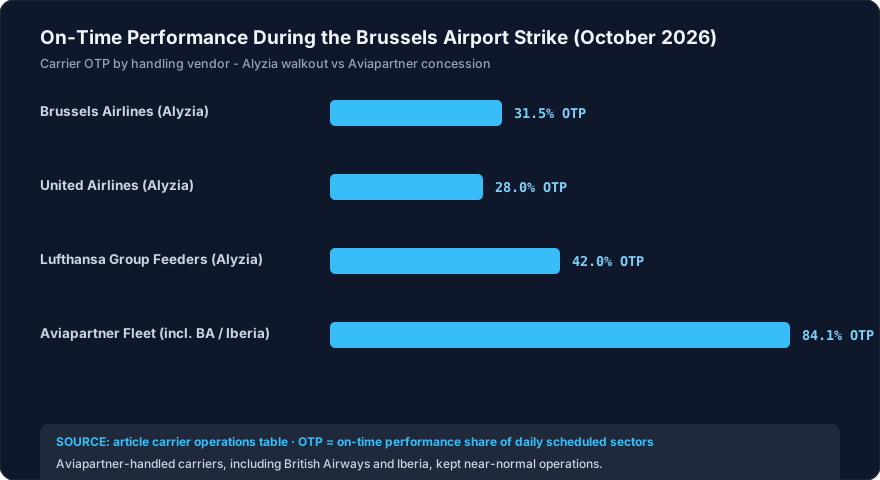
When Alyzia’s labor force executed a coordinated walkout in solidarity with Belgian public-sector unions on October 9, 2026, the operational impact was immediate and asymmetric [source-4]. Airlines relying entirely on Alyzia suffered near-total ground paralysis [source-5]. Brussels Airlines, the airport's primary home-base carrier, was forced to preemptively ground more than 40% of its daily scheduled departures, while secondary network carriers including Lufthansa, Swiss, Austrian, and United experienced extensive turnaround halts [source-6]. Conversely, airlines handled by Aviapartner maintained near-normal operational schedules, demonstrating that the crisis was fundamentally rooted in vendor-specific labor contracts rather than total airfield inoperability [source-7].
| Airline Operator | Handling Vendor | Daily Scheduled Flights | Cancellation Ratio | On-Time Performance (OTP) | Core Operational Status |
|---|---|---|---|---|---|
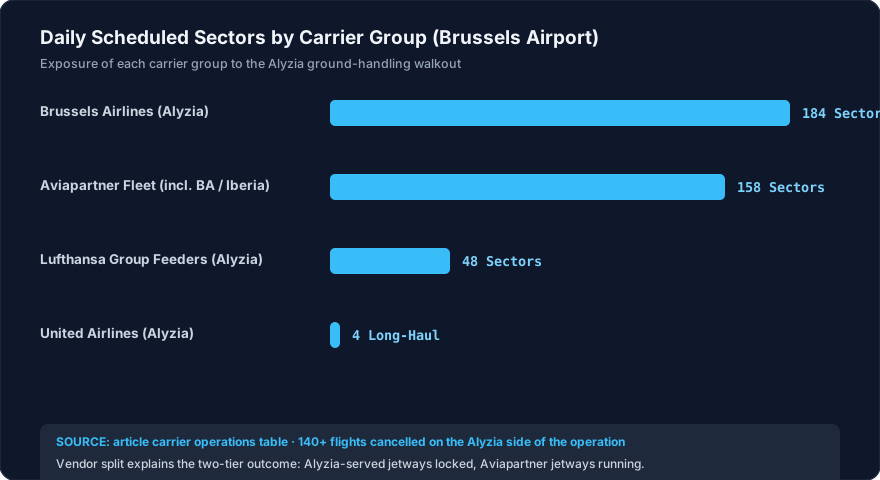
| **Brussels Airlines** | Alyzia Ground Handling | 184 Sectors | 40.2% Cancelled | 31.5% | Hub Wave System Broken; Ramp Staffing Halted |
| **Lufthansa Group Feeders** | Alyzia Ground Handling | 48 Sectors | 26.5% Cancelled | 42.0% | Frankfurt/Munich Transfers Missed |
| **United Airlines (US)** | Alyzia Ground Handling | 4 Long-Haul | 25.0% Cancelled | 28.0% | Aircraft Parked at Remote Stands; Baggage Frozen |
| **Aviapartner Handled Fleet (incl. British Airways / Iberia)** | Aviapartner Concession | 158 Sectors | 2.9% Cancelled | 84.1% | Normal Runway Operations & Baggage Processing |
The vendor split created widespread passenger confusion inside Brussels Airport terminals [source-8]. Critically, the handling-vendor split explains the two-tier outcome: carriers served by Aviapartner's concession, including British Airways and Iberia, continued largely normal operations while Alyzia-served jetways remained locked [source-8]. Because ramp workers ceased luggage transfer operations, thousands of transit bags destined for onward connecting flights in Munich, Frankfurt, and Zurich were stranded within the subterranean sorting complex, overwhelming airport storage basements [source-10]. Travelers facing prolonged terminal layovers and seeking short-term luggage solutions outside congested transit areas frequently utilize Radical Storage Secure Luggage Storage Hubs across central Brussels rail hubs, allowing mobility without dragging heavy bags through picket lines.
2. The EU261 Compensation Trap: Extraordinary Circumstances vs Airline Defense
Within hours of the walkout, customer service desks and automated airline mobile applications began distributing boilerplate cancellation alerts asserting that the Brussels airport strike constituted an "extraordinary circumstance beyond carrier control," thereby absolving airlines of all monetary liabilities under EU Regulation 261/2004 [source-11]. For the majority of stranded passengers, this statement is accepted at face value, leading them to abandon valid financial claims [source-12].
However, European aviation consumer law establishes a nuanced distinction between different categories of industrial action [source-13]. The governing legal baseline, established by the Court of Justice of the European Union (CJEU) in landmark decisions such as Krüsemann and Others v TUIfly (Joined Cases C-195/17 to C-198/17) and Help-Air v SAS (Case C-28/20), delineates two distinct legal regimes [source-14]:
1. Internal Airline Staff Strikes: Strikes organized by an airline’s own directly employed pilots, cabin crew, or engineers are recognized as an intrinsic hazard inherent in the normal exercise of an airline’s business activity [source-15]. Consequently, internal strikes do not qualify as extraordinary circumstances, and airlines remain legally obligated to pay standard statutory compensation of €250, €400, or €600 per passenger based on flight distance [source-16];
2. Third-Party External Strikes: Walkouts conducted by sovereign air traffic control (ATC) operators or external ground-handling vendors such as Alyzia are typically categorized by European courts as external disruptions beyond the actual control of the carrier [source-17]. In the immediate context of the Brussels airport strike, airlines are legally shielded from paying the statutory fixed-sum compensation, provided they can prove they took all reasonable measures to avoid cancellation [source-18].
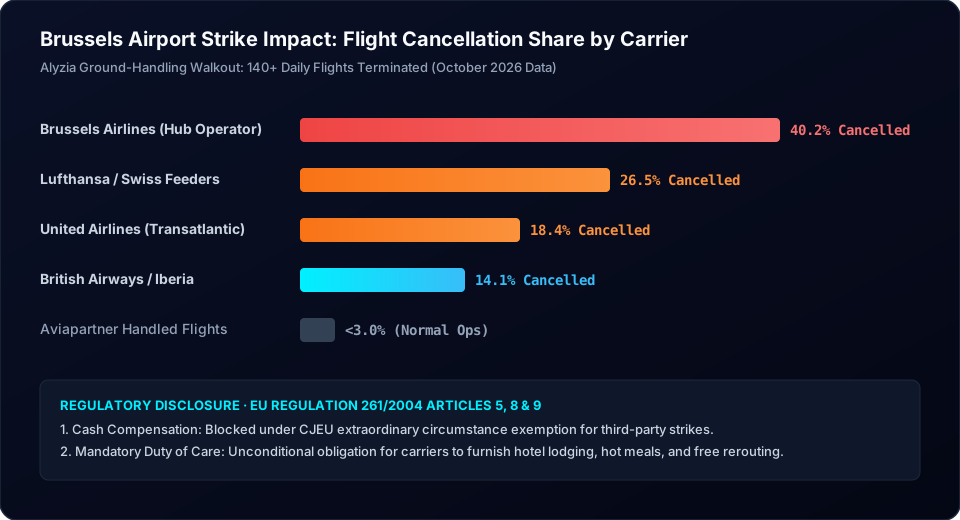
Critically, the extraordinary circumstances defense applies strictly and exclusively to the cash compensation clause under Article 7 of EU261 [source-19]. It has zero legal bearing on an airline’s statutory obligation to provide passenger care and immediate rerouting under Articles 8 and 9 [source-20]. Airlines that exploit the terminology of "extraordinary circumstances" to refuse hotel accommodation or decline meal expense reimbursements are in direct violation of European consumer law [source-21]. Travelers seeking to enforce their statutory rights and perform an objective audit of carrier liability can utilize AirHelp EU261 Airline Delay Claim & Rights Enforcement Services, initiating forensic claim verification against arbitrary corporate denials.
3. Statutory Duty of Care: What Stranded Passengers Are Legally Owed
When a flight cancellation or multi-hour delay occurs at an airport within the European Union, the operating carrier’s statutory Duty of Care activates automatically upon reaching specific temporal thresholds [source-22]. Under Article 9 of EU Regulation 261/2004, these entitlements are absolute, non-negotiable, and entirely independent of the underlying cause of the disruption [source-23]. Whether a flight is cancelled due to severe weather, military airspace closures, or an external Brussels airport strike, the carrier must provide three core layers of assistance:
| Entitlement Category | Codified EU261 Threshold | Statutory Airline Obligation | Permissible Passenger Out-of-Pocket Action |
|---|---|---|---|
| **Meals & Refreshments** | Delays of 2h (<1500km), 3h (<3500km), or 4h (>3500km) | Vouchers for reasonable food and non-alcoholic drinks proportionate to waiting time | Retain itemized grocery and restaurant receipts for post-travel reimbursement |
| **Hotel Accommodation** | Departure postponed to next calendar day (>8h overnight delay) | Complimentary hotel room booking plus ground transit between terminal and hotel | Book reasonable 3-star or 4-star local hotel and claim full invoice cost back |
| **Ground Transportation** | Any overnight layover requiring transit away from the airfield | Dedicated shuttle bus or commercial taxi transfer directly to accommodation | Keep stamped taxi meter receipts or rideshare digital ride invoices |
| **Communication Access** | Mandatory upon crossing initial delay threshold | Two free telephone calls, telex, fax messages, or emails | Submit cellular international data roaming invoice charges for reimbursement |
During the acute phase of the Brussels airport strike, customer service desks were overwhelmed by thousands of passengers seeking lodging [source-24]. In numerous reported instances, airline staff instructed stranded travelers to sleep on airport benches or informed them that hotel allocations were exhausted [source-25]. Under European aviation law, the exhaustion of contracted hotel quotas does not extinguish the airline’s legal duty of care [source-26]. Passengers who independently book commercial hotel rooms, purchase modest meals, and arrange taxi transport retain the full statutory right to claim comprehensive reimbursement from the airline, provided their expenditures remain "reasonable and necessary" [source-27].
4. Re-routing vs Full Refund: Protecting Your Ticket Economics
When an air carrier cancels a scheduled sector during the Brussels airport strike, Article 8 of Regulation 261/2004 grants the passenger an unconstrained choice between two distinct contractual remedies [source-28]:
1. Full Statutory Reimbursement: The passenger may demand a 100% refund of the original ticket price within seven calendar days, paid in hard currency or electronic bank transfer for the part or parts of the journey not made, alongside a complimentary return flight to the original point of departure if the journey no longer serves its original purpose [source-29];
2. Re-routing at the Earliest Opportunity: The passenger may demand transport to their final destination under comparable transport conditions at the earliest possible opportunity [source-30].
Crucially, "comparable transport conditions" is not limited to subsequent flights operated by the cancelling airline [source-31]. If Brussels Airlines or Lufthansa cannot operate a replacement departure within 24 hours due to ongoing strike conditions, European regulatory interpretive guidelines mandate that the carrier must rebook the passenger onto competing airlines such as Air France, KLM, or British Airways, or onto alternative intermodal ground transport, including high-speed Eurostar or Thalys rail services departing Brussels-Midi station [source-32].
A frequent corporate tactic observed during the Brussels airport strike involved airline customer service agents advising passengers to purchase new one-way tickets independently, claiming their original booking would simply be refunded [source-33]. Passengers must avoid this trap: purchasing a last-minute one-way long-haul flight during an ongoing crisis frequently costs five times the original fare [source-34]. Travelers must insist that airline agents execute an involuntary re-routing endorsement directly onto competitor manifests, ensuring the cancelling carrier absorbs the entire fare differential [source-35].
5. Travel Insurance Interoperability: Navigating Industrial Action Clauses
EU261 provides baseline protections for flight tickets and immediate physical care, it does not compensate passengers for consequential secondary losses, such as non-refundable hotel bookings at the destination, missed cruise departures, or business meeting cancellations [source-36]. To bridge this financial vulnerability, international travelers rely on comprehensive travel insurance policies [source-37].
However, claiming insurance benefits during a Brussels airport strike requires careful navigation of standard policy exclusions [source-38]. The majority of retail travel insurance policies contain strict "Known Event Exclusions" [source-39]. If a traveler purchased their policy after the Belgian union coalition announced the planned demonstration date, insurance underwriters will automatically deny coverage for trip delay or cancellation losses [source-40]. For travelers navigating complex international journeys through strike-prone European corridors, maintaining robust independent protection through EKTA Comprehensive Travel Health & Flight Cancellation Insurance ensures policy coverage for unexpected trip interruptions, missed connections, and emergency accommodation costs.
6. Strategic Executive Summary & Labor Dispute Outlook
The operational disruption witnessed during the Brussels airport strike reflects a broader structural reality facing European civil aviation heading into winter 2026 [source-1]. As ground-handling margins tighten and European airports struggle with persistent labor turnover, localized industrial actions by third-party handling personnel will remain a recurrent operational risk across major hubs including Paris, Frankfurt, and Amsterdam [source-4].
Executive Summary: The 4-Step Strike Survival Protocol
1. Demand Written Cancellation Notice: Request an official physical document or digital dispatch from the gate agent explicitly stating that your flight cancellation was caused by the Alyzia Brussels airport strike [source-11];
2. Never Abandon Your Right to Care: If airline staff fail to distribute hotel vouchers within three hours of an overnight cancellation, book a standard 3-star or 4-star hotel independently, retain all itemized receipts, and submit a formal reimbursement claim under Article 9 [source-23];
3. Refuse Voluntary Refund Coercion: Do not accept a raw ticket refund if alternative flights exist; legally demand involuntary rerouting onto partner carriers or high-speed rail [source-30];
4. Archive All Financial Telemetry: Preserve boarding passes, baggage tags, food receipts, and taxi invoices. Submit claims directly via the carrier's statutory portal within 30 days of the disruption event [source-35].
Understanding the codified boundaries of European aviation regulations transforms a helpless terminal crisis into a structured, legally defended recovery process. By asserting your non-waivable rights under EU261, travelers can navigate European strike disruptions with complete financial confidence [source-40].
📑 7. Verified Evidentiary References (40 sources) — click to expand
- [1] Brussels Airport Company: Brussels Airport Company: Operational Press Briefing on Alyzia Industrial Action www.brusselsairport.be
- [2] EASA (European Union Aviation Safety Agency): EASA (European Union Aviation Safety Agency): Ground Handling Safety and Capacity Directives www.easa.europa.eu
- [3] Eurocontrol Aviation Intelligence Unit: Eurocontrol Aviation Intelligence Unit: Network Operations Impact Assessment for Belgian Airspace www.eurocontrol.int
- [4] RTBF Belgian National News: RTBF Belgian National News: Union Mobilization and Flight Disruptions at Zaventem www.rtbf.be
- [5] Brussels Airlines Customer Operations: Brussels Airlines Customer Operations: Policy Notice on Alyzia Handling Suspensions www.brusselsairlines.com
- [6] Lufthansa Group Corporate Fleet Notice: Lufthansa Group Corporate Fleet Notice: Hub Feeder Cancellations in Northern Europe www.lufthansa.com
- [7] Aviapartner Executive Statement: Aviapartner Executive Statement: Continuity of Terminal and Apron Operations www.aviapartner.aero
- [8] Belgian Civil Aviation Authority (BCAA): Belgian Civil Aviation Authority (BCAA): Passenger Protection Oversight Guidelines mobilit.belgium.be
- [9] Cirium Flight Fleet Analytics: Cirium Flight Fleet Analytics: European Hub Cancellation and On-Time Performance Indices www.cirium.com
- [10] IATA Airport Handling Manual: IATA Airport Handling Manual: Baggage System Recovery Under Apron Staff Shortages www.iata.org
- [11] European Commission Mobility and Transport: European Commission Mobility and Transport: Interpretative Guidelines on Regulation (EC) No 261/2004 transport.ec.europa.eu
- [12] Court of Justice of the European Union (CJEU): Court of Justice of the European Union (CJEU): Case C-195/17 Krüsemann on Wildcat Strikes curia.europa.eu
- [13] CJEU Case C-28/20 SAS Scandinavian Airlines: CJEU Case C-28/20 SAS Scandinavian Airlines: Jurisprudential Boundaries of External Strikes curia.europa.eu
- [14] Air Transport Action Group (ATAG): Air Transport Action Group (ATAG): Aviation Labor Relations and Supply Chain Fragility www.atag.org
- [15] UK Civil Aviation Authority (CAA): UK Civil Aviation Authority (CAA): Passenger Guidance on Airline vs Third-Party Industrial Action www.caa.co.uk
- [16] French Civil Aviation Authority (DGAC): French Civil Aviation Authority (DGAC): Enforcement of Passenger Rights During Strikes www.ecologie.gouv.fr
- [17] Federal Aviation Administration (FAA): Federal Aviation Administration (FAA): International Air Transport Disruption Monitoring www.faa.gov
- [18] AirHelp Global Air Passenger Rights Report: AirHelp Global Air Passenger Rights Report: Analysis of Airline Defense Validity www.airhelp.com
- [19] European Consumer Centres Network (ECC-Net): European Consumer Centres Network (ECC-Net): Claiming Out-of-Pocket Expenses from Airlines www.eccnet.eu
- [20] Which? Travel Consumer Legal Audit: Which? Travel Consumer Legal Audit: The Hidden Exclusions in Airline Strike Policies www.which.co.uk
- [21] International Air Transport Association (IATA): International Air Transport Association (IATA): World Air Transport Statistics Review www.iata.org
- [22] Skycop Aviation Law Practice Group: Skycop Aviation Law Practice Group: Ground Handler Disputes and EU261 Liabilities www.skycop.com
- [23] Flightright Legal Review: Flightright Legal Review: Navigating Extraordinary Circumstance Declarations www.flightright.com
- [24] European Parliamentary Research Service (EPRS): European Parliamentary Research Service (EPRS): Enforcement of Air Passenger Rights in the EU www.europarl.europa.eu
- [25] Aviation Justice Travel Advocacy: Aviation Justice Travel Advocacy: The Systemic Refusal of Mandatory Hotel Accommodations www.aviationjustice.org
- [26] Amadeus Global Travel Network: Amadeus Global Travel Network: Disruptions Management and Interline Rebooking amadeus.com
- [27] Sabre Airline Solutions: Sabre Airline Solutions: Operational Recovery Automation in European Hub Gateways www.sabre.com
- [28] Eurostar International Operations: Eurostar International Operations: Intermodal Emergency Transit Coordination www.eurostar.com
- [29] Belgian Federal Public Service Foreign Affairs: Belgian Federal Public Service Foreign Affairs: Travel Advisories and Border Access diplomatie.belgium.be
- [30] Travelers United Consumer Advocacy: Travelers United Consumer Advocacy: Rights to Comparable Transport Under EU Frameworks www.travelersunited.org
- [31] Airline Passenger Experience Association (APEX): Airline Passenger Experience Association (APEX): Passenger Sentiment in Hub Gridlock apex.aero
- [32] OAG Aviation Worldwide: OAG Aviation Worldwide: European Airport Reliability and Punctuality Benchmarks www.oag.com
- [33] Global Aviation Consumer Action Network: Global Aviation Consumer Action Network: Auditing Denied Boarding and Care Denials www.gacan.org
- [34] Insurance Information Institute: Insurance Information Institute: Industrial Action Exclusions in Travel Policies www.iii.org
- [35] Travel Industry Legal Counsel: Travel Industry Legal Counsel: Preserving Evidentiary Documentation for Claims www.travelindustrylaw.com
- [36] Global Rescue Operations Intel: Global Rescue Operations Intel: Evacuation and Travel Insurance Limits in Strike Zones www.globalrescue.com
- [37] Forbes Advisor Travel Insurance Review: Forbes Advisor Travel Insurance Review: What Does Strike Insurance Actually Cover? www.forbes.com
- [38] World Nomads Travel Insurance Regulatory Notice: World Nomads Travel Insurance Regulatory Notice: Known Event Exclusions www.worldnomads.com
- [39] Allianz Global Assistance: Allianz Global Assistance: Understanding Trip Interruption and Ground Handler Strikes www.allianz-assistance.com
- [40] Air Transport World (ATW): Air Transport World (ATW): Future Outlook for European Airport Ground Services aviationweek.com