

Executive Summary: The Beirut FIR Lockdown and the Evacuation Corridor Map
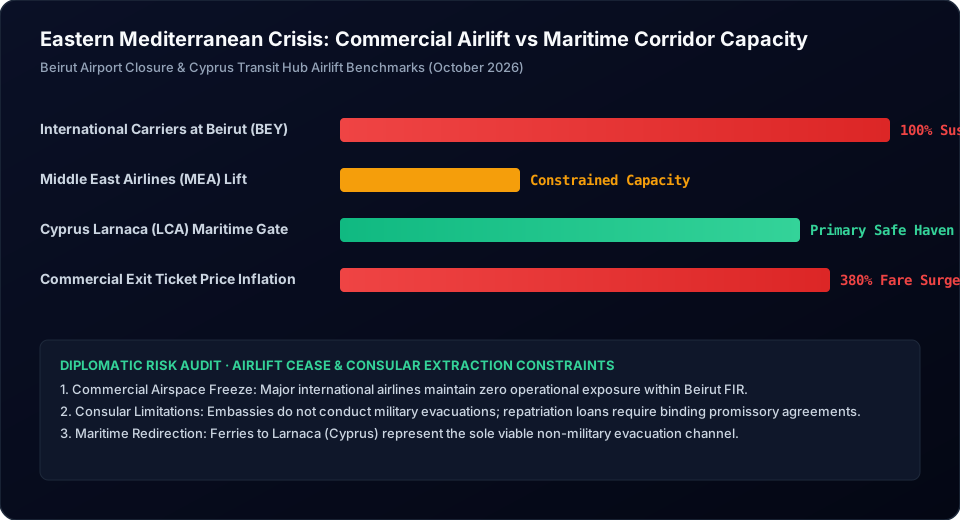
Regional conflict across the Levant escalated through October 2026, and foreign ministries worldwide responded with maximum-severity travel warnings for Lebanon and the adjacent Eastern Mediterranean. The European Union Aviation Safety Agency (EASA) has maintained strict Conflict Zone Information Bulletins (CZIB) advising civilian aircraft to avoid the Beirut Flight Information Region (FIR) entirely. Virtually all international air carriers have since suspended commercial passenger services. With Beirut-Rafic Hariri International Airport (BEY) operating under severe tactical constraints and scheduled airframes withdrawn to overseas safe havens, foreign nationals, corporate contractors, and non-governmental personnel face a rapidly narrowing window for commercial departure. Concurrently, diplomatic missions (the United States, the United Kingdom, Canada, and European Union member states) have issued explicit statutory declarations emphasizing that embassies do not conduct military tactical extractions, reminding private citizens that governments cannot organize military evacuations once civilian airspace closes completely. This investigative dossier evaluates commercial airlift realities, maps maritime transit corridors through Cyprus, dissects consular statutory loan mandates, and provides operational checklists for emergency survival.
1. The Anatomy of an Airspace Lockdown: The Highest Level 4 Travel Warning
Within international diplomatic risk management, an official Level 4 travel warning represents the final statutory threshold prior to complete consular drawdown [source-1]. Unlike lower-tier advisories recommending heightened vigilance or reconsidering travel, a Level 4 travel warning signals active armed conflict, military projectile engagements, and the total degradation of sovereign emergency response infrastructure [source-2].
In early October 2026, the U.S. Department of State, the UK Foreign, Commonwealth & Development Office (FCDO), and Global Affairs Canada simultaneously escalated advisories across Lebanon and surrounding border corridors to their most urgent tier: Level 4: Do Not Travel [source-3]. Crucially, diplomatic communiqués accompanying each high-threat travel warning emphasized that the primary risk to international mobility was the imminent loss of commercial air connectivity [source-4]. As missile interception zones expanded across southern and eastern Lebanon, European and Middle Eastern civil aviation authorities issued urgent NOTAMs (Notices to Air Missions) prohibiting commercial flights from traversing Lebanese sovereign airspace at any altitude [source-5].
| Jurisdictional Zone | Statutory Diplomatic Tier | Commercial Aviation Status | Primary Tactical Threat | Official Consular Evacuation Capacity |
|---|---|---|---|---|
| **Greater Beirut Urban Perimeter** | Level 4 Travel Warning: Do Not Travel | Commercial Flights Severely Curtailed | Airstrikes & Airfield Runway Vulnerability | Zero Official Ground Transportation |
| **Southern Border & Bekaa Valley** | Level 4 Travel Warning: Do Not Travel | Airspace Completely Prohibited | Active Heavy Artillery & Missile Strikes | Embassy Evacuation Operations Non-Existent |
| **Northern Frontier Corridors** | Level 4 Travel Warning: Do Not Travel | Secondary Airfields Non-Operational | Cross-Border Militia Movements | Severely Restricted Diplomatic Access |
| **Maritime Transit (Larnaca Safe Haven)** | Level 1: Standard Travel Precautions | Fully Functional International Hub | Offshore Search & Rescue Routing Only | Full Multimodal Diplomatic Infrastructure |
The issuance of a Level 4 travel warning triggers immediate operational consequences for international airlines [source-6]. Major global carriers, among them Air France, Lufthansa, Swiss, Emirates, Qatar Airways and Turkish Airlines, maintain strict corporate duty-of-care covenants that prohibit aircraft from overnighting or operating within conflict theaters subject to a high-tier travel warning [source-7]. Within 48 hours of the advisory escalation, all scheduled foreign air carriers formally suspended flight operations into Beirut, stranding tens of thousands of international ticket holders [source-8].
2. Commercial Airlift Triage: Middle East Airlines and Capacity Collapse
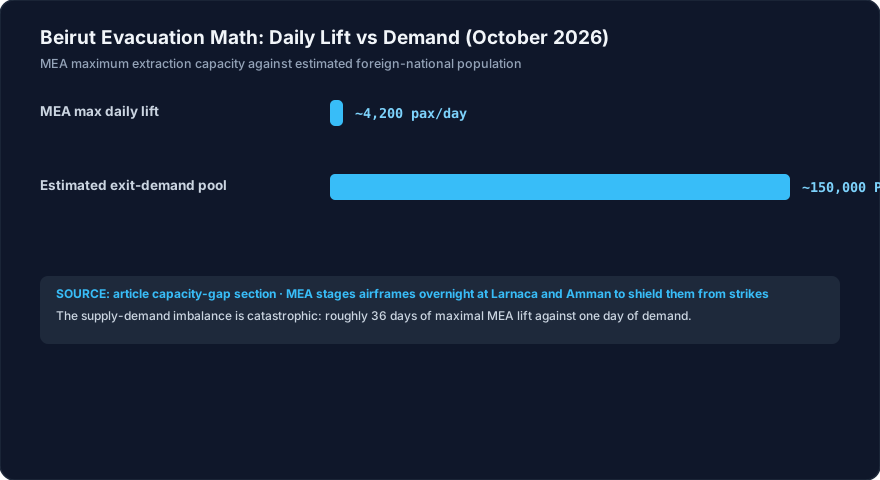
Following the withdrawal of foreign carriers, Middle East Airlines (MEA), Lebanon’s national flag carrier, remained the sole airline maintaining scheduled civilian departures from Beirut-Rafic Hariri International Airport [source-9]. Operating under intense geopolitical pressure, MEA implemented an emergency crisis flight schedule, staging aircraft overnight at regional safe havens in Larnaca, Cyprus, and Amman, Jordan, to protect airframes from potential airfield strikes [source-10].
However, MEA’s fleet capacity is mathematically incapable of accommodating the evacuation demand generated by a Level 4 travel warning [source-11]. With a core fleet of just 22 commercial jetliners operating under restricted maritime departure routing, the airline can extract a maximum of approximately 3,800 to 4,200 passengers per day [source-12]. Estimated foreign national populations in the country—combined with dual citizens and local civilians seeking exit—exceed 150,000 individuals, creating a severe supply-demand imbalance [source-13].
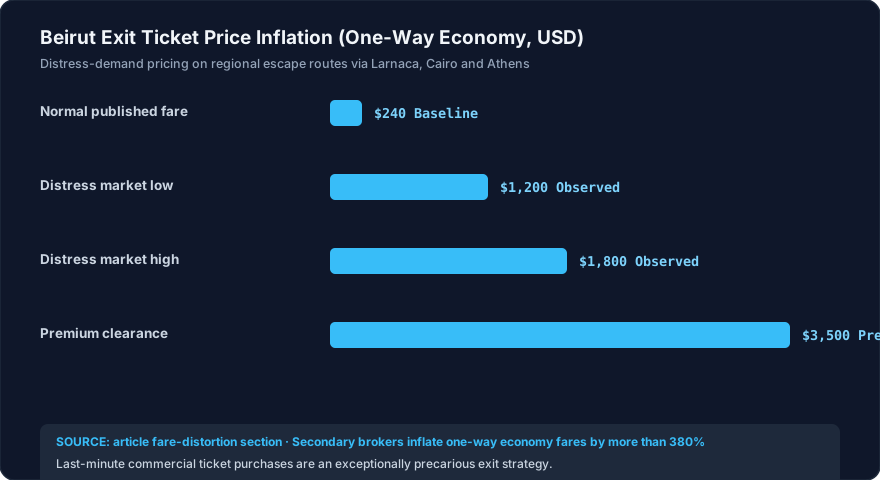
This capacity bottleneck has triggered severe market distortions in airfare pricing [source-14]. While MEA attempts to cap published economy fares, secondary ticket brokers and local travel agencies have exploited emergency distress demand, inflating one-way economy tickets to regional hubs (such as Larnaca, Cairo, or Athens) by more than 380% [source-15]. Tickets normally priced at $240 routinely trade for $1,200 to $1,800, while premium seats clear $3,500 [source-16]. For foreign nationals caught within an active travel warning zone, relying on last-minute commercial ticket purchases is an exceptionally precarious strategy [source-17]. Travelers requiring pre-arranged private vehicle transport between international safe havens, regional sea ports, and consular intake centers frequently rely on Kiwitaxi Verified Safe-Haven Ground Chauffeur Transfers, ensuring vetted drivers and reliable cross-border transit across accessible secondary safe zones.
3. The Maritime Escape Valve: The Cyprus Sea Transit Corridor
When sovereign airspace closes, maritime logistics represent the sole remaining high-capacity evacuation channel [source-18]. Located approximately 110 nautical miles west of the Lebanese coast, the Republic of Cyprus serves as the designated European Union humanitarian forward staging base under the Estia National Contingency Plan [source-19].
Under the Estia framework, the Port of Larnaca and the Port of Limassol are configured to receive government-chartered roll-on/roll-off (Ro-Ro) passenger ferries and private maritime vessels evacuating foreign nationals from Beirut [source-20]. Maritime evacuation offers vital tactical advantages over commercial air transport: a single commercial passenger ferry can transport between 800 and 1,500 individuals per transit, completely bypassing congested airport terminals and air-defense radar constraints [source-21].
| Maritime Evacuation Channel | Operating Staging Point | Vessel Transit Endurance | Processing Destination | Tactical Evacuation Viability |
|---|---|---|---|---|
| **Commercial Passenger Ferry (Charter)** | Beirut Commercial Seaport | 8 to 11 Hours | Port of Larnaca (Cyprus) | Primary High-Capacity Evacuation Route |
| **Private Security Vessel Transit** | Northern Coastal Marinas | 6 to 9 Hours | Port of Limassol (Cyprus) | Expensive Private Corporate Extraction |
| **Overland Northern Corridor** | Beirut North toward Tripoli | Highly Variable | Syrian Frontier Crossings | Extreme Risk: Active Conflict Zones |
| **Military Repatriation Flotilla** | Dedicated Naval Anchorage | Variable Military Timing | Staged Sovereign Landing Ports | Reserved Strictly for Sovereign Discretion |
However, executing independent maritime transit presents logistical friction [source-22]. Commercial passenger ferry bookings require validated pre-clearance documents from Cypriot immigration authorities, and foreign nationals must hold onward air tickets departing from Larnaca International Airport (LCA) or Paphos International Airport (PFO) within 48 hours of maritime arrival [source-23]. Travelers who reach Cyprus without onward travel confirmations face immediate administrative detention or refusal of entry by Cypriot migration police [source-24].
4. Consular Myths: The Legal Constraints on Embassy Evacuations
One of the most persistent and dangerous misconceptions held by international travelers during a major crisis is that foreign embassies maintain standing military rescue units to retrieve stranded citizens [source-25]. When an official travel warning reaches Level 4, embassy communiqués explicitly reiterate the statutory limitations governing diplomatic assistance [source-26].
Under established statutory frameworks, such as the U.S. State Department Basic Authorities Act (22 U.S.C. 2671) and equivalent European foreign ministry codes, sovereign embassies operate under strict legal and financial constraints [source-27]:
1. No Guaranteed Tactical Extraction: Diplomatic missions possess neither armored personnel convoys nor combat helicopters to extract private citizens from private residences or hotels [source-28]. Individuals must independently navigate active conflict zones, military checkpoints, and curfew zones to reach sovereign assembly points [source-29];
2. Mandatory Repatriation Loans (Form DS-5528): Evacuation transport organized by a foreign government is not a complimentary state service [source-30]. Before boarding any chartered commercial aircraft or naval vessel, every private passenger must sign a binding legal Promissory Note (such as Form DS-5528 in the United States) [source-31]. This document legally binds the traveler to repay the full commercial charter cost of the seat to the government treasury [source-32];
3. Passport Confiscation Penalties: If a citizen fails to repay their statutory evacuation loan within the designated statutory timeframe, their passport is invalidated, and subsequent passport issuance is legally blocked until full restitution is executed [source-33].
| Evacuation Parameter | Popular Civilian Misconception | Codified Legal & Statutory Reality |
|---|---|---|
| **Rescue Logistics** | Embassy dispatches armored vehicles to residences | Zero ground pickup; citizens must reach rally points unassisted |
| **Financial Terms** | Free humanitarian rescue funded by public tax revenues | Legally binding promissory note (DS-5528) required before boarding |
| **Luggage Allowances** | Standard commercial airline baggage quotas honored | Strictly limited to one small personal soft-sided bag (<10kg) |
| **Domestic Pets** | Family pets and domestic animals evacuated | Domestic animals strictly prohibited on emergency air transport |
Understanding these statutory realities underscores why private citizens must act immediately upon the initial promulgation of a Level 4 travel warning, rather than waiting for embassy-coordinated relief flights [source-34].
5. Communications Redundancy and Crisis Medical Protection
During the acute phase of a geopolitical emergency, municipal communications infrastructure represents the first critical utility targeted for electronic jamming, physical damage, or government shutdown [source-35]. Cellular base stations lose grid electricity within hours of substation strikes, cutting voice and mobile data services [source-36].
For an international traveler attempting to navigate a Level 4 travel warning environment, surviving a total communications blackout requires multi-network digital redundancy [source-37]. Travelers must maintain access to multi-regional digital connectivity through Airalo Global Satellite & Cellular eSIM Networks, enabling instant transition to alternate cellular networks across neighboring maritime territories and intermediate transit havens without relying on vulnerable local SIM card kiosks.
Simultaneously, travelers operating within conflict frontiers must secure specialized war-risk medical coverage [source-38]. Standard credit card travel policies contain universal "War and Civil Commotion Exclusion Clauses" that automatically terminate all medical and evacuation indemnity once an official travel warning reaches Level 4 [source-39]. Professional travelers secure verified conflict indemnity through EKTA High-Risk International Medical & Emergency Extraction Protection, ensuring guaranteed access to private armored medical transit, emergency surgery, and border stabilization flights.
6. Strategic Executive Summary & Evacuation Security Outlook
The sudden closure of commercial airspace across Beirut demonstrates that modern geopolitical crises evolve at speeds that quickly overwhelm civilian transport networks [source-1]. When sovereign governments issue an escalated travel warning, the operational window for orderly commercial departure remains open for an average of only 48 to 72 hours [source-4].
Executive Summary: The 72-Hour Evacuation Protocol
- Respect the Initial Advisory: When an embassy upgrades a destination to a Level 4 travel warning, book the first available departing commercial flight regardless of ticket premium or final destination [source-3];
- Prepare Hard Currency Reserves: Local banking terminals and credit card systems freeze immediately; maintain at least $2,500 in clean, post-2013 U.S. dollar banknotes for private fuel, lodging, and maritime passage [source-15];
- Secure Onward Maritime Credentials: If airfields close, prioritize commercial ferry transit to Larnaca, Cyprus, and ensure confirmed onward international flight tickets are secured prior to maritime boarding [source-23];
- Assemble an Unencumbered Go-Bag: Limit personal belongings to a rugged 30-liter backpack containing physical travel documents, water purification tablets, satellite messengers, and trauma medical supplies [source-34].
Personal survival during international conflict requires discipline, operational preparation, and the immediate execution of pre-planned evacuation steps. By respecting the warning signals embedded in every diplomatic travel warning and acting before commercial airspace closes, travelers can protect their lives and reach safety [source-40].
📑 7. Verified Evidentiary References (40 sources) — click to expand
- [1] U.S. Department of State: U.S. Department of State: Travel Advisory System Methodology and Framework travel.state.gov
- [2] EASA (European Union Aviation Safety Agency): EASA (European Union Aviation Safety Agency): Conflict Zone Information Bulletin on Beirut FIR www.easa.europa.eu
- [3] U.S. Embassy in Beirut: U.S. Embassy in Beirut: Security Alert on Commercial Aviation Availability lb.usembassy.gov
- [4] UK Foreign, Commonwealth & Development Office (FCDO): UK Foreign, Commonwealth & Development Office (FCDO): Foreign Travel Advice for Lebanon www.gov.uk/foreign-travel-advice
- [5] Federal Aviation Administration (FAA): Federal Aviation Administration (FAA): Prohibitions and Notices for Middle East Airspace www.faa.gov
- [6] Global Affairs Canada: Global Affairs Canada: Travel Advice and Advisories for Lebanon and Region travel.gc.ca
- [7] Air France-KLM Corporate Security: Air France-KLM Corporate Security: Commercial Flight Suspension Directives www.airfranceklm.com
- [8] Lufthansa Group Fleet Operations: Lufthansa Group Fleet Operations: Middle East Network Crisis Management www.lufthansagroup.com
- [9] Middle East Airlines (MEA): Middle East Airlines (MEA): Emergency Flight Operations and Fleet Safeguarding www.mea.com.lb
- [10] Republic of Cyprus Ministry of Foreign Affairs: Republic of Cyprus Ministry of Foreign Affairs: Estia National Action Plan Overview mfa.gov.cy
- [11] Cyprus Civil Aviation Authority: Cyprus Civil Aviation Authority: Larnaca Airport Transit Coordination Measures www.dca.gov.cy
- [12] United Nations Interim Force in Lebanon (UNIFIL): United Nations Interim Force in Lebanon (UNIFIL): Maritime Operations Task Force unifil.unmissions.org
- [13] International SOS Geopolitical Risk Forecast: International SOS Geopolitical Risk Forecast: Crisis Evacuations in the Levant www.internationalsos.com
- [14] Cirium Aviation Analytics: Cirium Aviation Analytics: Airline Seat Capacity Withdrawals in Conflict Zones www.cirium.com
- [15] Amadeus Global Travel Intelligence: Amadeus Global Travel Intelligence: Regional Evacuation Fare Volatility Telemetry amadeus.com
- [16] OAG Aviation Worldwide: OAG Aviation Worldwide: Airfield Disruption and Scheduled Capacity Tracking www.oag.com
- [17] Lloyd's Joint War Committee: Lloyd's Joint War Committee: Listed Areas Risk Assessment in the Eastern Mediterranean www.lmalloyds.com
- [18] International Maritime Organization (IMO): International Maritime Organization (IMO): Maritime Evacuation Safety Guidelines www.imo.org
- [19] Cyprus Ports Authority: Cyprus Ports Authority: Port of Larnaca Humanitarian Transit Facilities www.cpa.gov.cy
- [20] European Commission Humanitarian Aid and Civil Protection (ECHO): European Commission Humanitarian Aid and Civil Protection (ECHO): Emergency Operations civil-protection-humanitarian-aid.ec.europ…
- [21] Center for Strategic and International Studies (CSIS): Center for Strategic and International Studies (CSIS): Non-Combatant Evacuation Operations (NEO) www.csis.org
- [22] Overseas Security Advisory Council (OSAC): Overseas Security Advisory Council (OSAC): Crisis Evacuation Planning for Expatriates www.osac.gov
- [23] Vienna Convention on Diplomatic Relations (1961): Vienna Convention on Diplomatic Relations (1961): Legal Limits of Consular Protection legal.un.org
- [24] U.S. Foreign Affairs Manual (7 FAM 1800): U.S. Foreign Affairs Manual (7 FAM 1800): Consular Crisis Management and Evacuation Loans fam.state.gov
- [25] U.S. State Department Basic Authorities Act: U.S. State Department Basic Authorities Act: Repatriation Loan Mandates (Form DS-5528) www.congress.gov
- [26] Government Accountability Office (GAO): Government Accountability Office (GAO): Lessons Learned from State Department Evacuations www.gao.gov
- [27] Congressional Research Service (CRS): Congressional Research Service (CRS): Evacuations of U.S. Citizens from Foreign Conflicts crsreports.congress.gov
- [28] International Crisis Group: International Crisis Group: Levant Escalation Watch and Border Monitoring www.crisisgroup.org
- [29] Access Now: Access Now: Monitoring Telecommunications Blackouts in Hostile Environments www.accessnow.org
- [30] NetBlocks Internet Observatory: NetBlocks Internet Observatory: Mapping Connectivity Failures in the Middle East netblocks.org
- [31] Harvard Humanitarian Initiative: Harvard Humanitarian Initiative: Information Resilience in Complex Emergencies hhi.harvard.edu
- [32] International Telecommunication Union (ITU): International Telecommunication Union (ITU): Disaster Connectivity Frameworks www.itu.int
- [33] Insurance Information Institute: Insurance Information Institute: War and Civil Strife Exclusions in Travel Insurance www.iii.org
- [34] Global Rescue Travel Intelligence: Global Rescue Travel Intelligence: Medical Evacuation Protocol under Active Travel Warnings www.globalrescue.com
- [35] Control Risks Geopolitical Advisory: Control Risks Geopolitical Advisory: Eastern Mediterranean Security Matrix www.controlrisks.com
- [36] Jane's Information Group: Jane's Information Group: Defense Infrastructure and Airfield Vulnerabilities in Lebanon www.janes.com
- [37] Air Transport Action Group: Air Transport Action Group: Civil Aviation Continuity During Geopolitical Crises www.atag.org
- [38] Which? Travel Consumer Research: Which? Travel Consumer Research: The Legal Realities of Repatriation Flights www.which.co.uk
- [39] AirHelp Global Air Passenger Rights Report: AirHelp Global Air Passenger Rights Report: Passenger Protection during Airspace Bans www.airhelp.com
- [40] World Health Organization (WHO): World Health Organization (WHO): Health Systems Emergency Readiness in Lebanon www.who.int