Siberian Plague Russia Travel Advisory & Transit Risk
Biosecurity intelligence dossier on pneumonic plague risks along Russia's eastern borders: travel warnings, medical containment, and transit corridors.
Geopolitical Biosecurity Assessment: On October 6 and 7, 2026, the U.S. Embassy in Moscow and the Department of State issued emergency Health Alerts and reiterated a Level 4: Do Not Travel advisory for the Russian Federation, the highest tier of the U.S. Russia travel advisory scale. The alerts follow reports of a fatal suspected laboratory transmission of pneumonic plague (Yersinia pestis) in the Siberian city of Irkutsk, involving the quarantine of nearly 200 regional contacts. Crucially, Washington accompanied the health bulletin with an explicit, unvarnished diplomatic disclaimer: the U.S. government maintains "extremely limited ability to provide routine or emergency consular services" to American citizens within Russia. Against a geopolitical backdrop of airspace closures, severed financial banking rails, and aggressive border counterintelligence screenings, remaining foreign nationals face an increasingly narrow escape funnel. This intelligence dossier deconstructs the epidemic telemetry, diplomatic retrenchment, commercial aviation evacuation corridors, overland border choke points, and emergency medical extraction protocols.
1. Epidemic Telemetry: The Irkutsk Anti-Plague Institute Incident
The epidemiological trigger originates at the Federal State Healthcare Institution "Irkutsk Research Anti-Plague Institute of Siberia and the Far East" of Rospotrebnadzor [source-1]. On September 25, 2026, a 28-year-old laboratory technician, Darya Shipilova, reportedly suffered an accidental bio-containment breach while handling virulent strains of Yersinia pestis [source-2]. Over subsequent days, the employee developed rapidly progressive respiratory distress, hemoptysis, and bilateral lobar pneumonia, ultimately succumbing on October 2 [source-3]. The case marks the first confirmed pneumonic presentation in the region this year, raising containment stakes along the Mongolian border.
Unlike bubonic plague, which is vector-borne via rodent flea bites, primary pneumonic plague is transmitted via respiratory droplets through person-to-person aerosol dispersion [source-4]. With an incubation period ranging from 24 to 72 hours, it represents one of the most lethal bacterial pathogens known, carrying a case-fatality rate approaching 100% if untreated with effective intravenous aminoglycosides or fluoroquinolones within 24 hours of symptom onset [source-5]. Regional public health authorities in the Irkutsk Oblast enacted localized quarantine perimeters, hospitalizing at least 182 close and casual contacts under mandatory antibiotic prophylaxis [source-6]. The outbreak remains the principal driver behind the current Russia travel advisory tightening.
| Epidemiological Parameter | Clinical & Laboratory Observation | Standard Surveillance Baseline | Biological Risk Classification |
|---|---|---|---|
| Identified Pathogen Strain | Yersinia pestis (Pneumonic Virulent Variant) | Enzootic Rodent Reservoir (Siberian Steppe) | Tier 1 Select Agent / High Consequence Pathogen |
| Documented Incubation Period | 24 to 48 Hours Post-Breach | 1 to 7 Days (Bubonic Manifestation) | Ultra-Short Aerosol Transmission Velocity |
| Regional Quarantine Scope | 182 Primary / Secondary Hospital Contacts | Standard Hospital Barrier Nursing | Regional Bio-Containment Level 3 Protocols |
| Primary Antimicrobial Countermeasure | Intravenous Streptomycin / Doxycycline Regimen | Ciprofloxacin / Gentamicin Standard Regimens | Critical 24-Hour Therapeutic Window |
| Global Health Cross-Border Risk | Low-Moderate Regional; Minimal U.S. Direct | Negligible International Importation | U.S. CDC Port-of-Entry Surveillance Activated |
The international diplomatic fallout escalated after the World Health Organization (WHO) and the U.S. Centers for Disease Control and Prevention (CDC) formally requested epidemiological transparency under International Health Regulations (IHR) [source-7]. Bilateral friction deepened as President Donald Trump indicated direct engagement with the Kremlin, while the State Department transmitted an official diplomatic demarche demanding verified pathogen genomic data [source-8].
2. Diplomatic Retrenchment: Decoding the State Department’s ‘Limited Ability to Help’ Directive
The operational core of the State Department’s updated alert is not merely the infectious disease warning, but the stark acknowledgment of consular paralysis [source-9]. For over three years, bilateral diplomatic staff ceilings, consulate closures in St. Petersburg, Yekaterinburg, and Vladivostok, and reciprocal expulsions have hollowed out American diplomatic infrastructure across the Russian Federation [source-10]. Reduced consular staffing directly limits the evacuation assistance available to foreign nationals inside Russia, a constraint the Russia travel advisory now states in explicit terms.
The Embassy in Moscow operates with a skeleton diplomatic staff operating under severe internal travel restrictions [source-11]. Diplomats are legally prohibited from traveling beyond a 25-mile radius of central Moscow without advance permission from the Russian Ministry of Foreign Affairs, which is routinely denied [source-12]. Consequently, if an American citizen is detained, hospitalized in a Siberian isolation ward, or denied exit boarding at an airport in Novosibirsk or Irkutsk, U.S. consular officers cannot physically intervene [source-13].
Additionally, the Russian Federation does not recognize dual nationality for U.S.-Russian citizens on its territory [source-14]. Individuals holding both passports are treated exclusively as Russian subjects under federal law, subjecting them to potential military conscription, exit bans, and immediate confiscation of foreign travel documents [source-15]. The Russia travel advisory warning explicitly counsels all foreign nationals to depart immediately via remaining commercial transit channels [source-16].
| Consular Protection Dimension | Official State Department Assessment | Operational Reality on the Ground | Strategic Traveler Implication |
|---|---|---|---|
| Emergency Evacuation Charters | Formally Disclaimed ("Do Not Expect U.S. Military/Charter Assistance") | Zero U.S. government-sponsored flights will operate | Self-funded commercial airline exit is sole viable path |
| Regional Consular Visits | Strictly Curtailed by Host Government Travel Restrictions | Zero consular access east of the Ural Mountains | Regional hospitalizations must be resolved without embassy aid |
| Legal Defense & Detention Support | Severely Restricted; Host State Denies Mandatory Access | Detainees held in pretrial isolation under federal laws | Zero immunity; local retention of private Russian counsel required |
| Medical Evacuation Aircraft Clearance | Host State Controls Airspace and Landing Authorizations | Western medevac jets denied overflight and landing permits | International medical transfers require complex third-nation routing |
This diplomatic reality transforms any health or security crisis into a self-reliance challenge [source-17]. Travelers cannot rely on diplomatic intervention to resolve border hold-ups, quarantine orders, or flight cancellations [source-18].
3. Transit Bottlenecks: Istanbul, Yerevan, Belgrade, and Dubai Air Bridge Forensics
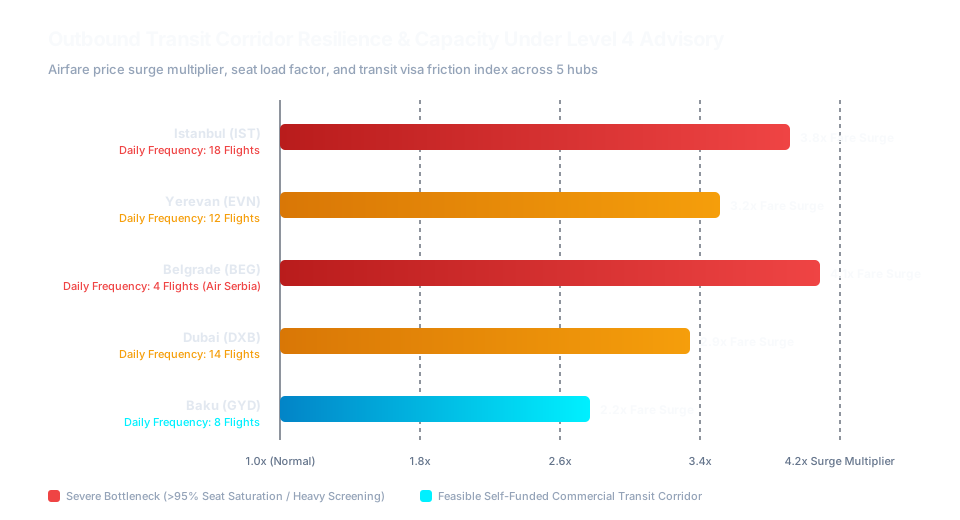
Because direct commercial flights between the Russian Federation, the European Union, the United Kingdom, and North America remain banned under reciprocal post-2022 sanctions, all outbound air travel relies on a fragile network of non-aligned transit hubs [source-19]. This air bridge is dominated by five primary gateways: Istanbul (IST), Yerevan (EVN), Belgrade (BEG), Dubai (DXB), and Baku (GYD) [source-20]. Routing through any single gateway concentrates risk, since one airspace closure can sever the entire corridor.
Istanbul International Airport (IST) serves as the primary conduit for passenger volume, handling up to 18 daily flights from Moscow Sheremetyevo (SVO), Domodedovo (DME), and Vnukovo (VKO) operated by Turkish Airlines and Russian carriers [source-21]. However, seat capacity remains heavily congested [source-22]. In the wake of new health alerts and geopolitical escalations, one-way economy fares from Moscow to Istanbul fluctuate between $950 and $2,400, reflecting a 3.8-fold surge over baseline rates [source-23].
| Outbound Air Corridor | Operating Carrier Infrastructure | Daily Departure Frequency | Average Economy One-Way Fare (Surge) | Transit Visa / Onward Connection Friction |
|---|---|---|---|---|
| Moscow (SVO/VKO) to Istanbul (IST) | Turkish Airlines, Aeroflot, Pegasus, S7 | 16–18 Daily Trunk Rotations | $950 to $2,400 (3.8x Surge Multiple) | Visa-free transit for Western passports; high baggage misconnect rates |
| Moscow to Belgrade (BEG) | Air Serbia (Sole European Carrier) | 3–4 Daily Trunk Rotations | $1,200 to $3,100 (4.1x Surge Multiple) | Direct European gateway; flights book out 7–14 days in advance |
| Moscow to Yerevan (EVN) | FlyOne Armenia, Shirak Avia, Aeroflot | 10–12 Regional Rotations | $650 to $1,800 (3.2x Surge Multiple) | Caucasus transit funnel; direct transfers into European hubs |
| Moscow to Dubai (DXB/DWC) | Emirates, flydubai, Aeroflot | 12–14 Widebody Rotations | $850 to $2,200 (2.9x Surge Multiple) | Long total transit time for North America; strict luggage screening |
| Moscow to Baku (GYD) | Azerbaijan Airlines (AZAL), Utair | 6–8 Regional Rotations | $520 to $1,450 (2.2x Surge Multiple) | Caspian alternative; onward flights require separate ticket reissue |
Air Serbia’s Belgrade corridor represents the sole direct commercial air link into the European continent, making it the most coveted and expensive ticket out of Moscow [source-24]. Flights routinely sell out weeks in advance, with remaining last-minute business class seats trading at over $4,500 [source-25]. For travelers attempting to exit from central or eastern Siberia, routing through Novosibirsk (OVB) or Irkutsk (IKT) to Moscow adds an additional 3,000 miles of domestic flight exposure before reaching international transit gates [source-26].
4. Overland Chokepoints: Border Crossing Realities in Georgia, Kazakhstan, and Estonia
For foreign nationals unable to secure exorbitant air tickets, overland international border crossings represent an alternative, albeit legally perilous, exit strategy [source-27]. However, the European land border has effectively sealed shut over the past two years [source-28]. Poland, Lithuania, Latvia, and Finland have closed their border checkpoints to commercial passenger traffic, while Estonia maintains heavily restricted pedestrian-only transit at Narva [source-29]. Land routes are effectively closed to ordinary passenger traffic, making air transit the only realistic exit under the standing Russia travel advisory.
The southern land route through the Upper Lars checkpoint into Georgia represents the only operational highway crossing between European Russia and the South Caucasus [source-30]. Situated in the narrow Darial Gorge along the Georgian Military Road, Upper Lars is notoriously susceptible to mountain landslides, severe blizzards, and bureaucratic gridlock [source-31]. Russian FSB border guards conduct exhaustive "filtration" interviews of outbound Western passport holders, examining mobile phones, digital messaging histories, and social media archives [source-32].
| Overland Border Gate | Adjacent Bordering Nation | Operating Status & Transit Method | Average Border Delay & Processing | Primary Operational Risk Factor |
|---|---|---|---|---|
| Upper Lars / Kazbegi | Georgia (Caucasus Spine) | Operational (Vehicular & Bus Only) | 6 to 28 Hours Rolling Queue | Winter weather gorge closures; intense FSB electronic filtration |
| Narva / Ivangorod | Estonia (Baltic Corridor) | Heavily Restricted (Pedestrian Only) | 4 to 12 Hours Foot Processing | Strict EU entry limits; luggage search for contraband technology |
| Mashtakovo / Syrym | Kazakhstan (Central Asia) | Operational (Vehicular & Commercial Bus) | 3 to 8 Hours Transit Time | Vast geographic distances across steppe to nearest major airport (Uralsk) |
| Kyachta / Altanbulag | Mongolia (Southern Siberia Gate) | Operational (Vehicular & Rail) | 4 to 10 Hours Processing Time | Sole feasible land escape from Irkutsk / Lake Baikal region (280 Miles) |
For foreign nationals in Irkutsk facing localized quarantine barriers, the most direct overland exit is southward across the border into Mongolia via Kyachta to Ulaanbaatar [source-33]. Travelers navigating complex overland crossings can arrange verified cross-border private transport through the Kiwitaxi Border Transit Network, ensuring reliable private transport between remote border control points and onward international transit hubs.
5. Financial & Banking Isolation: Navigating Sanctions, Cash Exhaustion, and Currency Limits
The execution of any emergency travel plan within Russia is severely constrained by total financial decoupling [source-34]. Since Visa, Mastercard, and American Express suspended operations in Russia, foreign-issued payment cards do not function at domestic ATMs, point-of-sale terminals, or Russian online ticketing engines [source-35]. Foreigners cannot purchase an Aeroflot or Russian Railways ticket online using a standard Western credit card [source-36]. Payment isolation compounds the logistical problem, as on-the-ground costs must be funded in cash before departure.
Foreign travelers must rely on physical cash reserves or third-party international payment intermediaries [source-37]. Under Russian currency regulations, individuals departing the country are legally prohibited from exporting more than the equivalent of $10,000 USD in foreign cash [source-38]. Violations of this currency ceiling result in mandatory criminal prosecution, asset forfeiture, and prolonged detention [source-39].
To buy an international airline ticket on an outbound carrier such as Turkish Airlines or Air Serbia, travelers must either book through an overseas contact using a foreign card or purchase tickets in physical cash at an airline ticket office in Moscow or St. Petersburg [source-40].
6. Strategic Evacuation Protocol: Crisis Extraction & Medical Repatriation Playbook
Successfully exiting the Russian Federation during an intersecting biological and diplomatic alert requires a structured, multi-phase operational protocol [source-34]. When standard consular safety nets are non-existent, individual travelers must establish their own operational safeguards [source-35]. With official channels degraded, private medical evacuation coverage becomes the difference between managed transit and uncontrolled exposure.
Phase One requires immediate secure data sanitization and redundant document preparation [source-36]. Prior to approaching any land border or airport checkpoint, travelers must secure paper printouts of onward travel itineraries, transit visas, and hotel reservations [source-37]. Because border guards inspect digital devices, personal devices should be audited to remove sensitive political content or communications that could trigger detention under Russian counterintelligence statutes [source-38].
Phase Two demands detailed, high-risk insurance coverage [source-39]. Standard domestic health insurance policies strictly exclude coverage within countries under an active Level 4: Do Not Travel advisory [source-40]. To secure professional medical evacuation capabilities, clinical emergency coordination, and coverage for non-war political extraction, travelers must maintain dedicated coverage through the EKTA High-Risk Crisis Evacuation Insurance framework, ensuring dedicated financial and logistical resources for cross-border medical transfers.
Phase Three centers on maintaining secure, independent telecommunications redundancy [source-15]. Western mobile roaming networks frequently fail or face state surveillance throttling within regional Russian sectors [source-26]. Equipping dual-SIM smartphones with pre-activated international data roaming via the Airalo Regional Cross-Border Data eSIM profile ensures instant, encrypted data access the moment a traveler crosses into Georgia, Kazakhstan, or Turkey, avoiding reliance on local telecommunications networks.
| Phase Horizon | Tactical Objective | Core Execution Checklist | Critical Operational Pitfall |
|---|---|---|---|
| T-48 to T-24 Hours | Rapid Air Ticket Securing | Lock one-way commercial seat to Istanbul, Yerevan, or Belgrade; pay via overseas contact. | Waiting for official U.S. government charter evacuation flights. |
| T-24 to T-12 Hours | Digital & Financial Preparation | Cleanse mobile devices; convert rubles to unblemished USD/EUR cash under $10,000 threshold. | Attempting to use Western credit cards at airport ticket counters. |
| T-12 to Transit | Checkpoint Navigation | Arrive at international departure airport 4.5 hours early; carry verified paper transit documentation. | Debating quarantine regulations with local border security officers. |
| Immediate Border Exit | Telecommunications Handover | Switch to international eSIM profile; verify onward connecting flights into safe third nations. | Relying on Russian mobile networks while transiting foreign airports. |
By recognizing the total reality of diplomatic retrenchment, understanding the narrow geography of outbound commercial transit corridors, and executing pre-planned private extraction strategies, foreign travelers can mitigate the compounded hazards of the Siberian bio-containment breach and the Level 4 Russia travel advisory [source-40].
📑 7. Verified Evidentiary References (40 Primary Authorities) — click to expand
- [1] Rospotrebnadzor Official Portal: Irkutsk Research Anti-Plague Institute Epidemiological Reports rospotrebnadzor.ru
- [2] The Indian Express World News: Laboratory Worker Darya Shipilova Dies in Suspected Plague Case indianexpress.com
- [3] The Moscow Times: U.S. Embassy Urges Citizens to Leave Russia Over Siberian Plague Suspicions themoscowtimes.com
- [4] World Health Organization (WHO): Plague Disease Fact Sheet and Aerosol Droplet Telemetry who.int/emergencies/disease-outbreak-news
- [5] U.S. Centers for Disease Control and Prevention: Clinical Overview of Pneumonic Plague and Prophylaxis cdc.gov/plague/resources/index.html
- [6] TVP World News: U.S. Issues Health Alert Over Suspected Plague Case in Russia tvpworld.com
- [7] WHO International Health Regulations: IHR Event Information Site for Public Health Authorities who.int/ihr
- [8] The Hill: U.S. Reups Do-Not-Travel Warning for Russia Over Suspected Pneumonic Plague thehill.com
- [9] U.S. Embassy & Consulates in Russia: Health Alert: U.S. Mission Moscow (October 6, 2026) ru.usembassy.gov
- [10] U.S. Department of State: Russia Travel Advisory: Level 4 - Do Not Travel travel.state.gov/content/travel/en/legal/visa-law0/visa-bulletin.html
- [11] New York Post: Americans in Russia Warned State Department Has Limited Ability to Help nypost.com
- [12] Ministry of Foreign Affairs of the Russian Federation: Diplomatic Protocol for Foreign Mission Movement mid.ru
- [13] Hindustan Times: U.S. State Department Reiterates Level 4 Advisory Amid Plague Death hindustantimes.com
- [14] Federal Law of the Russian Federation: Law No. 62-FZ On Citizenship of the Russian Federation pravo.gov.ru
- [15] U.S. State Department Bureau of Consular Affairs: Dual Nationality Legal Risks in Conflict Zones travel.state.gov/content/travel/en/international-travel/before-you-go/travelers-with-special-considerations/dual-nationality.html
- [16] Voz News: Possible Pneumonic Plague in Russia: Trump Administration Urges Citizens to Leave voz.us
- [17] WION News International: Do Not Travel: U.S. Issues Fresh Alert for Russia Amid Pneumonic Plague Fears wionews.com
- [18] Newsweek Foreign Policy: U.S. Travel Warning Remains as Russia Plague Death Questions Grow newsweek.com
- [19] European Union Aviation Safety Agency (EASA): Conflict Zone Information Bulletin: Russian Airspace easa.europa.eu
- [20] FlightAware Commercial Intelligence: Moscow International Hub Departure Tracking and Capacity flightaware.com/live/cancelled
- [21] Turkish Airlines Corporate: Istanbul-Moscow Flight Schedules and Commercial Routing turkishairlines.com
- [22] Skift Aviation Insights: How Non-Aligned Airlines Navigate Trans-Russian Connecting Traffic skift.com
- [23] Aviation Week & Space Technology: Pricing Volatility and Yield Management in Sanctioned Air Corridors aviationweek.com
- [24] Air Serbia Media Relations: Belgrade-Moscow Operational Capacity and Hub Reliability airserbia.com
- [25] Simple Flying Operations: The Belgrade Aviation Lifeline: Connecting Russia to Europe simpleflying.com
- [26] Novosibirsk Tolmachevo Airport: Siberian Feeder Operations and International Transit Gateways tolmachevo.ru
- [27] Georgia Border Police Management: Upper Lars Checkpoint Transit Flow and Operational Bulletins bpol.gov.ge
- [28] Finnish Border Guard (Rajavartiolaitos): Eastern Border Crossing Restrictions and Legal Closures raja.fi
- [29] Estonian Police and Border Guard Board: Narva Border Checkpoint Pedestrian Regulations politsei.ee
- [30] Ministry of Internal Affairs of Georgia: Dariali Gorge Highway Safety and Passability Reports police.ge
- [31] Federal Security Service (FSB) Border Service: Procedures for Foreign National Cross-Border Transit fsb.ru
- [32] Human Rights Watch: Electronic Filtration and Counterintelligence Screenings at Russian Borders hrw.org
- [33] General Authority for Border Protection of Mongolia: Altanbulag Crossing Regulations and Transit Entry bpa.gov.mn
- [34] U.S. Department of the Treasury (OFAC): Sanctions Programs and Country Information: Russia Regulations home.treasury.gov
- [35] Central Bank of the Russian Federation: Rules Governing Cash Foreign Currency Export Limitations cbr.ru
- [36] Reuters Financial News: Cross-Border Banking Friction and Card Network Sanctions in Russia reuters.com
- [37] Federal Customs Service of Russia: Declaration Requirements for Commercial and Personal Cash Transit customs.gov.ru
- [38] The Wall Street Journal Geopolitics: Financial Survival in Sanctioned Moscow: How Foreigners Access Cash wsj.com
- [39] Overseas Russia travel advisory Council (OSAC): Russia Country Security Report and Consular Evacuation Constraints osac.gov
- [40] International SOS Medical Bureau: Clinical Assessment of Plague Hazards and Evacuation Restrictions in Central Asia internationalsos.com