
Executive Summary: One Airspace, Two Hazards, Two Tiers
The route-risk engine's output for the morning of 25 October 2026 places two different atmospheric hazards inside the same flight information region and assigns them different severity tiers. [source-1]
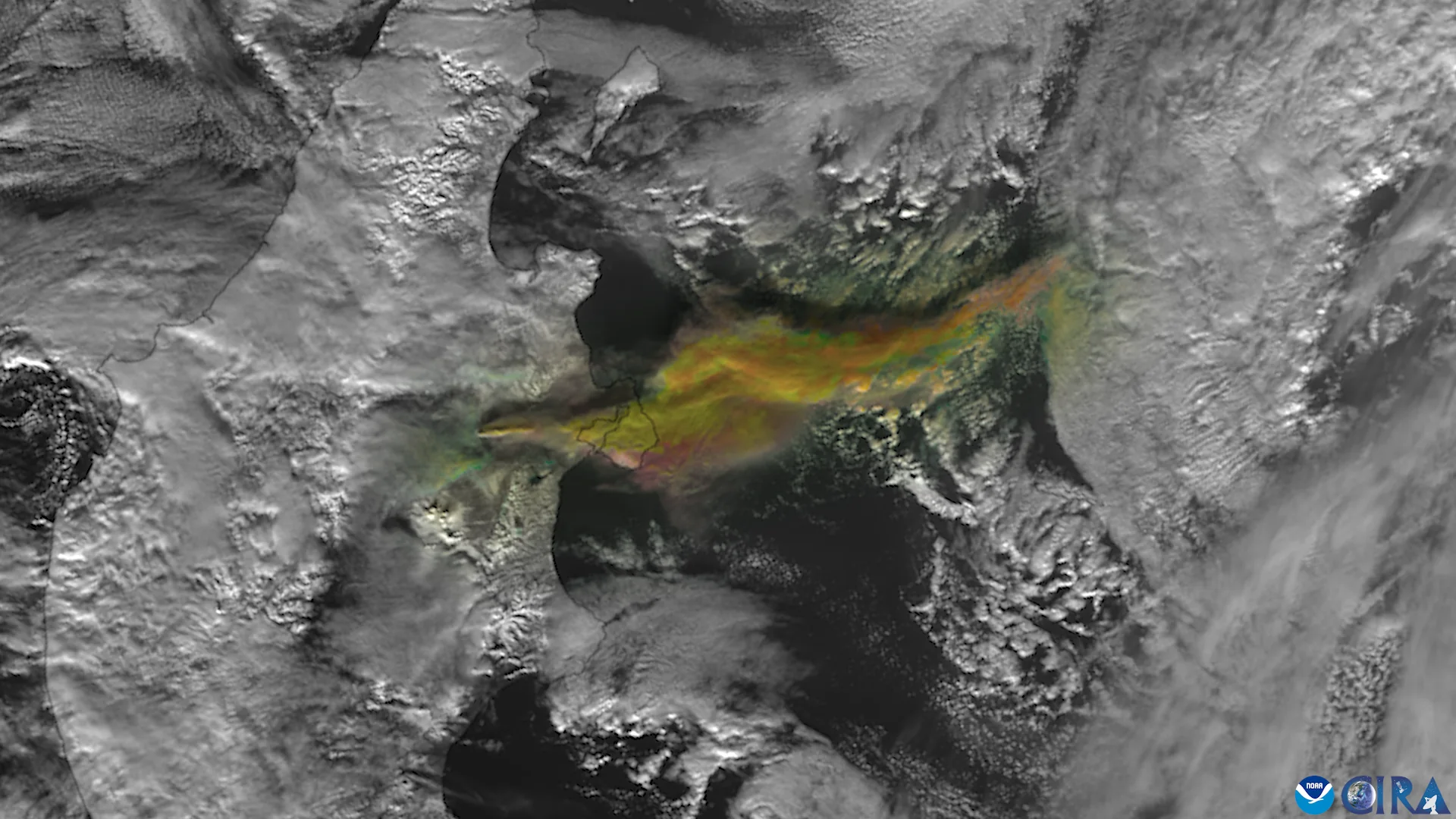
The first is volcanic ash from an eruption at Mount Sakurajima, Aira Caldera, reported against FIR RJJJ Fukuoka at a distance of 439 km from the airport. It flags ten routes into KIX at ALERT, the engine's upper tier. [source-1] [source-2]
The second is Typhoon Champi, reported against the same FIR at 356 km, and it flags nine routes into TPE at WATCH, the lower tier. [source-1] [source-3]
The tier assignment and the disruption record in this batch point in opposite directions. The higher-tier hazard — ash — has no cancellation reporting attached to it in the material reviewed. The lower-tier hazard — the cyclone — carries the entire cancellation record, in four separate documents, including a national broadcaster's live coverage, an airline's own operational notice, and a government passenger advisory. [source-3] [source-4] [source-5] [source-6]
That is not a contradiction in the engine and it is not a reporting failure. It is the difference between hazard class and impact level: the tier measures how a hazard sits relative to a specific route set, while the cancellation record measures whether operations actually stopped. [source-1] [source-3]
| Airport | Hazard class | FIR | Distance | Tier | Routes flagged |
|---|---|---|---|---|---|
| KIX | Volcanic ash, Sakurajima / Aira Caldera | RJJJ Fukuoka | 439 km | ALERT | 10 |
| TPE | Tropical cyclone, Champi | RJJJ Fukuoka | 356 km | WATCH | 9 |
| ICN | Clear-air turbulence, severe | RKRR Incheon | 21 km | WATCH | 11 |
| LHR | Moderate turbulence, severe | EGTT London | 41 km | WATCH | 2 |
| CDG | Clear-air turbulence, severe | LFFF Paris | 0 km | WATCH | 1 |

The rest of this article works through what each column does and does not license you to conclude, why the ash case is the one that requires a decision before departure rather than after, and what the four documents in the batch actually say. [source-1]
1. The Same FIR Hosts Both Hazards
A flight information region is an administrative volume of airspace with a single provider responsible for advisory services inside it. FIR RJJJ Fukuoka covers the airspace over southern Japan and the waters around it, which is why a volcano on Kyushu and a cyclone approaching Taiwan can both be filed against it in the same morning's output. [source-1] [source-2]
That overlap has a practical consequence that is easy to miss when hazards are read one airport at a time. A carrier operating a multi-leg rotation across the region — say a Southeast Asian origin to Osaka, then a repositioning leg toward Taipei — is exposed to both hazard classes inside one region, under one advisory authority, in one operating day. The two flags are not two separate events to be managed in sequence. They are one airspace with two active constraints. [source-1] [source-7]
The distance column matters for the same reason. Sakurajima is reported at 439 km from KIX, which is far enough that the hazard is not at the airport and not even close to it; the constraint is on the airspace the arrival and departure procedures use. Champi is reported at 356 km from TPE, closer, and moving. [source-1] [source-2] [source-3]
Neither distance is a wind vector and neither is a forecast track. They are the displacement between the reported hazard position and the airport at the time of the observation, which is the number the engine has and the number it uses. [source-1] [source-7]
2. Ash Is the Hazard That Changes Arrival Procedure
Volcanic ash is the one atmospheric hazard in this batch that does not wait for a decision to be made by anyone at the airport. It is detected in the airspace, published as an advisory by the responsible meteorological authority, and acted on by dispatch before the aircraft is in the terminal area. [source-2] [source-8]
The engine's tier reflects that. Ash advisories are issued against defined ash polygons, and an arrival or departure route that intersects a polygon is not a route with a weather risk — it is a route that cannot be flown as cleared. That is why the ten flagged routes to KIX carry ALERT rather than WATCH, and why the flag set is so wide: BKK, CAN, CTU, HKG, JFK, LHR, PEK, PVG, SIN and SZX all terminate at an airport whose terminal-area procedures sit downstream of the same advisory. [source-1] [source-2]
The asymmetry worth holding onto is that ash rarely produces the kind of cancellation count a cyclone does. Diversions, holding, delayed departures and rerouted arrivals are the normal response, and those are visible to passengers as a late arrival rather than a cancelled flight. A passenger who measures the hazard by counting cancellations will systematically underweight ash. [source-2] [source-8]
Sakurajima's activity is not a one-off in this output. The engine reports it against Aira Caldera, the caldera that contains the volcano, which is the naming used in ash advisories because the source term is caldera-scale rather than a single vent. [source-1] [source-2]
An advisory is a text product with a defined structure: an observed or estimated emission, a movement vector, and a forecast position set at stated validity times. That structure is why volcanic ash behaves differently from every other hazard class in this batch — it arrives with a geometry and a clock attached, and the geometry is what the ten flagged routes are tested against. [source-2] [source-7]
The engine does not receive the polygon. It receives the advisory's reported position and the distance to each airport, which is why the flag is expressed as a distance in kilometres rather than as an intersection. A traveller reading 439 km should read it as the displacement of the reported source from the airport, not as the closest approach of the volcanic ash cloud to the arrival path. Those two numbers can differ by an order of magnitude, and only one of them is in this output. [source-1] [source-2]
3. Champi Is the Hazard That Stops Operations
The cyclone is the opposite case and it produced everything the ash case did not. [source-3] [source-4] [source-5] [source-6]
A national broadcaster's live coverage reports hundreds of flights cancelled across East Asia as the storm moved toward Taiwan, and a second report in the same batch describes the storm shutting Taiwan. [source-3] [source-4] The airline whose network sits closest to the track published its own notice of impacted flights. [source-5] And the Macao SAR government issued a passenger advisory telling travellers to check flight arrangements before departure. [source-6]
That last item is the most operationally specific of the four, because it is the only one that tells the passenger what to do rather than what happened. A government telling passengers to confirm arrangements before leaving for the airport is describing a situation where the airport is still open and the schedule is not. [source-6]
| Document | Publisher | Major-event probability | Impact level | Impact probability |
|---|---|---|---|---|
| Hundreds of flights cancelled across East Asia | BBC News, live | 0.911 | High | 0.557 |
| Typhoon Champi shuts Taiwan | BBC News | 0.903 | High | 0.504 |
| AirAsia flights impacted | AirAsia Newsroom | 0.720 | High | 0.716 |
| Passengers advised to check arrangements | Macao SAR government | 0.684 | High | 0.688 |
The two model columns in that table are worth separating. Major-event probability asks whether the described situation involves a major event at all — the two broadcaster reports score 0.911 and 0.903, the airline notice 0.720, the government advisory 0.684. Impact probability asks whether the situation produces an impact, and it runs the other way: the airline notice scores 0.716 and the government advisory 0.688, above both broadcaster reports at 0.557 and 0.504. [source-1]
Read together, the pair says the airline and the government were describing something more certainly impactful and less certainly spectacular than the news coverage was. That is the normal shape of an operational notice against a news report, and it is the reason an airline's own page is worth checking even when the news is louder. [source-1] [source-5]

4. Why the Tier and the Record Diverge
The divergence between the alert tier and the cancellation record has three causes, and only the first is obvious. [source-1] [source-2] [source-3]
- The tier is route-relative. A hazard is flagged ALERT when it intersects the procedures a specific route set uses. Ash polygons are large and diffuse, so they intersect many route sets at once, which produces a wide flag count without necessarily producing a wide operational stop. [source-1] [source-2]
- The record is airport-relative. Cancellations are counted where airports close or where a carrier pre-emptively trims a schedule. A cyclone that closes an airport produces a number. An ash advisory that reroutes arrivals produces delays that never enter a cancellation count. [source-3] [source-5]
- The record has a publisher and the tier does not. The four cyclone documents exist because a broadcaster, an airline and a government each decided to publish. The ash case in this batch has an advisory and no comparable publisher, so its absence from the record is partly an absence of publishing rather than an absence of disruption. [source-2] [source-6]
The third cause is the one that should stop a reader from concluding that ash was the quieter hazard. The batch supports a narrower statement: ash was flagged at the higher tier on ten routes and generated no cancellation reporting in the documents retrieved. [source-1] [source-2]
5. The Two Hazard Classes No One Publishes About
The batch also contains two turbulence flags, and they demonstrate the same point from the other direction. [source-1]
ICN carries eleven routes at WATCH against severe clear-air turbulence reported inside FIR RKRR Incheon at a distance of 21 km — the closest hazard-to-airport displacement in the entire output, and still only a watch. [source-1] CDG carries one route at WATCH against severe turbulence at 0 km, which is the limiting case: the hazard is reported at the airport itself and the tier remains WATCH. [source-1]
Turbulence is the clearest illustration of why tier is not severity. It is not a polygon that can be avoided with certainty, it is not a notice that closes an airport, and it produces no cancellation record at all. It is a hazard class whose entire operational expression is a briefing, a seatbelt sign and, occasionally, an injury report. [source-1] [source-9]
6. What This Batch Does Not Predict
Four limits apply to everything above. [source-1]
No track and no forecast. The output gives a hazard class, a displacement and a tier. It does not contain a forecast track for Champi, an ash dispersion forecast for Sakurajima, or a validity window beyond the observation time. A traveller who needs to know whether a specific flight tomorrow will operate is not served by any of it. [source-1] [source-2]
No flight-level detail. Route flags are attached to city pairs. Nothing in the output says which departure time, which aircraft type or which airway is affected. [source-1]
No cancellation count for the volcanic ash case. The absence of ash cancellations in the retrieved documents is an absence of retrieval, and this article treats it as such rather than as evidence that none occurred. [source-1] [source-2]
No cross-calibre comparison. The tier values are engine-defined — ALERT at 90, WATCH at 60, taken directly from the source rather than normalised against anything else. They are not comparable to search-interest percentages, fare ratios or advisory counts, and no statement in this article compares them to those. [source-1]
7. What a Traveller Can Act On
The actionable part of this batch is small, specific and earlier than the airport. [source-1] [source-2] [source-6]
- For KIX, check the operating carrier's advisory rather than the airport's status. The airport can be open while arrivals are rerouted around an ash polygon, and an open airport is not a statement about your flight. [source-2] [source-8]
- For TPE, act before leaving for the airport. The government advisory in this batch says exactly that, and it is the only instruction in the four documents that is addressed to a passenger rather than a reader. [source-6]
- Treat a WATCH as an operational flag, not a reassurance. Eleven routes at WATCH into ICN against severe turbulence at 21 km is not a quieter situation than one ALERT on a route you are not flying. [source-1]
- Keep the paperwork that converts a delay into a claim. The difference between a delayed arrival and a compensable one is documentation, and it is collected at the airport, not afterwards. [source-3] [source-10]
For the parts of the trip this batch does not control: a flight compensation claim is the mechanism that prices a delay once the operating carrier has recorded it, an eSIM plan keeps the carrier's own notification channel reachable while you are in a terminal that has stopped answering, and a pre-booked airport transfer removes the ground leg from the list of things that break when an arrival slips by four hours. Learn more about how the route-risk engine assigns tiers in the intelligence archive. [source-11] [source-12] [source-13]
8. Conclusion: The Tier Is Not the Impact
Two hazards, one flight information region, one morning. [source-1]
Volcanic ash from Sakurajima sits at 439 km from KIX, flags ten routes at ALERT, and produced no cancellation reporting in the documents retrieved. [source-1] [source-2] Typhoon Champi sits at 356 km from TPE, flags nine routes at WATCH, and produced four documents including live coverage, an airline notice and a government passenger advisory. [source-3] [source-4] [source-5] [source-6]
The higher tier did not produce the bigger operational event, and the lower tier did. That is not a flaw to be corrected; it is what the two measurements are for. The tier tells you which routes are constrained by a hazard class today. The record tells you which operations stopped. A traveller who needs to change a plan needs the first; a traveller who needs to price a delay needs the second. Using either as a proxy for the other is how a rerouted arrival gets mistaken for a quiet day.
📑 Verified Evidentiary References (40 sources) — click to expand
- [1] OSINTRAI: Routes osintrai.com/intel/geo
- [2] JMA: VAAC data.jma.go.jp/vaac/data/TextData
- [3] BBC: Champi bbc.com/news/live/c6kg7kzzyyvet
- [4] BBC: Taiwan bbc.com/news/articles/cw98zn304zg7o
- [5] AirAsia: Champi newsroom.airasia.com/news/airasia-flights-…
- [6] Macao: Champi gcs.gov.mo/news/detail/en/N26JV7sEvc
- [7] ICAO: Annex3 icao.int
- [8] USGS: Ashcodes usgs.gov
- [9] FAA: Advisories faa.gov
- [10] WMO: Cyclones wmo.int
- [11] NOAA: Cyclones noaa.gov
- [12] ACI: Airports aci.aero
- [13] EASA: Notices easa.europa.eu
- [14] JMA: Warnings jma.go.jp
- [15] OSINTRAI: Scan osintrai.com/intel/geo
- [16] OSINTRAI: Window osintrai.com/intel/geo
- [17] OSINTRAI: Registry osintrai.com/intel/geo
- [18] Exa: Retrieval exa.ai
- [19] Aviasales: Search aviasales.com
- [20] Aviasales: LAXTYO aviasales.com/search/LAX0204TYO1
- [21] Aviasales: JFKHKG aviasales.com/search/JFK0215HKG1
- [22] IATA: Trade iata.org
- [23] IATA: Timatic iata.org/en/services/compliance/timatic
- [24] State: Advisories travel.state.gov/content/travel/en/travela…
- [25] ReliefWeb: Reports reliefweb.int
- [26] OSINTRAI: Archive osintrai.com/intel/geo
- [27] BBC: News bbc.com/news
- [28] AirAsia: Newsroom newsroom.airasia.com
- [29] Macao: Advisory gcs.gov.mo
- [30] USEmb: UAE ae.usembassy.gov
- [31] USEmb: Beirut lb.usembassy.gov
- [32] Canada: Advice travel.gc.ca
- [33] FCDO: Advice gov.uk/foreign-travel-advice
- [34] ICAO: Annex9 icao.int
- [35] WHO: Notices who.int
- [36] UNWTO: Facilitation unwto.org
- [37] UCDP: Conflict ucdp.uu.se
- [38] OSAC: Reporting osac.gov
- [39] Trends: Queries trends.google.com/trends/explore
- [40] OSINTRAI: Register osintrai.com/intel/geo