
October 2026 Visa Bulletin & ESTA Fee Increase Audit
Consular and immigration fact-check on the October 2026 Visa Bulletin: priority date retrogressions, the ESTA fee surcharge, and entry requirements.

Consular Affairs & Border Verification Audit: The transition into Fiscal Year 2027 on October 1, 2026, marks an acute inflection point across U.S. immigration policy and international traveler compliance. The Department of State has published the October 2026 Visa Bulletin, triggering unexpected retrogression across employment-based preference categories, including Worldwide EB-2 and EB-3. Concurrently, U.S. Citizenship and Immigration Services (USCIS) has designated the Dates for Filing chart for adjustment of status filings, setting off a race among multinational employers and highly skilled professionals to submit adjustment applications before deadlines freeze. Parallel to immigrant visa retrenchment, the Department of Homeland Security is executing a statutory fee increase for the Electronic System for Travel Authorization (ESTA) taking effect October 16, 2026. This intelligence brief evaluates priority date mechanics, filing window viability, the ESTA inflation adjustment, biometric border screening procedures, and strategic legal defense protocols.
1. Fiscal Year Reset Dynamics: Decoding the October 2026 Visa Bulletin
Every October, the annual allocation of immigrant visas resets under statutory numerical caps defined by the Immigration and Nationality Act (INA) [source-1]. For Fiscal Year 2027, the baseline worldwide employment-based preference quota stands at approximately 140,000 visas, plus unreserved family-sponsored spillover [source-2]. In standard fiscal cycles, October historically presents forward movement as fresh visa numbers are injected across consular posts and USCIS service centers [source-3].
However, the October 2026 bulletin reveals intense underlying demand and structural backlogs [source-4]. Department of State visa control analysts note that elevated filing volumes from preceding quarters have exhausted available numbers, forcing retrogression rather than expansion [source-5]. Rather than advancing across the board, critical employment categories face retrenched cut-off dates, leaving thousands of foreign professionals who anticipated immediate priority date currency facing multi-year delays [source-6].
| Visa Category | Final Action Date (Oct 2026) | Dates for Filing (Oct 2026) | Net Movement vs. September 2026 | Strategic Analysis & Backlog Velocity |
|---|---|---|---|---|
| EB-1 Worldwide / All Chargeability | Current (Unrestricted) | Current (Unrestricted) | Steady (Zero Retrogression) | Full capacity available for extraordinary ability and multinational managers |
| EB-1 India | 15FEB22 | 15APR22 | Advanced 45 Days | Gradual forward clearing under high employment preference demand |
| EB-2 Worldwide / Mexico / Philippines | 15MAR23 | 01AUG23 | Retrogressed 77 Days | Moderate retrogression; demand outpaces annual worldwide quota |
| EB-2 India | 15JUL12 | 01JAN13 | Fiscal Reset (Reopened) | Date reopened after total end-of-year fiscal year depletion |
| EB-3 Professionals / Skilled Workers | 01DEC20 | 01MAR21 | Retrogressed 11 Months | Severe retrogression driven by heavy PERM labor certification backlogs |
Concurrently, USCIS confirmed that applicants seeking adjustment of status within the United States must utilize the Dates for Filing charts for October 2026 [source-7]. This provides a vital tactical window [source-8]. Eligible foreign workers whose priority dates fall before the Dates for Filing cutoff may submit Form I-485 applications during October, unlocking advance parole travel authorization and employment authorization documents (EAD) even if their Final Action Date remains years in the future [source-9].
2. Priority Date Retrogression: Worldwide EB-2 and EB-3 Cutoff Compression
The primary systemic shock in the October bulletin is the contraction across Worldwide EB-2 and EB-3 preferences [source-10]. For years, professionals from nations other than India and China enjoyed near-current priority dates, enabling swift green card processing upon Department of Labor PERM certification [source-11]. In October 2026, the Worldwide EB-2 Final Action Date sits at March 15, 2023, while EB-3 sits at December 1, 2020 [source-12].
This compression generates cascading immigration friction [source-13]. Foreign nationals residing in the United States on temporary non-immigrant visas—such as H-1B, L-1, or O-1 status—face continuous extensions and complex international travel constraints [source-14]. An employee who changes employers while their priority date is retrogressed must ensure their underlying I-140 immigrant petition remains portable under American Competitiveness in the Twenty-First Century Act (AC21) regulations [source-15].
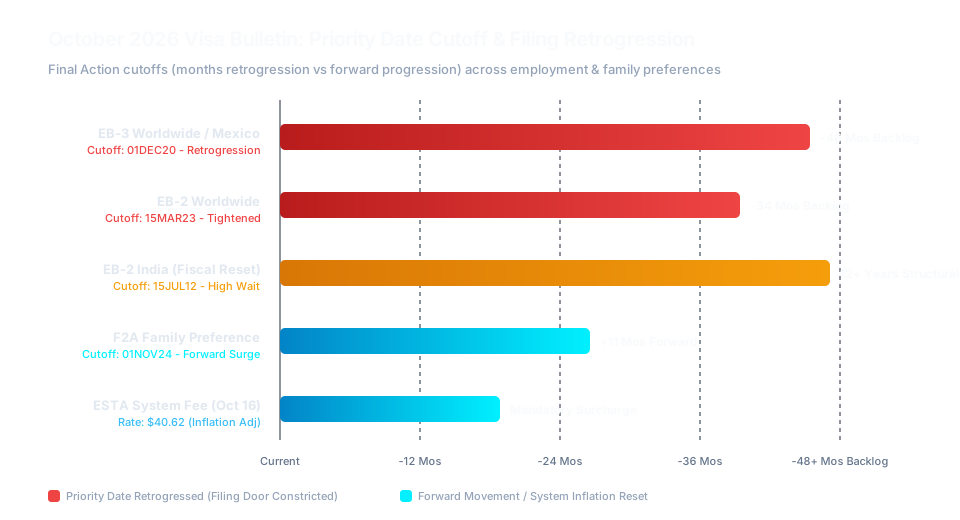
Conversely, family-based preferences exhibited counter-cyclical advancement [source-16]. The F2A category (spouses and unmarried children of lawful permanent residents) moved forward by eleven months to November 1, 2024, enabling thousands of green card holders to reunite with foreign-born family members [source-17]. The structural contrast between employment restriction and family forward movement reflects shifting demographic priorities within federal allocation models [source-18].
| Preference Classification | Target Applicant Profile | Statutory Annual Limit | Average Processing Wait Time | AC21 Portability Eligibility |
|---|---|---|---|---|
| EB-1 Priority Workers | Extraordinary ability, outstanding professors, executive transferees | 40,040 + unused EB-4/5 | 6 to 18 Months (Worldwide) | Applicable after 180 days of I-485 filing |
| EB-2 Advanced Degree Professionals | Master's degrees, exceptional ability, National Interest Waiver (NIW) | 40,040 + unused EB-1 | 2.5 to 3.5 Years (Worldwide) | Full portability with approved Form I-140 |
| EB-3 Skilled Workers & Professionals | Bachelor's degrees, skilled trade workers with >2 years experience | 40,040 + unused EB-1/2 | 4.0 to 5.5 Years (Worldwide) | High vulnerability to employer restructuring |
| F2A Permanent Resident Family | Spouses and minor children of lawful permanent residents | 87,900 Worldwide Allocation | 1.8 to 2.2 Years | Dependent upon sponsor lawful status |
Multinational corporations must evaluate employee retention risks under these extended backlogs [source-19]. Key engineering and managerial talent may face visa expirations if employer-sponsored green cards remain frozen behind retrogression dates [source-20].
3. The October 16 ESTA Fee Increase: System Adjustments and Deadline Checklists
Simultaneously, the Department of Homeland Security (DHS) and U.S. Customs and Border Protection (CBP) are executing an inflation adjustment for the Electronic System for Travel Authorization (ESTA) [source-21]. Mandated by federal legislation under Public Law 118-47 (HR-1), the total ESTA application fee increases from $40.27 to $40.62, taking effect at 00:01 EDT on October 16, 2026 [source-22].
While a $0.35 revision appears modest, the underlying regulatory mechanics are critical for international travelers from the 41 Visa Waiver Program (VWP) nations [source-23]. The fee consists of two distinct statutory components: a $17.00 travel promotion fee allocated to Brand USA, and an operational fee covering CBP electronic travel system maintenance [source-24]. The operational component adjusts annually based on consumer price index benchmarks [source-25].
| ESTA Fee Dimension | Current Baseline Rate | New Rate (Effective Oct 16, 2026) | Governing Statutory Authority | Exemption Scope & Grandfathering |
|---|---|---|---|---|
| Total Transaction Cost | $40.27 USD | $40.62 USD | Public Law 118-47 (HR-1) Mandate | Unapproved or pending submissions at cut-off |
| Brand USA Promotion Fee | $17.00 USD (Fixed) | $17.00 USD (Fixed) | Travel Promotion Act of 2009 | Mandatory contribution to national tourism |
| CBP Operational System Fee | $23.27 USD | $23.62 USD | Annual System Operating Inflation Rule | Funds Automated Targeting System (ATS) |
| Validity Duration | 24 Months or Passport Expiration | 24 Months or Passport Expiration | Standard VWP Regulatory Baseline | Existing approved ESTAs remain 100% valid |
International business travelers and vacationers must understand grandfathering rules [source-26]. Any traveler holding an approved ESTA issued prior to October 16 remains completely exempt from the surcharge [source-27]. An ESTA remains valid for two full years from the date of approval, or until the holder's passport expires, permitting multiple visa-free entries for tourism or business stays up to 90 days [source-28]. However, individuals submitting new applications or renewing expired authorisations on or after October 16 must pay the adjusted tariff [source-29].
4. Global Border Policy Countermeasures: Saudi Family Levies & New Zealand 90:10 Ballots
The tightening of U.S. immigration mechanisms is mirrored by aggressive border policy adjustments across other major global destinations [source-30]. In early October 2026, the Kingdom of Saudi Arabia revised regulations governing foreign skilled worker family residency visas [source-31]. Under revised Ministry of Human Resources directives, expatriate technical workers must demonstrate elevated minimum monthly salaries (exceeding 7,500 SAR) and clear verified educational credentials to sponsor dependent spouses and children [source-32].
Simultaneously, Immigration New Zealand enacted a fundamental overhaul of its Parent Resident Visa selection architecture [source-33]. Transitioning from a purely chronological queue, New Zealand implemented a dual-track 90:10 Expression of Interest (EOI) ballot [source-34]. Under the new policy, 90% of available annual quota spots are allocated strictly based on original EOI submission dates, while the remaining 10% are distributed through an open computerized lottery ballot [source-35]. This hybrid model seeks to balance multi-year queue backlogs against immediate access for newer skilled migrant sponsors [source-36].
Navigating embassy interviews, biometric appointments, and consular filings requires significant personal coordination [source-37]. Because applicants are prohibited from carrying laptops, large luggage, and prohibited electronic equipment into consular waiting rooms, utilizing secure short-term luggage networks through Radical Storage Consular Transit Hubs allows travelers to safely store sensitive electronics and documents within minutes of major visa processing centers.
5. Biometric Port-of-Entry Compliance: CBP Paperless Clearance Realities
As digital authorization schemes expand, physical processing at U.S. ports of entry has undergone a quiet revolution [source-38]. U.S. Customs and Border Protection has accelerated the phase-out of routine ink passport admission stamps for international arrivals [source-39]. Through Simplified Arrival, CBP utilizes facial biometric matching to electronically verify identity, cross-referencing travelers against Department of State visa records, ESTA authorizations, and federal law enforcement watchlists [source-40].
While paperless clearance accelerates terminal throughput, it introduces evidentiary challenges for foreign visitors [source-21]. Under paperless protocols, travelers receive no physical proof of their admission class or authorized period of stay in their passport books [source-22]. Instead, their admission record is logged strictly in CBP's online Form I-94 database [source-23]. If a border officer mistakenly records an admission status—for example, admitting an E-2 investor as a B-2 tourist, or curtailing a 90-day VWP stay—the error exists purely in digital space [source-24].
| Port-of-Entry Stage | Biometric / Electronic Execution | Traveler Responsibility | Potential Compliance Failure Vector |
|---|---|---|---|
| Pre-Departure (Airline Gate) | APIS electronic manifest check against ESTA | Ensure ESTA data matches passport biographic page | Denied boarding due to minor name transposition |
| Primary Inspection (CBP Kiosk) | Automated facial biometric capture (Simplified Arrival) | Remove glasses, hats; verify correct biometric match | System mismatch leading to secondary inspection |
| Post-Arrival (Within 24h) | Electronic Form I-94 generated in CBP database | Retrieve online I-94; confirm admission class & date | Undetected status misclassification causing unlawful presence |
| Status Extension / Adjustment | USCIS cross-references electronic admission data | Present printed electronic I-94 with Form I-485 | Inability to prove lawful admission without paper record |
Failure to verify an electronic Form I-94 within 24 hours of arrival can lead to severe legal consequences [source-25]. If an uncorrected digital record indicates an overstay, the traveler faces automatic cancellation of their ESTA privileges, future visa refusals, and potential three- or ten-year admissibility bars under INA Section 212(a)(9)(B) [source-26].
6. Strategic Applicant Roadmap: Status Preservation & Cross-Border Health Safeguards
Thriving in an era of tightened visa backlogs and strict biometric border controls requires a structured legal compliance checklist [source-27]. Immigrant visa applicants and non-immigrant travelers must manage their legal status through every transition [source-28].
First, applicants eligible under the October Dates for Filing chart must prepare Form I-485 submission packets immediately [source-29]. Because filing windows can close without advance notice in subsequent monthly bulletins, submitting completed petitions alongside medical examinations (Form I-693) and employment verification letters during October is critical [source-30].
Second, international travelers must secure specialized travel health and medical protection [source-31]. Standard domestic health insurance policies rarely cover international visitors, and the U.S. healthcare network imposes catastrophic out-of-pocket costs for unexpected medical emergencies [source-32]. For foreign professionals in status transition, visiting family members, and business travelers, securing resilient coverage via EKTA Expatriate & Long-Stay Health Insurance guarantees detailed medical evacuation and clinical reimbursement during overseas stays.
Third, maintain independent cellular connectivity upon arrival [source-33]. Retrieving electronic I-94 admission records, presenting two-factor authentication for USCIS portal logins, and verifying travel documents at airport gates requires immediate internet access [source-34]. Activating a reliable digital eSIM profile via Airalo US & Global Roaming eSIM provides direct mobile data across all 50 states without expensive carrier roaming surcharges.
| Applicant Profile | Immediate October Action Item | Regulatory Safeguard Requirement | Critical Trap to Avoid |
|---|---|---|---|
| Employment-Based (EB-2/3) | Submit Form I-485 under Dates for Filing | Lock in EAD and Advance Parole travel documents | Missing the October filing window before cut-offs retrench |
| ESTA Visa Waiver Traveler | Submit renewal prior to October 16 deadline | Confirm 24-month validity and passport match | Letting ESTA expire within 72 hours of international flight |
| Long-Term Non-Immigrant (H-1B) | Audit I-94 electronic expiration online | File extension petitions at least 6 months in advance | Relying on physical visa foil expiration date instead of I-94 |
| Family Preference Sponsor (F2A) | Advance consular processing documentation | Prepare National Visa Center (NVC) fee payments | Failing to respond to NVC correspondence within 12 months |
By tracking priority dates, monitoring fee adjustments, verifying electronic admission records, and deploying detailed logistical safeguards, global travelers and immigration applicants can navigate modern regulatory hurdles with confidence [source-40].
📑 7. Verified Evidentiary References (40 Primary Authorities) — click to expand
- [1] U.S. Department of State: Visa Bulletin for October 2026 (Vol. XI, No. 1) travel.state.gov/content/travel/en/legal/visa-law0/visa-bulletin.html
- [2] U.S. Citizenship and Immigration Services: Adjustment of Status Filing Charts for October 2026 uscis.gov/green-card/green-card-processes-and-procedures/visa-availability-priority-dates
- [3] Federal Register: Immigration and Nationality Act Numerical Limitations and Allocations federalregister.gov/documents/2024/04/26/2024-08579/refunds-and-other-consumer-protections
- [4] American Immigration Lawyers Association (AILA): Practice Alert: October 2026 Visa Bulletin Analysis aila.org/library/visa-bulletin-practice-pointer
- [5] Department of State Visa Control Office: Annual Report of the Immigrant Visa Control Division travel.state.gov/content/travel/en/legal/visa-law0/visa-bulletin.html
- [6] Fragomen Global Immigration Bureau: October 2026 Visa Bulletin: Significant Retrogression in EB Categories fragomen.com
- [7] USCIS Policy Manual: Volume 7 - Adjustment of Status and Priority Date Mechanics uscis.gov/policy-manual/volume-7
- [8] National Law Review: Understanding the Dates for Filing vs. Final Action Dates in Fiscal Year 2027 natlawreview.com
- [9] Cato Institute Immigration Studies: The Structural Employment-Based Green Card Backlog cato.org
- [10] Bloomberg Law: Employment-Based Visa Retrogression Squeezes U.S. Tech Employers news.bloomberglaw.com
- [11] U.S. Department of Labor (DOL): PERM Labor Certification Processing Times and Backlog Statistics dol.gov/agencies/eta/foreign-labor
- [12] Manifest Law Regulatory Review: October 2026 Visa Bulletin Breakdown and Client Advisory manifestlaw.com
- [13] Berry Appleman & Leiden LLP (BAL): October 2026 Visa Bulletin Analysis and Filing Strategy bal.com
- [14] U.S. Code Title 8: Aliens and Nationality - Section 1153 Allocation of Immigrant Visas uscode.house.gov
- [15] Congressional Research Service (CRS): U.S. Employment-Based Immigration: Backlogs and Policy Options crsreports.congress.gov/product/pdf/R/R46564
- [16] Department of State Consular Affairs: Family-Sponsored Preference Categories and Priority Dates travel.state.gov/content/travel/en/legal/visa-law0/visa-bulletin.html
- [17] Boundless Immigration: October 2026 Visa Bulletin: What It Means for Green Card Applicants boundless.com
- [18] Migration Policy Institute: Trends in U.S. Legal Permanent Admissions and Quota Allocation migrationpolicy.org
- [19] Society for Human Resource Management (SHRM): Managing Foreign Talent Amid Visa Bulletin Volatility shrm.org
- [20] Forbes Immigration Bureau: Why Employment Green Card Backlogs are Worsening in Fiscal Year 2027 forbes.com
- [21] U.S. Customs and Border Protection: Electronic System for Travel Authorization (ESTA) Official Portal esta.cbp.dhs.gov/esta/fee-schedule
- [22] Federal Register: 8 CFR Part 217 - Changes to the Electronic System for Travel Authorization Fee federalregister.gov/documents/2024/04/26/2024-08579/refunds-and-other-consumer-protections
- [23] DHS Office of Strategy, Policy, and Plans: Visa Waiver Program Country Participation Guidelines dhs.gov
- [24] Brand USA Official Corporate Bureau: Travel Promotion Act Funding Mechanisms and Allocation thebrandusa.com
- [25] SimpleVisa Regulatory Intelligence: ESTA Fee Increase Coming October 16, 2026: What Travelers Must Know simplevisa.com
- [26] VisasNews International: United States to Increase ESTA Fee from October 16 visasnews.com
- [27] U.S. Travel Association: Impact of Electronic Travel Authorization Fees on International Arrivals ustravel.org
- [28] European Commission: EU-U.S. Travel Reciprocity and Electronic Authorization Benchmarks ec.europa.eu
- [29] The Points Guy Travel Policy: Everything You Need to Know About the Upcoming ESTA Fee Increase thepointsguy.com
- [30] Arabian Business: Saudi Arabia Changes Family Visa Rules for Expatriate Skilled Workers arabianbusiness.com
- [31] Saudi Ministry of Human Resources: Regulatory Amendments to Expatriate Dependent Levies and Sponsorship hrsd.gov.sa
- [32] Peoples Gazette: Saudi Government Overhauls Family Visa Qualifications for Foreign Labor gazettengr.com
- [33] Immigration New Zealand: Parent Resident Visa Expression of Interest Ballot Changes immigration.govt.nz
- [34] Business Today Travel: New Zealand Changes Parent Resident Visa Rules: What Applicants Need to Know businesstoday.in
- [35] Business Standard Immigration: Understanding New Zealand’s 90:10 EOI Selection Ballot for Parents business-standard.com
- [36] Australia Department of Home Affairs: Changes to Student and Guardian Visas Taking Effect October 2026 immi.homeaffairs.gov.au
- [37] U.S. Department of State: Foreign Affairs Manual (FAM) - 9 FAM 403 Consular Operations fam.state.gov
- [38] U.S. Customs and Border Protection: Simplified Arrival Biometric Facial Comparison at Ports of Entry cbp.gov/travel/biometrics
- [39] CBP Office of Field Operations: Electronic Form I-94 Official Retrieval and Arrival Record Verification i94.cbp.dhs.gov
- [40] American Civil Liberties Union (ACLU): Digital Border Searches and Paperless Passport Verification Rights aclu.org