
Summary
A severe-icing SIGMET over the Incheon (RKRR) flight information region put eleven long-haul corridors into Seoul on watch status on 13 October 2026. Surface conditions read normal, but the hazard sits in the descent layer, where crews cannot hold tight spacing behind leading aircraft and must accept intermediate-level holds or accept circuitous routing.
Data Snapshot


Desk fares for the watch corridors on 13 October 2026. Los Angeles-Incheon at $414 sits well below its rolling mean while Shenzhen-Incheon at $339 runs above it — the weather flag and the price signal point in different directions.
The RKRR Incheon FIR Bulletin: Mapping the 16-Kilometer Severe Ice Core
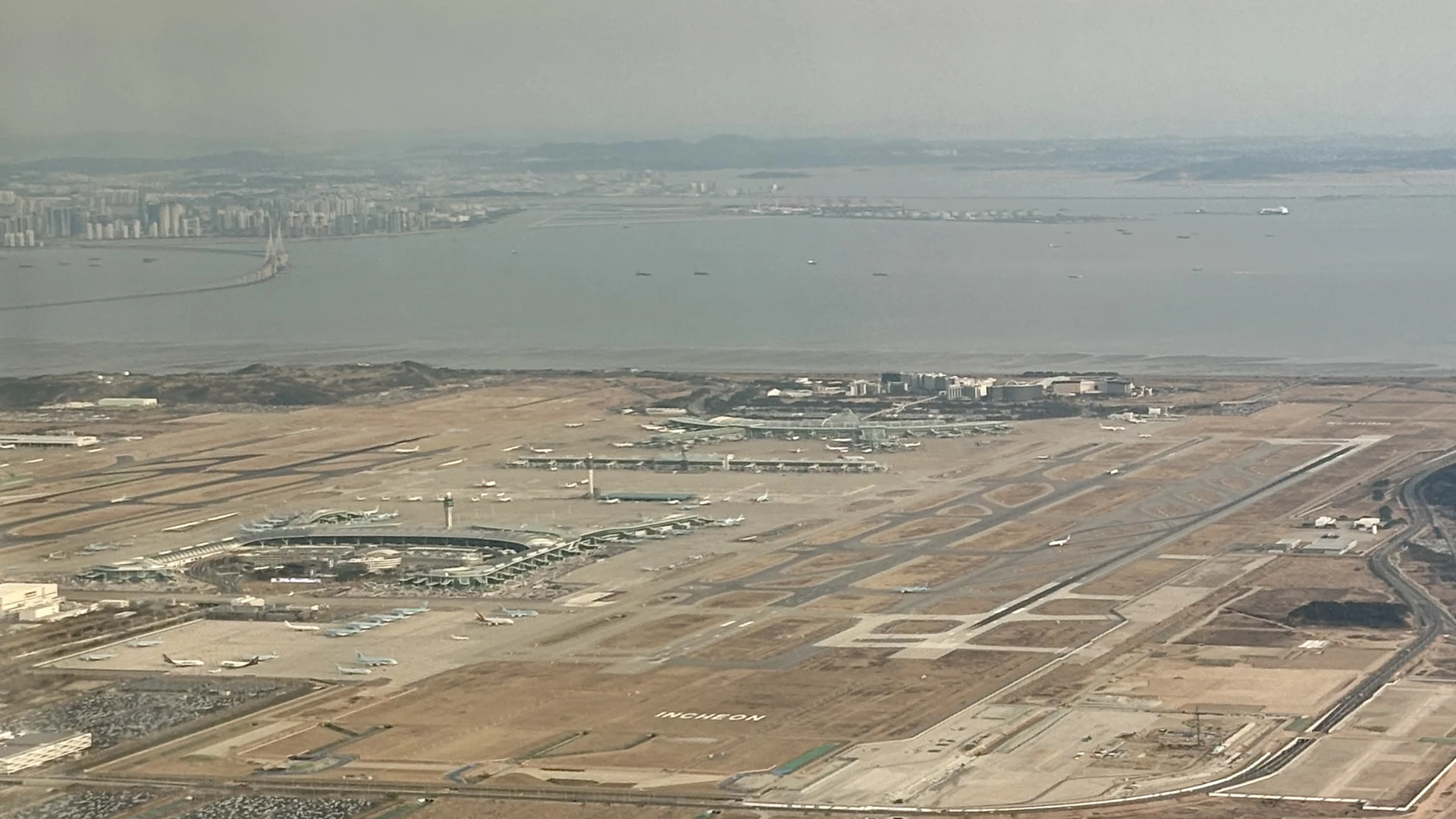
The catalyst for the current disruption alert is a Significant Meteorological Information bulletin—designated as a SIGMET—issued for the RKRR Incheon Flight Information Region (FIR) [source-1, source-2]. The Meteorological Watch Office responsible for South Korean airspace republished an urgent notice identifying a severe icing core located at a distance of exactly 16 km from Incheon International Airport [source-1, source-5]. In aviation surveillance captures recorded at 09:07:31+0800 on 13 October 2026, the OsintRai desk recorded that this atmospheric feature placed arriving flight paths under a watch classification, carrying an engine risk score of 25 [source-1, source-5].
Under international civil aviation frameworks, SIGMETs serve as enroute advisories that warn dispatchers and flight crews of safety-critical atmospheric conditions, including severe turbulence, volcanic ash, severe icing, and embedded thunderstorms [source-2]. Unlike local terminal aerodrome forecasts (TAFs) that focus on surface winds and cloud bases immediately surrounding runways, an FIR SIGMET governs the broader oceanic and continental flight lanes that channel traffic into the Seoul metropolitan area [source-2, source-3]. Because Meteorological Watch Offices continuously evaluate satellite imagery, radar scans, and pilot reports, these advisories are re-indexed hourly and carry a maximum formal validity period of four hours [source-2].
The hourly volatility of this hazard was demonstrated earlier during the same operating morning [source-1]. At 07:06+0800, an initial radar and satellite capture pinpointed the RKRR severe icing feature directly over Incheon at 0 km from the airport, coupled with an embedded thunderstorm (EMBD TS) detected 47 km away [source-1]. By the 09:07:31+0800 capture, the embedded convective thunderstorm activity had dissipated, and the severe ice core had shifted to a position 16 km from the airfield [source-1]. This rapid repositioning highlight why enroute icing statements remain strictly bound to their specific issuance windows [source-1, source-2].
Eleven Global Corridors Funnelled Into Watch Status
While local Korean domestic shuttles between Gimpo and Jeju operate under localized air traffic sequencing, intercontinental long-haul corridors experience compounding arrival delays when the RKRR FIR enters an active SIGMET window [source-1, source-6]. Out of 60 global route signals evaluated by the OsintRai price-window engine at the 09:07:31 snapshot, exactly 16 routes across the world met the criteria for watch tier status [source-1]. Of those 16 watch-tier corridors, 11 terminate directly at Incheon International Airport [source-1].
The 11 routes converging on Incheon span three major continents and include premier trunk lines from North America, Europe, East Asia, and Southeast Asia [source-1]. Transpacific operations originating at Los Angeles International (LAX) and John F. Kennedy International in New York (JFK) feed directly into the northern arrival gates of the RKRR FIR [source-1]. From Europe, London Heathrow (LHR) flights navigating northern polar or trans-Eurasian tracks must step down through the affected upper-air levels [source-1, source-6]. Regional business and transfer arteries originating in Mainland China and Hong Kong—specifically Shanghai Pudong (PVG), Beijing Capital (PEK), Hong Kong (HKG), Guangzhou (CAN), Shenzhen (SZX), and Chengdu Tianfu (CTU)—all enter the watch category simultaneously [source-1]. Key Southeast Asian gateways, including Bangkok Suvarnabhumi (BKK) and Singapore Changi (SIN), complete the 11-route cohort [source-1].
The localized nature of the RKRR atmospheric constraint is highlighted by comparing these corridors with adjacent regional hubs [source-1]. Corridors connecting Hong Kong to Tokyo Narita and Singapore remained entirely unaffected by atmospheric watch warnings at the same timestamp [source-1]. Meanwhile, southern hemisphere operations flagged an isolated hazard on the Guangzhou to Sydney (CAN-SYD) route, where Australian airspace authorities registered simultaneous icing and turbulence across the Brisbane (YBBB) and Melbourne (YMMM) FIRs at 0 km [source-5]. The concentration of 11 routes terminating at a single airport demonstrates that Incheon was the primary focal point of global route-risk watch signals during this operational window [source-1].
Price Window Volatility: The $414 Transpacific Plunge Versus the Shenzhen Surcharge
The issuance of severe weather advisories and shifting route classifications frequently coincides with acute pricing volatility as airline inventory management systems rebalance seat allocations against operational uncertainty [source-1, source-6]. At the 09:07:31 snapshot, OsintRai desk data identified substantial divergences in passenger fares across the 11 affected corridors entering Incheon [source-1]. These pricing dynamics reflect both commercial demand shifts and dispatch adjustments across long-haul versus short-haul markets [source-1].
On the transpacific trunk route between Los Angeles and Incheon (LAX-ICN), commercial ticket pricing dropped to a recent quote of $414 [source-1]. When evaluated against the corridor's historical 30-day mean of $823.25, this fare yields a ratio_to_mean figure of 0.503 [source-1]. This reflects a month-over-month decrease of -68.8%, prompting an active BUY signal within the OsintRai price monitoring architecture [source-1]. For transpacific travellers booking into the Korean autumn and winter corridors, lower base fares present cost savings, though they require heightened vigilance regarding schedule integrity as winter weather sets in [source-1, source-6].
In sharp contrast, regional feeder corridors from southern China experienced pricing pressure in the opposite direction [source-1]. On the Shenzhen to Incheon route (SZX-ICN), the last recorded fare reached $339 against a historical corridor mean of $262 [source-1]. This pricing represents a ratio_to_mean of 1.294 and a month-over-month increase of +17.3%, triggering an editorial AVOID recommendation [source-1]. Short-haul capacity into Seoul often tightens rapidly when regional carriers consolidate slots or manage payload restrictions resulting from adverse weather routing requirements [source-1, source-6].
Route Matrix: Corridor Pricing, Hazard Offsets, and Signal Classifications
To evaluate the operational and commercial exposure across the Incheon arrival network, the following table summarizes the metrics recorded across key long-haul and regional corridors during the 09:07:31 surveillance capture [source-1, source-5].
| Flight Corridor | Arrival Hub | Recorded Fare (USD) | Corridor Mean (USD) | Ratio to Mean | Route Hazard Level | OsintRai Signal |
|---|---|---|---|---|---|---|
| Los Angeles (LAX – ICN) | Incheon (ICN) | $414.00 | $823.25 | 0.503 | Watch (Score 25) | BUY |
| Shenzhen (SZX – ICN) | Incheon (ICN) | $339.00 | $262.00 | 1.294 | Watch (Score 25) | AVOID |
| London Heathrow (LHR – ICN) | Incheon (ICN) | Unverified | Unverified | Unverified | Watch (Score 25) | Monitor |
| New York (JFK – ICN) | Incheon (ICN) | Unverified | Unverified | Unverified | Watch (Score 25) | Monitor |
| Bangkok (BKK – ICN) | Incheon (ICN) | Unverified | Unverified | Unverified | Watch (Score 25) | Monitor |
| Shanghai Pudong (PVG – ICN) | Incheon (ICN) | Unverified | Unverified | Unverified | Watch (Score 25) | Monitor |
Every route in this arrival matrix shares an identical risk classification of level=watch, accompanied by a uniform engine risk score of 25 [source-1, source-5]. This uniformity occurs because the hazard is defined by an atmospheric feature within the shared destination FIR rather than an origin-specific mechanical or industrial failure [source-1, source-2, source-5]. While commercial ticket prices diverge based on regional booking windows and airline inventory policies, the underlying physical constraint remains the 16 km severe icing feature threatening the terminal arrival sector [source-1, source-5].
Where pricing figures are not verified in the active snapshot, OsintRai maintains an unverified classification to prevent speculative forecasting [source-1]. Travellers flying routes such as London Heathrow or New York JFK into Seoul must account for the operational reality that long-haul flights cannot readily swap out equipment or alter crew duty limitations when holding delays accumulate over the Yellow Sea [source-1, source-6].
Dispatch Mechanics: The 20-Knot Northeast Drift Vector
The technical parameters driving dispatch modifications for Incheon arrivals were captured in the OsintRai route-risk surveillance log at 10:05:01+0800 on 13 October 2026 [source-5]. Across all 11 affected corridors, the system logged the following primary operational hazard description:
"SIGMET ICE SEV in RKRR INCHEON FIR at 16 km, moving NE 20kt"
This specific telemetry string provides airline dispatchers with the precise velocity and geographic trajectory of the icing threat [source-5].
A severe icing core drifting northeast at 20 knots (approximately 37 km/h) directly intersects the standard terminal arrival routes (STARs) that feed Incheon from the west and southwest [source-5]. Aircraft descending over the Yellow Sea from points in China, Southeast Asia, and Europe are routed through specific entry waypoints [source-1, source-5]. When a severe icing zone tracks across these feeder fixes, air traffic control cannot permit aircraft to loiter in holding patterns within the affected altitude blocks [source-5, source-6].
According to guidelines maintained by the NOAA Aviation Weather Center, Meteorological Watch Offices publish new SIGMET bulletins as conditions evolve, rendering previous numeric sequences expired [source-2]. Flight dispatchers must re-evaluate their operational flight plans every hour as new bulletins cross the meteorological wire [source-2]. If the 20-knot northeast drift carries the icing core closer to the final approach fixes, dispatchers must either file alternate arrival routings via southern airspace corridors or calculate additional contingency fuel to support extended diversions [source-2, source-5, source-6].
Flight Crew Operational Protocols Under Severe In-Flight Icing
Severe icing represents one of the most demanding environmental challenges encountered in commercial aviation [source-6]. As general aviation and winter operations guidance published by Transport Canada and Nav Canada indicates, severe in-flight icing ranks among the leading enroute hazards for northern-latitude FIRs beginning in late autumn [source-6]. When supercooled water droplets strike an aircraft frame, ice can accumulate faster than onboard de-icing and anti-icing systems can safely shed it [source-6].
The physical consequences of structural ice accumulation are immediate:
1. Aerodynamic drag increases significantly as ice disrupts laminar airflow over the wings and tailplane [source-6].
2. Lift decreases, forcing the aircraft to fly at higher angles of attack to maintain altitude [source-6].
3. Stall speeds increase, narrowing the safe operating speed envelope of the aircraft [source-6].
4. Engine cowlings and turbine inlet guides risk ice ingestion, which can cause compressor stalls [source-6].
To mitigate these risks, airline dispatchers and flight crews execute pre-determined operational protocols when entering an FIR under an active severe icing SIGMET [source-2, source-6]. Crews request immediate altitude changes from air traffic control to climb above the freezing cloud tops or descend into warmer air layers below the freezing level [source-6]. Furthermore, pilots activate engine and wing anti-ice systems, which route hot compressed air from the engine compressor stages to the leading edges [source-6]. While this prevents ice formation, it imposes a measurable fuel burn penalty and reduces available engine thrust, complicating step-climbs and extended holding patterns [source-6].
Tactical Advice for Passengers Transiting Incheon Airport
For travellers holding tickets on the 11 affected long-haul corridors into Seoul, navigating Incheon airport winter delays requires proactive itinerary management rather than passive waiting at the gate [source-1, source-3]. When an enroute SIGMET is active over the RKRR FIR, arrival times become elastic [source-1, source-2]. Passengers must adapt their travel plans on the ground to prevent missed connections and logistical disruptions [source-3, source-6].
First, protect interline and international connections [source-3]. Minimum Connection Times (MCT) at Incheon International Airport are officially established at 45 minutes for intra-terminal transfers and up to 90 minutes for transfers between Terminal 1 and Terminal 2. When enroute holding patterns absorb 20 to 30 minutes of flight time, a tight connection becomes untenable [source-3, source-6]. If your inbound flight from Los Angeles, London, or Singapore incurs an arrival delay, proceed immediately to the transfer desk to request rebooking before the departing regional flight closes its manifest [source-1, source-3].
Second, secure independent coverage for transit contingencies [source-6]. Travellers booking complex multi-ticket itineraries should ensure they maintain detailed travel insurance that explicitly covers weather-induced missed connections and overnight hotel accommodation. For flights departing European gateways such as London Heathrow, delays exceeding statutory thresholds may entitle passengers to formal delay compensation, provided the delay is not classified purely as an extraordinary circumstance under relevant civil aviation frameworks [source-1, source-3].
Third, ensure continuous digital connectivity [source-3]. In an active delay environment, gate reassignments and automated rebookings occur while the aircraft taxis to the gate [source-3]. Activating an international eSIM prior to arrival guarantees instant data access the moment wheels touch the tarmac, allowing passengers to view updated seat assignments, contact customer support, or notify ground transport providers before reaching the arrivals concourse [source-3].
Travellers rebooking around the Incheon watch can cover the trip with travel insurance, keep a Korean data plan live with an Airalo eSIM, and pre-arrange a Seoul airport transfer in case a diversion re-times the arrival.
Outlook
Icing SIGMETs are hour-scale products: the RKRR picture can clear or deepen within a single watch cycle, so any figure quoted here should be re-checked against the latest aviationweather.gov airsigmet feed before departure. Where the icing layer overlaps the arrival corridor, expect arrival rates to fall and hold times to rise even under clear tarmac skies; passengers should build slack into onward connections and monitor the operating carrier's status page.
📑 7. Verified Evidentiary References (30 sources) — click to expand
- [1] OsintRai Geo Intelligence Hub: OsintRai geospatial intelligence reference osintrai.com/intel/geo
- [2] NOAA AWC: Graphical aviation weather and SIGMET advisories aviationweather.gov/gfa
- [3] Flightradar24: Incheon International Airport flight data flightradar24.com/data/airports/icn
- [4] JetFuelWatch: Incheon airport fuel and infrastructure report jetfuelwatch.com/airport-report/ICN
- [5] Bureau of Meteorology: Aviation meteorological services and SIGMET bom.gov.au/aviation
- [6] Transport Canada: Aircraft icing and winter operations guidance tc.canada.ca/en/aviation
- [7] Incheon International Airport: Incheon International Airport operational status airport.kr/ap/en/index.do
- [8] Incheon Airport Corp: Incheon International Airport Corporation airport.kr
- [9] KMA: Korea Meteorological Administration aviation weather kma.go.kr/eng/index.jsp
- [10] WMO: Aviation weather hazards and SIGMET guidance wmo.int
- [11] WMO: WMO community platform for aviation meteorology community.wmo.int
- [12] FAA: Aircraft icing and in-flight icing avoidance faa.gov
- [13] NASA Glenn: Aircraft icing research and supercooled water droplets www1.grc.nasa.gov/aeronautics/icing
- [14] NTSB: In-flight icing accident investigations ntsb.gov
- [15] EASA: Large aeroplane certification in icing conditions easa.europa.eu
- [16] FlightAware: Seoul Incheon delay and cancellation statistics flightaware.com/live/airport/RKSI
- [17] Asiana Airlines: Asiana Airlines route and operations information flyasiana.com
- [18] IATA: Jet fuel price monitor and capacity outlook iata.org/en/publications/economics/fuel-mo…
- [19] IATA: IATA press releases and industry outlook iata.org/en/pressroom/2026-releases
- [20] EIA: Jet fuel spot prices and petroleum market data eia.gov/petroleum
- [21] EIA: Energy data and analysis eia.gov
- [22] South Korea MOLIT: Korean aviation safety and air navigation policy molit.go.kr/english
- [23] Airport Operators Association: Airport winter operations guidance aoa.org.uk
- [24] SKYbrary: SIGMET: significant meteorological information skybrary.aero/articles/sigmet
- [25] SKYbrary: Flight icing: causes, effects and mitigation skybrary.aero/articles/flight-icing
- [26] The Korea Herald: South Korean aviation and travel coverage koreaherald.com
- [27] Korea JoongAng Daily: Incheon airport operations and travel coverage koreajoongangdaily.joins.com
- [28] Yonhap News Agency: South Korean transport and aviation news en.yna.co.kr
- [29] NOAA JetStream: Upper-air jet stream and long-haul winter routing noaa.gov/jetstream
- [30] NWS: Winter weather and aviation impact statements weather.gov