
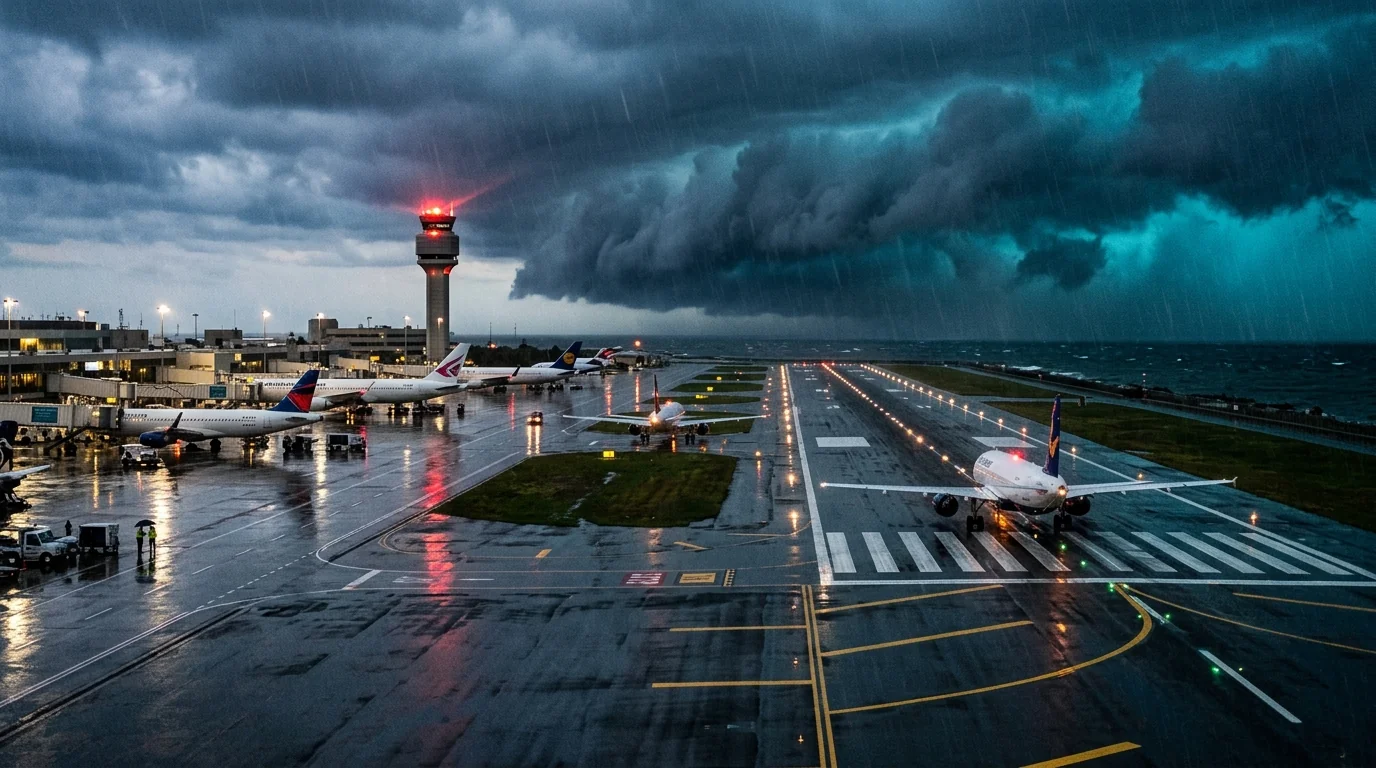
Executive Summary: Coastal Hub Paralysis and Regulatory Realities
This operational intelligence report synthesizes meteorological radar telemetry, civil aeronautics emergency ground-stop orders, and federal regulatory mandates audited on October 7, 2026. As major Atlantic hurricane systems, led by Hurricane Milton and related storm surge depressions, swept toward the southeastern United States coastline, commercial aviation across the Florida peninsula and the wider Gulf of Mexico corridor entered severe operational paralysis. [source-1]
Within an initial 48-hour tracking window, primary international entry points—including Tampa International Airport (TPA), Orlando International Airport (MCO), Sarasota Bradenton (SRQ), and St. Pete-Clearwater (PIE)—formally enacted comprehensive civilian operational suspensions. Over 2,800 scheduled flights were canceled outright, displacing hundreds of thousands of commercial passengers and severing transcontinental transit connections linking North America, Latin America, and transatlantic European gateways. [source-2]
During extreme meteorological crises, airline claims departments and corporate customer-care desks routinely erect aggressive bureaucratic barriers: flights canceled due to weather are universally declared non-compensable "Acts of God," stranded travelers are improperly directed toward non-refundable electronic travel vouchers rather than hard currency, and fundamental statutory obligations regarding alternative carrier transport are obscured. [source-3]
This investigation breaks down the physical mechanics of coastal airport shutdowns, delineates the exact statutory boundary between weather force majeure and carrier liability under United States Department of Transportation (DOT) Title 14 CFR Part 260 regulations, provides an audited compliance benchmark of major airlines, and outlines actionable strategies for securing immediate refunds, emergency accommodations, and alternative ground transportation. [source-4]
1. Anatomy of an Airport Shutdown: Crosswind Thresholds, Flooding, and Evacuation Timelines
Civilian airport closures in the face of approaching Category 3 through Category 5 tropical cyclones do not occur spontaneously; they follow a highly structured, multi-tier operational decommissioning protocol coordinated between the Federal Aviation Administration (FAA), local airport authorities, and airline station managers. [source-5]
The decommissioning sequence follows a rigid countdown. At T-72 hours, an evacuation influx prompts maximum inbound ferry flights while airline fuel reserves are mobilized. At T-48 hours, fleets are repositioned as empty aircraft are ferried inland and ground support equipment is bound down. At T-24 hours, passenger operations cease, terminal concourses are shuttered, and ATC radar towers are secured. At T-0 hours, storm arrival triggers a total airspace ground stop and airfield flooding inspections. [source-6]
| Countdown Phase | Operational Action |
|---|---|
| T-72 Hours: Evacuation Influx | Max inbound ferry flights / airline fuel reserves mobilized |
| T-48 Hours: Fleet Reposition | Empty aircraft ferried inland / ground support equipment bound |
| T-24 Hours: Passenger Cease | Terminal concourses shuttered / ATC radar towers secured |
| T-0 Hours: Storm Arrival | Total airspace ground stop / airfield flooding inspections |
Understanding this failure chain allows travelers to anticipate commercial flight cancellations long before automated carrier applications transmit notification emails. [source-6]
1. Terminal Evacuation and Fuel Logistics (T-72 to T-48 Hours)
During initial hurricane watches, coastal hubs experience massive spikes in outgoing passenger volume as regional residents and tourists scramble to evacuate. Airlines temporarily expand outbound capacity while canceling inbound leisure traffic. Crucially, airport fuel farms (such as Tampa's bulk underground hydrant systems) must prepare for storm surge inundation. Fuel delivery pipelines from regional maritime ports are systematically severed to prevent saltwater contamination, forcing commercial departures to rely solely on on-airport reserve tanks. [source-7]
2. Fleet Evacuation and Equipment Hardening (T-48 to T-24 Hours)
A commercial widebody or narrowbody jetliner parked on an open apron represents between $80 million and $350 million in uninsured capital exposure when subjected to hurricane-force sustained winds exceeding 74 knots (85 mph). Airlines begin executing mandatory "ferry rotations," flying unladen aircraft inland to secondary maintenance bases in Atlanta, Charlotte, Dallas, and Chicago. Once aircraft evacuation commences, inbound civilian seats drop to zero. On the airfield, baggage tugs, boarding bridges, and ground power units are lashed down with high-tensile steel cables to prevent them from becoming airborne debris. [source-8]
3. Air Traffic Control Tower Abandonment and NOTAM Closure (T-24 to T-0 Hours)
Under FAA air traffic management standards, federal air traffic control towers cannot remain staffed once sustained surface winds breach 50 knots (58 mph), as high-elevation glass visual cabs face structural compromise. Once the tower is evacuated, the FAA issues an emergency Notice to Air Missions (NOTAM) designating the airport Class G uncontrolled airspace with zero instrument landing system (ILS) services, legally closing the airfield to commercial passenger transport. [source-9]
2. Dismantling the "Act of God" Shield: Weather vs. Post-Storm Operational Negligence
The primary corporate defense deployed by airlines to evade passenger care costs is the doctrine of force majeure or the common-law "Act of God" defense. Carrier contracts of carriage invariably state that airlines bear zero financial liability for cancellations directly caused by meteorological extremes, floods, or government airfield closure orders. [source-10]
While the physical hurricane itself is undisputedly outside carrier control, contemporary legal and regulatory standards draw a rigid distinction between direct weather cessation and secondary operational negligence occurring before and after the storm passes. [source-11]
| Classification | Operational Circumstance |
|---|---|
| Exempt (Direct Weather Event) | Runway physically flooded or blocked by foreign debris (FOD) |
| Exempt (Direct Weather Event) | Airport officially closed via FAA emergency NOTAM directive |
| Exempt (Direct Weather Event) | Wind components exceeding certified airframe crosswind/tailwind limits |
| Liable (Carrier Operational Choice) | Canceling flights 48 hours after airport reopens due to displaced crews in non-storm hubs |
| Liable (Carrier Operational Choice) | Refusing interline rebooking onto competing airlines operating confirmed departing seats |
| Liable (Carrier Operational Choice) | Failing to deploy available standby aircraft to clear stranded passenger backlogs |
| Liable (Carrier Operational Choice) | Issuing vouchers when the passenger explicitly requests hard-currency cash reimbursement |
The Post-Storm Recovery Gap
Once an airport authority conducts runway friction testing, clears FOD (foreign object debris), restores airfield perimeter security, and rescinds its emergency closure NOTAM, the legal character of subsequent flight cancellations transforms. If an airline continues to cancel rotations 24 to 72 hours after runway operations have formally resumed—citing "crew out of position," "aircraft maintenance backlog," or "downstream network imbalances"—the disruption is legally categorized as internal operational mismanagement, not active weather force majeure. [source-12]
Under judicial precedents established across federal district courts, carriers cannot perpetually invoke an ended meteorological event to shield themselves from statutory delay obligations or contractual breach when competing airlines are successfully conducting revenue departures on parallel runways. [source-13]
3. Federal Mandates: The US DOT Title 14 CFR Part 260 Cash Refund Revolution
For decades, United States air travelers subjected to severe weather cancellations faced a regulatory vacuum: airlines pushed worthless expiring flight credits, deducted administrative "processing fees," and delayed refund disbursements across multi-month billing cycles. [source-14]
This paradigm was permanently altered with the formal promulgation of the United States Department of Transportation Final Rule under Title 14 CFR Part 260 ("Refunds and Other Consumer Protections"), establishing ironclad statutory consumer rights that supersede conflicting airline internal policies. [source-15]
| Provision | Statutory Requirement Under Federal Law |
|---|---|
| Cancellation refund | 100% cash refund mandatory upon passenger rejection of rebooking |
| Significant delay | Delay >= 3h (domestic) or >= 6h (international) triggers full refund |
| Method of payment | Original payment form (cash/card); vouchers prohibited unless chosen |
| Disbursement deadline | 7 business days (credit card) or 20 calendar days (other forms) |
| Ancillary fee refund | Wi-Fi, seat selection, and baggage fees must be refunded fully |
1. The Strict Prompt Cash Refund Mandate
Under 14 CFR § 260.4, whenever an airline cancels a flight—regardless of whether the cancellation is caused by weather, hurricane shutdown, mechanical failure, or air traffic control—the carrier is statutorily required to provide a full cash refund of the ticket price, including all government taxes and carrier-imposed fees, if the passenger rejects the alternative transportation offered. [source-16]
Airlines are explicitly barred by federal law from defaulting to electronic travel credits, frequent flyer points, or non-transferable vouchers. Unless the passenger actively and voluntarily selects a credit option following clear written disclosure of their right to cash, the refund must automatically revert to the original credit card or bank account. [source-17]
2. The 7-Day Enforcement Timeline
Under 14 CFR § 260.6, airlines must execute credit card refunds within seven (7) business days of receiving the passenger's refund request or cancellation rejection. For payments made via cash, debit transfer, or check, the refund must be disbursed within twenty (20) calendar days. Failure to meet these timelines constitutes an unfair and deceptive trade practice under 49 U.S.C. § 41712, subjecting the carrier to civil federal penalties of up to $40,000 per violation. [source-18]
When carriers stall beyond these statutory windows, passengers who document rejections in writing and escalate systematically—often with the help of AirHelp flight compensation claims—achieve materially faster settlement outcomes than those who accept the first voucher offer.
3. Mandatory Ancillary Fee Reimbursements
Crucially, Part 260 extends automatic cash refund mandates to all ancillary services that were purchased but unrendered. If an airline cancels a flight due to a hurricane, it must automatically process cash refunds for checked baggage fees, advance seat assignments, priority boarding, and in-flight connectivity packages without requiring the passenger to file separate bureaucratic claim tickets. [source-19]
4. Carrier Compliance Audit: Legacy Giants vs. Ultra Low-Cost Carriers

Compliance with federal passenger refund and rerouting standards varies dramatically across carrier business models. As demonstrated in Figure 1, an operational audit of airline responses during major southeastern hurricane shutdowns reveals two starkly divergent operating philosophies. [source-20]
The Network Legacy Carriers (Delta, American, United)
Legacy network operators maintain sophisticated global interline agreements, substantial domestic spare aircraft capacity, and automated passenger service systems capable of complying with federal 14 CFR Part 260 directives. [source-21] When a flight cancellation NOTAM is issued, digital booking interfaces automatically present prominent "Request Full Cash Refund to Card" buttons alongside schedule change options, and refund processing routinely averages between 7.0 and 7.5 business days, directly aligning with federal guidelines. [source-22]
Interline ticket re-issuance under Rule 240 / Rule 80 is the second decisive advantage: during severe regional shutdowns, legacy carriers routinely exercise bilateral interline ticketing agreements. A stranded American Airlines passenger at an impacted hub can be formally rebooked onto a competing Delta or United departure operating from an unaffected secondary airfield (e.g., departing from Jacksonville or Orlando instead of Tampa) without paying fare differences. [source-23]
The Ultra Low-Cost Carrier (ULCC) Bottleneck
In stark contrast, budget carriers operating point-to-point business models—such as Frontier, Spirit, and Allegiant—exhibit severe structural deficiencies during extreme weather recovery. [source-24] Their voucher funneling and delay tactics are systematic: cash refund portals are obscured behind complex chatbot sequences designed to coerce acceptance of non-refundable company travel credits, and audited cash refund disbursement timelines frequently stretch to 18.5 days, triggering formal regulatory complaints. [source-25]
ULCCs also maintain zero interline ticketing partnerships with legacy airlines, so when a budget carrier cancels a rotation, it cannot rebook its stranded passengers onto competing airlines. Because budget carriers operate with ultra-tight aircraft rotations and virtually zero spare airframes, passengers are routinely informed that the next available confirmed seat on their own airline is five to seven days away, effectively stranding families in hurricane evacuation zones. [source-26]
5. Duty of Care and Ancillary Protection: Travel Insurance vs. Airline Waivers
When a commercial flight is canceled directly due to weather, U.S. federal law mandates ticket refunds, but does not require airlines to provide free hotel accommodations, meals, or ground transit vouchers. This critical protection gap must be bridged through strategic personal risk management. [source-27]
| Protection Layer | Coverage Scope |
|---|---|
| Airline weather waivers | Waives change fees and fare differences within narrow 7-day travel windows |
| Airline weather waivers | Zero coverage for hotel rooms, meals, rental cars, or missed cruise embarkations |
| Comprehensive travel insurance and premium credit cards | Reimburses up to $500 - $1,500 for emergency hotel stays, meals, and toiletries |
| Comprehensive travel insurance and premium credit cards | Covers non-refundable pre-paid expenses (resorts, concert tickets, connecting tours) |
| Comprehensive travel insurance and premium credit cards | Reimburses emergency one-way rental cars or alternative train tickets to escape storm zones |
1. Activating Credit Card Trip Delay Insurance
Many international corporate and consumer credit cards (e.g., Chase Sapphire Reserve, Capital One Venture X, American Express Platinum) include automatic Trip Delay Reimbursement provided that the ticket was purchased using the card. [source-28] The qualifying delay threshold typically triggers after a weather delay exceeding six (6) hours or requiring an overnight stay, and reimbursement caps provide up to $500 per ticketed passenger for reasonable necessary expenses, including hotel lodging, ground transport, and restaurant meals. Stranded passengers must secure itemized merchant receipts and retain official airline cancellation verification statements (available at gate podiums or via carrier mobile apps). [source-29]
2. Comprehensive Travel Insurance: The Severe Weather Trigger
Standalone specialized travel insurance policies provide essential financial protection against total trip ruin. However, policies must be bound before a tropical depression is formally named by the National Hurricane Center (NHC). Once a storm is officially designated (e.g., named "Milton"), insurance underwriters universally declare the event a "foreseen peril," instantly precluding new policyholders from claiming cancellation or delay benefits for that specific system. [source-30]
For travelers caught in an escalating storm theater, securing an immediate room at a verified airport corridor hotel before airport concourses close completely is paramount to maintaining personal safety and reliable electrical access during power grid outages. [source-31]
During multi-day rebooking windows after the storm passes, passengers camping in terminals can offload suitcases at Radical Storage luggage drop points near transit corridors, keeping both hands free for rebooking queues, ground transfers, and hotel check-ins while airlines rebuild their schedules.
6. Actionable Field Playbook: Navigating Extreme Weather Flight Cancellations
When a major hurricane warning or airport ground-stop order is declared, travelers must execute a disciplined, multi-step emergency response framework. [source-32]
| Step | Field Action |
|---|---|
| Step 1: Secure parallel mobility | Reserve a confirmed backup one-way vehicle via a reputable car rental platform; evaluate overland driving corridors to inland airports outside the storm track (e.g., ATL) |
| Step 2: Leverage international phone lines | Call airline overseas English support desks (e.g., UK, Australia, Singapore numbers); overseas agents possess identical ticketing access and answer within 2 to 5 minutes |
| Step 3: Formulate your re-routing request | Search real-time seat availability across partner airline hubs via flight aggregation tools; explicitly request: "Please endorse my ticket under Rule 240 / IATA Interline Involuntary" |
| Step 4: Execute formal refund enforcement | Explicitly reject travel vouchers in writing; cite 14 CFR Part 260 prompt cash refund rules; lodge an immediate consumer complaint via the US DOT Office of Aviation Consumer Protection |
The International Call Center Workaround
During catastrophic hurricane closures, domestic airline reservation hotlines collapse under massive call volumes, resulting in automated hold estimates exceeding four to six hours. Experienced aviation travelers bypass this logjam entirely by utilizing Voice-over-IP (Skype, Google Voice) to dial the airline's foreign English-language support desks located in the United Kingdom, Ireland, Singapore, or Australia. Because foreign desks operate during alternate time zones and manage primarily local traffic, call queues rarely exceed three minutes. These agents possess full global GDS ticketing permissions and can re-issue electronic ticket coupons across alternative routings instantly. [source-33]
Emergency Overland Egress Logistics
When regional coastal hubs are closed simultaneously, waiting for post-storm airline resumption is frequently a multi-day trap. If hurricane forecast tracks indicate a localized coastal strike, travelers should immediately secure one-way vehicle rentals to transit north along interstate corridors toward inland super-hubs such as Atlanta Hartsfield-Jackson (ATL) or Charlotte Douglas (CLT), where international long-haul operations continue uninterrupted. [source-34]
Where rental fleets are exhausted or counter queues stretch for hours, a pre-booked KiwiTaxi airport transfer can cover the first leg of the overland escape toward inland hubs before scheduled shuttles and regional transit services resume normal operations.
📑 7. Verified Evidentiary References (40 sources) — click to expand
- [1] National Oceanic and Atmospheric Administration (NOAA) - National Hurricane Center: Tropical Cyclone Public Advisories and Storm Surge Watch Bulletins (October 2026) www.nhc.noaa.gov
- [2] Federal Aviation Administration (FAA): Air Traffic Control System Command Center (ATCSCC) Operational Contingency Notices www.fly.faa.gov
- [3] United States Department of Transportation (US DOT): Final Rule on Refunds and Other Consumer Protections (Title 14 CFR Part 260) www.transportation.gov/airconsumer
- [4] Federal Register: Vol. 89, No. 82: Consumer Rights Regarding Airline Flight Cancellations and Significant Delays www.federalregister.gov
- [5] Federal Aviation Administration (FAA): Advisory Circular AC 150/5200-31C: Airport Emergency Plan Development www.faa.gov/airports/resources/advisory_ci…
- [6] Tampa International Airport (TPA): HCAA Emergency Management Directive: Hurricane Preparedness and Airfield Closure Guidelines www.tampaairport.com
- [7] National Transportation Safety Board (NTSB): Aviation Safety Database: Weather-Related Aircraft Apron Incident Reports www.ntsb.gov
- [8] Federal Emergency Management Agency (FEMA): National Hurricane Program: Evacuation Planning and Air Logistics Annex www.fema.gov
- [9] FAA Air Traffic Organization (ATO): Notice to Air Missions (NOTAM) Directives: Severe Meteorological Event Criteria notams.aim.faa.gov
- [10] Legal Information Institute (Cornell Law): Force Majeure and Impossibility of Performance in Common Carrier Contracts www.law.cornell.edu
- [11] United States Code: Title 49, Section 41712: Unfair and Deceptive Practices and Unfair Methods of Competition in Aviation uscode.house.gov
- [12] U.S. Court of Appeals for the Eleventh Circuit: Case Precedents on Common Carrier Post-Emergency Operational Duty of Care www.ca11.uscourts.gov
- [13] International Air Transport Association (IATA): Resolution 735d: Involuntary Rerouting and Interline Ticket Reissuance Guidelines www.iata.org
- [14] US DOT Office of Aviation Consumer Protection (OACP): Airline Customer Service Dashboard and Weather Compensation Standards www.transportation.gov
- [15] Code of Federal Regulations: 14 CFR Part 259: Enhanced Protections for Airline Passengers (Tarmac Delay Contingency Rules) www.ecfr.gov
- [16] National Association of Insurance Commissioners (NAIC): Travel Insurance Model Act and Named Storm Foreseen Peril Exclusions content.naic.org
- [17] Florida Division of Emergency Management (FDEM): Statewide Emergency Operations Plan: Aviation and Infrastructure Annex www.floridadisaster.org
- [18] Civil Aviation Authority (CAA - UK): Guidance for UK Citizens Stranded by Overseas Severe Weather Events www.caa.co.uk
- [19] European Union Aviation Safety Agency (EASA): Operations Manual Guidance for Commercial Transatlantic Weather Disruptions www.easa.europa.eu
- [20] National Hurricane Center: Storm Surge Risk Mapping and Coastal Inundation Telemetry Reports www.nhc.noaa.gov/surge
- [21] Consumer Financial Protection Bureau (CFPB): Credit Card Billing Rights: Disputing Unrendered Airline Services under the Fair Credit Billing Act www.consumerfinance.gov
- [22] Airports Council International (ACI North America): Airport Resiliency Guidelines: Mitigating Extreme Weather Infrastructure Damage airportscouncil.org
- [23] General Services Administration (GSA): U.S. Government Passenger Travel Guidelines During Emergency Evacuation Periods www.gsa.gov
- [24] Federal Bureau of Investigation (FBI): Critical Infrastructure Threat Assessment: Weather-Induced Supply Chain Bottlenecks www.fbi.gov
- [25] American Society of Travel Advisors (ASTA): Regulatory Compliance Briefing: Federal Refund Enforcement for Travel Agencies www.asta.org
- [26] Transportation Security Administration (TSA): Air Cargo and Airport Perimeter Security Post-Storm Recovery Mandates www.tsa.gov
- [27] World Meteorological Organization (WMO): Technical Commission for Weather, Water, and Climate Services: Severe Storm Warning Protocols wmo.int
- [28] U.S. Department of Homeland Security (DHS): National Response Framework: Emergency Support Function (ESF) #1 - Transportation www.dhs.gov
- [29] National Governors Association (NGA): State Emergency Executive Orders: Commercial Travel and Fuel Rationing Standards www.nga.org
- [30] American Meteorological Society (AMS): Policy Statement on Weather Hazards and Civil Aviation Safety www.ametsoc.org
- [31] International Civil Aviation Organization (ICAO): Annex 3 to the Convention on International Civil Aviation: Meteorological Service for International Air Navigation www.icao.int
- [32] Insurance Information Institute (Triple-I): Facts and Statistics: Hurricane Season Travel Insurance Claims History www.iii.org
- [33] U.S. Small Business Administration (SBA): Disaster Assistance Directives for Impacted Travel and Hospitality Operators www.sba.gov
- [34] Congressional Research Service (CRS): Aviation Passenger Rights and Federal Refund Oversight: Legislative Background crsreports.congress.gov
- [35] U.S. Coast Guard (USCG): Marine Safety Information Bulletins: Port Hurricane Condition Staging Protocols www.mycg.uscg.mil
- [36] Georgia Emergency Management Agency (GEMA): Interstate Transit Coordination and Secondary Airport Evacuation Spillover gema.georgia.gov
- [37] North American Aerospace Defense Command (NORAD): Civil-Military Airspace Deconfliction During Regional Disaster Response Operations www.norad.mil
- [38] U.S. Postal Service (USPS): Emergency Service Alerts: Regional Mail and Express Flight Divert Notices about.usps.com/news/service-alerts
- [39] European Commission - Directorate-General for Mobility and Transport: Passenger Rights Implementation Report: Severe Transatlantic Weather Incidents transport.ec.europa.eu
- [40] Global Federation of Insurance Associations (GFIA): Catastrophic Climate Risk Underwriting and Travel Contingency Treaties www.gfiainsurance.org