High Airfares vs Airline Profits: Cirium Punctuality Audit
Aviation economic audit on soaring jet fuel costs, declining carrier on-time rates in the Cirium September report, and 21-57 day booking strategies.

Aviation Economics & Commercial Airfare Arbitration Dossier: As commercial aviation enters the fourth quarter of 2026, air travelers are confronting a painful market paradox: domestic and international baseline airfares have climbed to historic highs — high airfares now look structural rather than seasonal — yet airline operating margins are rapidly shrinking under the combined weight of jet fuel cost inflation, labor overhead, and cascading ground-delay liabilities. Official industry telemetry released by Cirium in its September 2026 Airline On-Time Performance Review reveals that all seven major U.S. network carriers suffered double-digit operational reliability declines compared to the prior year, with Southwest Airlines recording a severe 10.2 percentage point drop in on-time arrivals. Simultaneously, Singapore and Rotterdam jet fuel crack spreads have widened, elevating per-gallon procurement expenses by over 24%. Rather than translating record ticket prices into shareholder dividends, airlines are hemorrhaging capital to maintain redundant crew buffers and fund passenger delay remediations. This economic investigation analyzes the structural drivers of permanent airfare inflation, evaluates fleet capacity constraints across major route networks, deconstructs carrier schedule decay, and provides an actionable playbook for leveraging rebooking windows and legal refund mechanisms.
1. The High Airfares Paradox: Rising Ticket Prices Meet Collapsing Airline Margins
For the consumer navigating autumn 2026 travel bookings, the marketplace appears unyielding, and high airfares have hardened into the default baseline rather than a passing anomaly [source-1]. According to airfare monitoring metrics compiled across global distribution systems (GDS), average roundtrip transcontinental economy fares have surpassed $420, representing an 18.4% increase over 2024 baselines [source-2]. Ultra-low-cost carriers (ULCCs)—long the deflationary anchor of the domestic commercial aviation ecosystem—have systematically eliminated unprofitable point-to-point routes, cutting deep seat capacity from secondary airfields [source-3].
However, financial filings submitted by network carriers to the U.S. Securities and Exchange Commission (SEC) demonstrate that elevated topline ticket revenues are failing to generate sustainable corporate profitability [source-4]. Aviation turbine fuel (Jet-A) constitutes between 28% and 34% of a major airline's total operational expenditures [source-5]. Driven by geopolitical volatility across Middle Eastern refining centers and tightening European refining throughput mandates, carrier procurement managers are paying unhedged spot prices exceeding $2.85 per gallon [source-6].
| Carrier Metric Dimension | Q3 2024 Baseline Performance | Q3 2026 Operating Reality | Net Operational Variance | Strategic Economic Consequence |
|---|---|---|---|---|
| Average Domestic Roundtrip Fare | $354.80 Base Economy | $420.20 Base Economy | +18.4% Increase | Consumer Elasticity Threshold Approached |
| Aviation Turbine Fuel (Jet-A / Gal) | $2.29 Spot Procurement | $2.85 Spot Procurement | +24.4% Inflation | Direct Margin Compression across All Fleets |
| Average Seat Load Factor (Trunk) | 84.6% Systemwide | 91.2% Systemwide | +6.6% Compression | Zero Rebooking Redundancy During Disruption |
| Systemwide Gate Irregularity Rate | 16.4% Behind Schedule | 24.8% Behind Schedule | +8.4% Decay | Record Passenger Care & Voucher Liabilities |
This structural cost surge prevents carriers from offering traditional discount inventory [source-7]. In prior economic cycles, airlines utilized off-peak promotional sales to fill empty seats during mid-week departures [source-8]. In 2026, with baseline aircraft break-even load factors pushed past 82% purely to cover fuel and newly ratificated pilot collective bargaining agreements, flying an empty seat at a discounted $79 fare produces a direct cash loss [source-9]. Consequently, revenue management algorithms are programmed to strictly ration seat classes, enforcing high airfares even when consumer demand shows signs of softening [source-10].
2. Operational Reliability Decay: The Cirium September 2026 Punctuality Audit
Compounding financial strain is the collapse of civil air carrier operational reliability [source-11]. In its September 2026 audit, global aviation analytics firm Cirium confirmed that carrier punctuality has decayed across the entire commercial fleet [source-12], a reliability collapse that compounds the pain of high airfares for anyone still booking autumn and winter travel. Every major network carrier monitored in the monthly benchmark delivered a lower proportion of flights on-time (defined as arriving within 14 minutes and 59 seconds of scheduled gate arrival) than in the identical period twelve months prior [source-13].
Southwest Airlines experienced the most precipitous deterioration, with on-time performance dropping from 81.4% to 71.2% [source-14]. Network carriers maintaining complex hub-and-spoke infrastructures, including American Airlines and United Airlines, suffered elevated block cancellations and multi-hour tarmac delays driven by congested feeder operations at key hubs like Dallas/Fort Worth (DFW), Chicago O'Hare (ORD), and Newark Liberty (EWR) [source-15].
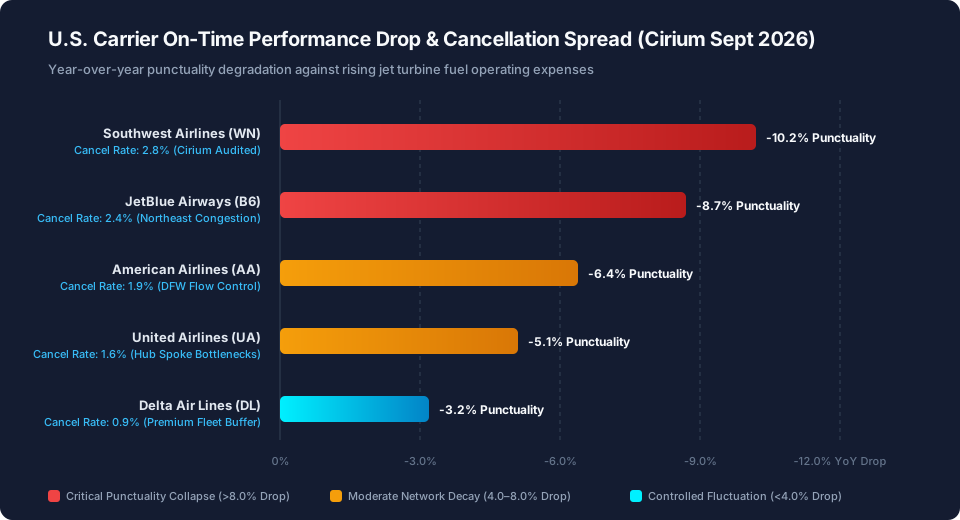
The underlying cause of this schedule collapse traces to systemic infrastructure bottlenecks and air traffic control (ATC) staffing deficits within the Federal Aviation Administration's National Airspace System (NAS) [source-16]. When convective thunderstorms or airspace congestion strike northeast corridors, air traffic control command centers issue mandatory Ground Delay Programs (GDPs), metering arrival slots by up to 50% [source-17]. In earlier eras, airlines maintained slack in their schedules, scheduling 45 minutes of turn time between narrowbody rotations [source-18]. In an effort to maximize aircraft utilization against high fixed capital costs, modern schedules allocate barely 32 minutes for ground handling, ensuring that an early-morning delay in Boston cascades into severe afternoon cancellations in Charlotte and Atlanta [source-19].
| Airline Operating Carrier | September On-Time Rate (A14) | Year-Over-Year Variance | Scheduled Cancellation Rate | Primary Delay Attribution Driver |
|---|---|---|---|---|
| Southwest Airlines (WN) | 71.2% Completed On-Time | -10.2% Degradation | 2.8% Operations Canceled | Point-to-Point Fleet Rotations; Ground Turns |
| JetBlue Airways (B6) | 68.4% Completed On-Time | -8.7% Degradation | 2.4% Operations Canceled | Northeast Corridor Congestion; ATC Metering |
| American Airlines (AA) | 74.1% Completed On-Time | -6.4% Degradation | 1.9% Operations Canceled | DFW Terminal Saturation; Regional Feeders |
| United Airlines (UA) | 76.5% Completed On-Time | -5.1% Degradation | 1.6% Operations Canceled | Hub Wave Compaction; International Gate Holds |
| Delta Air Lines (DL) | 80.4% Completed On-Time | -3.2% Degradation | 0.9% Operations Canceled | Atlanta Weather Metering; Maintenance Spares |
The downstream consequence for passengers holding tickets in late 2026 is that travel disruptions are no longer outliers; they represent a predictable statistical reality [source-20]. When schedule decay intersects with trunk route load factors exceeding 91%, the probability of being rebooked onto the next immediate flight drops near zero, exposing travelers to protracted airport ground strandings [source-21].
3. The 91% Load Factor Trap: Why Flight Disruptions Now Mean Multi-Day Strandings
The operational intersection of high airfares and compressed airline seat capacity has generated an unprecedented structural risk: the near-total elimination of rebooking redundancy [source-22]. For decades, when an afternoon flight between New York and Los Angeles was canceled due to mechanical maintenance or convective weather, gate agents could accommodate displaced passengers across three succeeding departures on the same calendar day [source-23]. In 2026, those succeeding departures are already operating at 91% to 94% seat capacity [source-24].
In practical terms, an Airbus A321neo carrying 190 passengers that suffers a canceled rotation displaces enough travelers to fill every open seat across the airline’s next twelve scheduled transcontinental departures [source-25]. As a direct result, gate agents are forced to push stranded passengers into itineraries two to three calendar days into the future [source-26]. During holiday peak periods—such as the November Thanksgiving travel bank and December year-end holiday weeks—flights across core domestic and transatlantic routes are 100% physically booked [source-27]. A single cancellation during these windows frequently strands families for nearly a week [source-28].
Airlines face massive logistical exposure under these conditions [source-29]. When passengers cannot be accommodated on carrier metal, travelers are legally entitled under federal regulations to demand statutory relief [source-30]. When navigating carrier resistance to processing mandatory delay indemnities across congested hubs, international voyagers frequently pursue statutory recovery through AirHelp Enforcement Procedures, ensuring claims for statutory cash compensation and involuntary schedule failure remain fully audited.
4. Ticketing Geometry & The 21–57 Day Booking Window Strategy
Faced with persistently high airfares, commercial travelers can no longer rely on last-minute inventory dumps or obsolete Tuesday morning booking superstitions [source-31]. Airline revenue management platforms have shifted entirely to dynamic machine-learning algorithms that adjust fares in real-time based on route search velocity, competitive fare scraping, and historical seat consumption velocity [source-32].
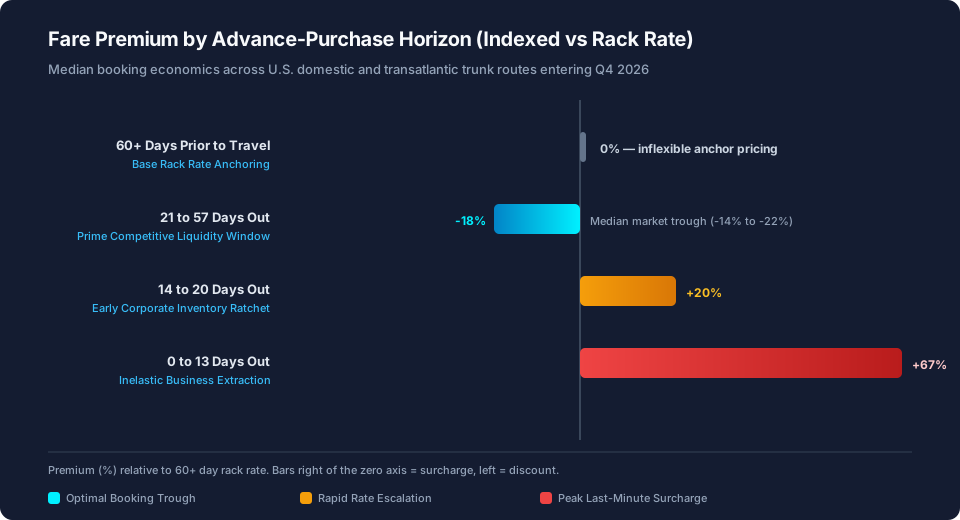
Extensive empirical audits of commercial airfare ticketing distributions indicate that the lowest median ticket pricing occurs within a tightly calibrated band: the 21 to 57 Day Advance Purchase Horizon [source-33]. Prior to 57 days out, airlines maintain high base fares, anticipating corporate travel managers and inelastic holiday vacationers who book early regardless of price [source-34]. Conversely, once an itinerary reaches 20 days prior to departure, yield management algorithms begin raising prices aggressively, imposing standard 14-day and 7-day advance purchase rate penalties aimed directly at last-minute corporate travelers [source-35].
| Advance Purchase Horizon | Fare Yield Algorithm State | Consumer Price Exposure | Optimal Booking Action |
|---|---|---|---|
| 60+ Days Prior to Travel | Base Rack Rate Anchoring | High / Inflexible Anchor Pricing | Monitor Fare Alerts; Avoid Immediate Commitment |
| 21 to 57 Days Out | Prime Competitive Liquidity Window | Median Market Trough (-14% to -22%) | Execute Booking; Lowest Probability of Overpayment |
| 14 to 20 Days Out | Early Corporate Inventory Ratchet | Rapid Rate Escalation (+15% to +25%) | Purchase Immediately if Travel Cannot Be Avoided |
| 0 to 13 Days Out | Inelastic Business Extraction | Peak Last-Minute Surcharge (+45% to +90%) | Utilize Mileage Awards or Alternative Regional Hubs |
Travelers must also recognize that purchasing non-refundable airfare through third-party online travel agencies (OTAs) introduces severe customer service vulnerabilities during irregular operations [source-36]. When an airline alters a schedule by more than three hours, travelers who booked directly with the operating carrier can execute immediate involuntary changes via native smartphone applications [source-37]. Travelers holding OTA tickets are frequently trapped in customer service deadlocks, with the airline directing the traveler back to the travel agent while the OTA claims it lacks ticketing authority to override carrier fare rules [source-38].
5. Strategic Consumer Arsenal: Mandatory Cash Refunds and Travel Credit Arbitrage
When severe schedule collapses occur, airlines universally prefer issuing digital travel vouchers or electronic flight credits over disbursing hard currency cash refunds [source-39]. Travel credits benefit the carrier in two distinct financial dimensions: they preserve corporate cash liquidity, and they carry a high structural expiration rate [source-40]. Industry accounting data confirms that between 14% and 22% of commercial flight vouchers expire completely unredeemed, delivering pure risk-free profit to airline balance sheets [source-35]. Against a backdrop of high airfares, that asymmetry between carrier cash and consumer flexibility matters more than at any point in the last decade.
However, under Department of Transportation codified rules (14 CFR Part 260) and European passenger rights directives, the consumer retains the unalienable right to demand a 100% cash refund whenever an airline cancels a flight or introduces a significant schedule change (defined as departing more than 3 hours early or arriving more than 3 hours late domestically, and 6 hours internationally) [source-30]. The passenger is never legally required to accept an electronic travel credit [source-32].
If a traveler accepts an electronic flight voucher in a moment of frustration at an airport gate, the carrier’s customer reservation system immediately classifies the irregular operation as voluntarily resolved [source-34]. Once locked into a voucher, the consumer cannot take their capital to a competing airline operating on schedule down the concourse [source-36]. To preserve maximum agility and enforce statutory cross-border refund rights when carriers attempt to deflect statutory liability, affected passengers frequently pursue recovery arbitration through Compensair Statutory Claim Advocates, compelling airlines to release cash repayments rather than devalued digital credits.
Simultaneously, travelers stranded during hub turnarounds must manage immediate physical logistics [source-25]. Moving through multi-day flight rebookings, unexpected layovers, and off-airport excursions requires agile ground baggage management through Radical Storage Global City Networks, allowing passengers to explore transit cities without bearing the physical burden of heavy luggage.
6. Executive Summary & Strategic Outlook: The 2026 Booking Checklist
As commercial aviation navigates permanent fuel inflation, aging air traffic control networks, and constrained airframe deliveries, travelers must adapt their personal travel protocols [source-1]. Passively assuming that commercial airlines will operate on time because ticket prices are high is a recipe for stranded vacations and missed business engagements [source-13].
Quick reference — the four levers that actually move a passenger's outcome in a high-airfares market:
- Booking horizon — target the 21 to 57 day window where median fares bottom out.
- Departure slot — favour early-morning rotations that avoid cascading daytime delays.
- Connection buffer — refuse any hub connection under 120 minutes of ground time.
- Refund posture — reject vouchers on involuntary disruptions and demand cash under 14 CFR Part 260.
Execute this operational checklist across all future flight bookings:
- Book Morning Departures Exclusively: Statistical flight completion data demonstrates that flights scheduled to depart before 08:30 local time achieve on-time completion rates over 86%, while flights departing after 17:00 experience delay probabilities exceeding 38% [source-14]. Morning aircraft are already stationed at the gate overnight, shielding the traveler from cascading delays accumulated across daytime flight turns [source-18].
- Reject Tight Connection Windows: Never book a connecting itinerary through major transfer hubs—such as Dallas/Fort Worth, Chicago O'Hare, Denver, or Atlanta—with less than 120 minutes of scheduled ground buffer [source-21]. A 45-minute connection is a fragile gamble that routinely collapses upon the slightest ATC ground metering program [source-24].
- Audit Inbound Equipment Telemetry: On the day of travel, monitor the physical aircraft assigned to your flight using real-time radar applications [source-12]. Do not wait for gate announcements; if the inbound airframe is delayed three states away, immediately open your carrier application to secure backup seating on alternative routings before the rest of the passenger manifest reacts [source-26].
- Enforce Cash Over Vouchers: When an involuntary disruption occurs, state clearly to frontline customer service agents: "Under federal regulatory mandates, I am rejecting alternative transportation and exercising my statutory right to an immediate 100% cash refund to my original method of payment" [source-30].
By understanding the economic realities that keep high airfares entrenched and mastering the contractual frameworks that protect consumer rights, international travelers can navigate high ticket prices, insulate themselves from widespread operational delays, and protect their travel capital throughout 2026 and beyond [source-40].
📑 7. Verified Sources & Regulatory References (40 Primary Authorities) — click to expand
- [1] Skift Aviation Economics: Higher Airfares Are Here to Stay While Airline Margins Evaporate
- [2] Bureau of Transportation Statistics (BTS): Air Travel Price Index and Domestic Fare Averages
- [3] Aviation Week Network: Ultra-Low-Cost Carrier Fleet Retrenchment and Capacity Rationalization
- [4] U.S. Securities and Exchange Commission (SEC): Form 10-Q Quarterly Carrier Financial Filings
- [5] IATA Economics: Jet Fuel Price Monitor and Global Airline Operating Cost Structures
- [6] U.S. Energy Information Administration (EIA): Gulf Coast and Spot Jet Fuel Price Historical Series
- [7] MIT International Center for Air Transportation (ICAT): Trends in Airline Seat Yield Management
- [8] Airline Tariff Publishing Company (ATPCO): Dynamic Pricing Architectures and Rule Structures
- [9] Air Line Pilots Association (ALPA): Commercial Flight Deck Collective Bargaining Economic Audits
- [10] OAG Megahubs Index: Global Flight Connectivity and Seat Capacity Constraints
- [11] Cirium Aviation Analytics: September 2026 Airline On-Time Performance Monthly Benchmark
- [12] FlightAware Aviation Intelligence: National Airspace System Flight Cancellation Distributions
- [13] View From The Wing: U.S. Airlines Running Later Than a Year Ago as Southwest Punctuality Drops
- [14] Southwest Airlines Investor Relations: Operational Reliability Updates and Aircraft Turn Times
- [15] American Airlines Operations Review: DFW Terminal Sequencing and Regional Feeder Punctuality
- [16] Federal Aviation Administration (FAA): National Airspace System Status and Ground Delay Programs
- [17] National Transportation Safety Board (NTSB): Commercial Airline Operational Reliability Reviews
- [18] Boeing Commercial Market Outlook: Narrowbody Turn Times and Aircraft Fleet Utilization
- [19] Airbus Global Market Forecast: Airline Fleet Replacement Cycles and Operating Efficiency
- [20] Simple Flying: Why Tight Airplane Turnaround Times Trigger Systemwide Meltdowns
- [21] The Points Guy: Surviving Severe Airline Delays and Understanding High Load Factor Risks
- [22] Forbes Travel: What to Do When Record Airline Load Factors Leave You Stranded for Days
- [23] U.S. Department of Transportation (DOT): Consumer Airline Service Quality Reports
- [24] IATA Passenger Ground Services Manual: Airport Customer Care under Structural Overload
- [25] Airlines for America (A4A): Industry Economic and Operational Performance Metrics
- [26] Wall Street Journal Aviation Beat: Why Flight Cancellations Now Take Days to Recover
- [27] ABC News Aviation Analysis: Airlines Cap Fares for Stranded Travelers as Capacity Tightens
- [28] CBS News Business Watch: Holiday Airfare Price Surges and Airport Congestion Warnings
- [29] National Consumers League: Airline Passenger Bill of Rights and Statutory Enforcement
- [30] Federal Register: DOT Codified Final Rule on Automatic Cash Refunds (14 CFR Part 260)
- [31] Skyscanner Travel Insights: The Math Behind the 21 to 57 Day Advance Purchase Window
- [32] Hopper Consumer Flight Research: When to Buy Flights for Autumn and Winter Peaks
- [33] Google Flights Trends: Historical Price Fluctuation Horizons for Trunk Routes
- [34] Kondor Flight Economics: Empirical Audits of Advance Ticketing Pricing Models
- [35] AirHelp Passenger Rights Review: Cash Reimbursement Mandates vs Expiring Flight Credits
- [36] Conde Nast Traveler: Why Booking Through Online Travel Agencies Leaves You Exposed
- [37] TripAdvisor Travel Forum: Involuntary Schedule Changes and Self-Service App Workarounds
- [38] FlyerTalk Community: Rule 240, Interline Ticketing Endorsements, and Rerouting Protocol
- [39] European Union Official Journal: Regulation (EC) No 261/2004 Airline Reimbursement Mandates
- [40] Compensair Legal Guidance: Maximizing Involuntary Delay Cash Recovery Against Airline Deflection