
October 19 DOT Flight Delay Refund Rule Playbook
Essential compliance brief on the October 19 U.S. DOT refund mandate: 10 airline delay scenarios requiring automatic cash refunds and rebooking playbooks.
Federal Regulatory Compliance & Airfare Arbitration Brief: On October 19, 2026, the U.S. Department of Transportation (DOT) enacts the DOT flight delay rule, a pivotal regulatory overhaul redefining commercial aviation disruption reporting and airline customer service accountability. While passenger rights advocacy groups have celebrated new federal mandates establishing automatic cash refunds for cancelled airfare, airlines have successfully carved out ten critical disruption categories from the "controllable" delay framework. Events ranging from urgent airworthiness directives to third-party baggage belt collapses are now formally classified as "outside carrier control," legally releasing airlines from voluntary commitments to provide free hotel lodging, meal vouchers, and ground transfers. Simultaneously, domestic holiday airfares have surged to ten-year peaks, while extreme operational meltdowns—such as United Airlines' 12-hour tarmac cancellation on flight IAD–FCO—leave passengers holding depreciated vouchers. This investigation provides strategic analysis of the regulatory shift, the ten exclusion vectors, statutory refund enforcement, holiday pricing dynamics, and practical rebooking frameworks.
1. Regulatory Anatomy: The October 19 Reclassification Shift
Federal oversight of commercial airline performance has long balanced consumer protections against carrier operational realities [source-1]. For decades, the DOT categorized flight delays under four primary reporting buckets: Air Carrier (controllable maintenance, crew rostering, baggage handling), Extreme Weather, National Aviation System (NAS flow control, airport volume), and Security [source-2]. Under the Biden-Harris administration's Executive Order on Promoting Competition in the American Economy, regulators pressed airlines to publish customer service dashboards guaranteeing meals and hotels during controllable disruptions [source-3]. The distinction between a controllable and an exempt delay now carries direct financial consequences for every stranded passenger, and the DOT flight delay rule is the first federal instrument to codify that distinction.
However, the DOT flight delay rule entering full statutory enforcement on October 19, 2026, introduces a sophisticated structural carve-out [source-4]. While codifying strict definitions of "significant delay" (three hours for domestic travel, six hours for international itineraries) that trigger mandatory cash refunds, the regulation fundamentally alters the threshold of controllable responsibility [source-5]. Major U.S. network carriers successfully argued that events driven by external vendors, sudden FAA airworthiness mandates, and passenger medical emergencies should not generate mandatory hotel liabilities [source-6].
| Regulatory Era | Governing Legal Standard | Hotel / Meal Voucher Liability | Cash Refund Trigger Threshold | Carrier Burden of Proof |
|---|---|---|---|---|
| Pre-October 2026 Baseline | Voluntary Airline Customer Service Dashboard Commitments | Mandated for all "Air Carrier Controllable" delays exceeding 3 hours | Inconsistent across carriers; often disguised as travel credits | Low; internal airline reason codes rarely audited in real-time |
| October 19, 2026 Enforcement | 14 CFR Part 259 / Part 260 Codified Federal Regulation | Formally waived across 10 designated external operational vectors | Automatic 100% cash refund within 7 days (credit card) or 20 days (cash) | High; mandatory federal reporting under revised exclusion taxonomies |
| European Standard (EU261) | European Regulation (EC) No 261/2004 Strict Liability | Unconditional Right to Care (hotel/meals) regardless of cause | Statutory right to cash reimbursement plus fixed statutory compensation | Strict; "extraordinary circumstances" exempt compensation but never duty of care |
This regulatory compromise creates a stark divergence between U.S. and European aviation passenger protections [source-7]. Under European Regulation (EC) 261/2004, the airline's duty of care (providing meals, refreshments, and hotel accommodations during extended overnight delays) remains unconditional, even when caused by severe storms or volcanic ash [source-8]. Under the newly enacted U.S. doctrine, carriers are legally permitted to strand domestic passengers overnight with zero complimentary lodging if the delay traces to any of the ten exclusion causes [source-9]. That asymmetry is the defining feature of the DOT flight delay rule.
2. The 10 Carve-Outs: How Airlines Legally Shed Hotel and Meal Obligations
The core of the October 19 regulatory revision rests in the ten designated operational exclusions [source-10]. Previously, if an aircraft developed an unexpected hydraulic sensor malfunction or cracked avionics display at the departure gate, the event was logged as an Air Carrier mechanical failure, requiring the airline to issue meal vouchers and hotel rooms for overnight stranding [source-11]. Each exclusion vector shifts the burden of proof onto the traveler, who must document the root cause before any claim can proceed.
Under the revised framework, unscheduled non-deferrable maintenance—specifically including urgent FAA airworthiness directives (ADs) and mandatory manufacturer safety groundings—is classified as outside carrier control [source-12]. If Boeing, Airbus, or the FAA issues an immediate fleet inspection requirement, airlines can ground airframes without issuing hotel compensation to affected ticket holders [source-13].
Similarly, airport infrastructure failures have been decoupled from airline responsibility [source-14]. If a centralized third-party baggage sorting conveyor system suffers an electrical failure at Denver International Airport (DEN) or Charlotte Douglas (CLT), forcing an airline to cancel evening banks due to displaced passenger luggage, the carrier bears zero regulatory liability for hotel accommodation [source-15]. The ten operational exclusions are formally codified below:
| Number | Excluded Operational Vector | Specific Technical Trigger Definition | Practical Passenger Impact |
|---|---|---|---|
| 1 | Unscheduled Non-Deferrable Maintenance | Mandatory safety grounding or urgent FAA Airworthiness Directive | No complimentary hotel rooms; passengers must arrange private lodging |
| 2 | Medical Emergencies in Transit | Onboard medical intervention or passenger diversion not caused by crew | Gate staff exempt from issuing concessionary meal or accommodation vouchers |
| 3 | Unruly Passenger Extraction | Law enforcement removal and required security deplaning procedures | Rolling departure delays without airline customer service compensation |
| 4 | Compliant Cybersecurity Incidents | Third-party cyber attack where airline maintains NIST federal compliance | Multi-hub system outages treated as force majeure events |
| 5 | Severe Weather Aircraft Damage | Physical airframe damage from microbursts, wind shear, or hail | Overnight cancellations treated under traditional weather exemptions |
| 6 | Foreign Object Debris (FOD) Ingestion | Runway debris engine strikes or structural punctures | Aircraft out-of-service delays exempt from voluntary hotel commitments |
| 7 | Third-Party Baggage System Failure | Terminal sorting infrastructure collapse outside airline direct control | Luggage displacement and connection misconnects self-funded by traveler |
| 8 | Federal Airspace System IT Outages | FAA NOTAM system collapse, radar failures, or telecommunications loss | Widespread national ground stops classified as government disruption |
| 9 | Emergency Brake Overheating | Thermal brake events resulting from mandatory high-speed rejected takeoffs | Extended tarmac returns with zero airline duty of care provision |
| 10 | Post-Fatality Cabin Sanitation | Forensic deep-cleaning following an in-flight passenger death | Extended aircraft swaps exempt from controllable delay service metrics |
Travelers must recognize that while these exclusions eliminate mandatory hotel and meal provisions, the DOT flight delay rule does not waive the passenger's statutory right to demand a 100% cash refund if they refuse the carrier's alternative flight schedule [source-16].
3. Case Forensics: The 12-Hour Tarmac Nightmare and the $175 Voucher Trap
The practical consequences of airline customer service limits are vividly illustrated by recent international tarmac crises [source-17]. In early October 2026, United Airlines flight UA230 from Washington Dulles International Airport (IAD) to Rome Fiumicino (FCO) suffered a cascade of mechanical faults, crew duty-hour expirations, and tarmac ground delays stretching across 12 agonizing hours [source-18]. The UA230 sequence illustrates how a single diagnostic fault can cascade into an overnight stranding with no statutory care obligation.
Passengers boarded the Boeing 777-200ER at 17:45 EDT, only to encounter an auxiliary power unit (APU) pneumatic starter failure [source-19]. Maintenance teams attempted gate repairs, followed by a taxi out to the runway holding pad, where the flight crew subsequently exceeded their mandatory Federal Aviation Regulation (FAR) Part 117 duty time limits [source-20]. The aircraft returned to the terminal, but gate congestion prevented immediate deplaning for several hours [source-21].
| Operational Timeline (UA230 IAD–FCO) | Event Description & Technical Milestone | Carrier Action Taken | Displaced Passenger Experience |
|---|---|---|---|
| 17:45 EDT (T-0:00) | Initial Scheduled Boarding at Dulles Concourse C | Standard passenger boarding completed | Cabin doors closed; pushback cleared |
| 19:15 EDT (T+1:30) | Auxiliary Power Unit (APU) Pneumatic Failure | Aircraft returns to gate for maintenance inspection | Passengers kept onboard in seated cabin |
| 22:30 EDT (T+4:45) | Flight Crew Exceeds FAR Part 117 Duty Limits | Flight grounded pending relief crew availability | Bottled water and minimal snack distribution |
| 02:15 EDT (T+8:30) | Replacement Pilot Rostering Collapses | Tarmac holding delay formal termination | Aircraft towed to remote hardstand holding |
| 05:45 EDT (T+12:00) | Formal Flight Cancellation Declared | Issuance of digital $175 Electronic Travel Certificate | Passengers deplaned into closed terminal without hotels |
Rather than providing overnight hotel accommodations in northern Virginia, the carrier issued passengers a generic $175 Electronic Travel Certificate alongside a voucher for concession food [source-22]. Because the cancellation occurred at 05:45 in the morning, passengers faced depleted hotel inventories and inflated last-minute room rates exceeding $320 per night [source-23]. Under the revised DOT rules, had United attributed the APU pneumatic failure to an urgent manufacturer bulletin, frontline representatives could legally refuse even the concession voucher [source-24].
Crucially, passengers who accept an electronic flight voucher often waive their underlying legal claim to a cash refund [source-25]. Once an electronic credit is deposited into a loyalty account, customer service systems mark the reservation as "voluntarily resolved," locking the consumer into future travel on the same airline [source-26]. To enforce statutory rights across complex international cancellations, passengers must navigate regulatory escalation mechanisms through the AirHelp Enforcement Protocol, ensuring that legal claims for cash refunds and cross-border statutory remedies remain fully preserved.
4. Cash Refund vs. Travel Voucher Economics: The Statutory Guarantee
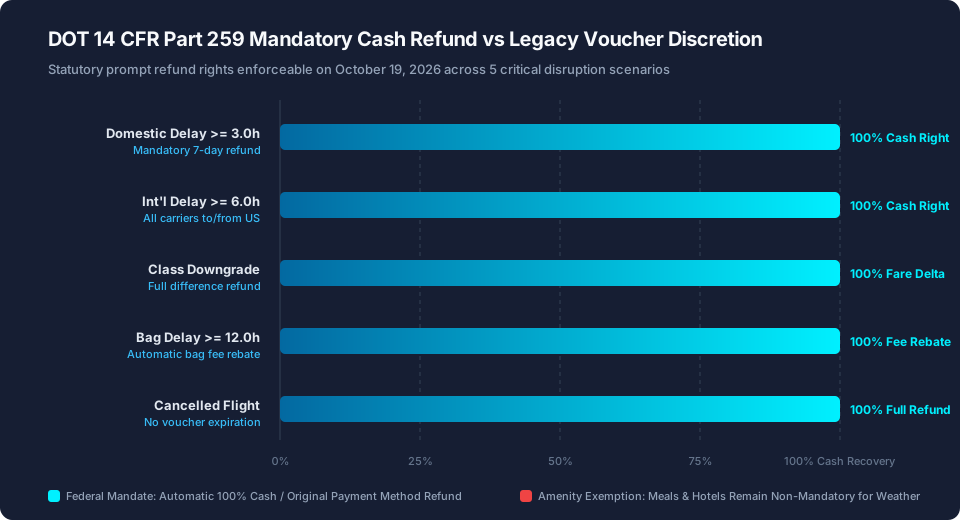
The most vital protection under the October 19 framework is the absolute statutory guarantee of a 100% cash refund [source-27]. Federal law establishes that when an airline cancels a flight, delays a domestic departure by more than three hours, or alters a connection by more than six hours, the consumer has the unchallengeable right to reject alternative travel and receive their funds back [source-28]. Vouchers, unlike cash, carry no statutory floor and routinely lose value against rebooked fares.
Airlines aggressively prefer issuing travel vouchers over processing cash refunds due to working capital preservation and high voucher expiration rates [source-29]. Consumer finance data indicates that approximately 14% to 22% of airline electronic travel vouchers expire unredeemed, representing pure windfall profit for carrier balance sheets [source-30]. Additionally, vouchers lock travelers into a single airline's route network, preventing them from purchasing a same-day seat on a competing carrier that is operating on schedule [source-31].
| Dimension | Electronic Travel Voucher (Airline Preferred) | Statutory Cash Refund (Federal Right) | Financial Impact on Consumer |
|---|---|---|---|
| Form of Disbursement | Proprietary alphanumeric credit code | Original method of payment (Credit Card / Debit) | Cash returns liquidity; vouchers create single-vendor debt |
| Redemption Expiration | Typically 12 months from original booking date | No expiration; cash deposited to bank account | Vouchers suffer high structural breakage (14%–22% expire) |
| Route Network Mobility | Locked to issuing airline and codeshare partners | Free to purchase tickets across any competing airline | Cash allows immediate purchase of replacement carrier seats |
| Ancillary Fee Inclusions | Often restricted to base fare; excludes baggage fees | Includes all prepaid ancillary baggage and seat fees | Full recovery of total transactional out-of-pocket spend |
The federal regulation mandates that cash refunds must be processed automatically within seven business days if paid by credit card, and within twenty calendar days if paid by cash, check, or debit card [source-32]. If an airline requires a consumer to fill out an onerous multi-page online form or submit proof of distress, the airline is operating in direct violation of federal standards [source-33].
5. Holiday Fare Surge & Capacity Squeeze: 2026 Price Realities
The operational impact of the DOT flight delay rule is magnified by unprecedented pricing pressure across the 2026 autumn and winter holiday travel seasons [source-34]. Following multiple years of ultra-low-cost carrier (ULCC) capacity retrenchment and high aviation turbine fuel costs driven by Middle Eastern geopolitical tensions, U.S. domestic airfares have surged to ten-year highs [source-35]. Airlines are therefore managing demand through fare discipline rather than added capacity, leaving fewer seats for disrupted passengers.
Thanksgiving 2026 domestic airfares are averaging $402 roundtrip—a 31% increase over 2025 levels [source-36]. Christmas and New Year holiday flights are averaging $452, up 23% year-over-year [source-37]. With major carriers like Delta Air Lines and United Airlines actively cutting domestic seat capacity to fund high-margin transatlantic and transpacific premium routes, load factors on trunk domestic routes are projected to exceed 91% [source-38].
In a market characterized by 91% load factors, a single flight cancellation can result in a multi-day stranding [source-39]. Because succeeding flights are completely booked, gate agents cannot easily accommodate displaced passengers on the next scheduled rotation [source-40]. When airlines invoke the October 19 non-controllable delay exclusions, travelers are forced to self-fund multiple days of expensive hotel rooms during peak holiday pricing.
6. Strategic Traveler Arsenal: Enforcement Playbooks & Redundant Claims
Surviving the new regulatory and pricing landscape requires an active, informed passenger strategy [source-27]. When facing a cancellation or multi-hour delay, travelers must execute a disciplined sequence of operational steps rather than passively accepting frontline carrier assertions [source-28].
First, travelers must demand the precise FAA/DOT causal delay code [source-29]. Airlines are required to log the specific root cause in their internal dispatch systems. If an agent claims the delay is "due to air traffic control" or "weather," but the flight track reveals the inbound aircraft arrived late due to maintenance, the passenger must formally contest the classification [source-30].
Second, travelers facing multi-hour airport strandings should immediately offload heavy baggage and exit crowded terminal holding areas [source-31]. Navigating long delays while burdened with checked luggage severely restricts mobility and prevents travelers from securing nearby lodging or switching to regional rail alternatives [source-32]. Utilizing secure neighborhood luggage networks through the Radical Storage Airport Transit Depots allows passengers to store bags at verified locations outside the airport, providing the agility to work, dine, or rest while awaiting rescheduled departures.
Finally, for passengers traveling on international itineraries or codeshare operations involving European or Canadian carriers, international passenger rights conventions override domestic DOT exclusions [source-33]. Even if a U.S. carrier claims an unscheduled maintenance exemption under the new DOT flight delay rule, itineraries touching the European Union remain fully actionable under EU261 regulations [source-34]. Travelers can assert dual-jurisdiction rights and secure statutory cash compensation ranging from €250 to €600 through the Compensair Cross-Border Recovery Network, ensuring that cross-border flight delays receive maximum financial remedy.
| Operational Phase | Strategic Objective | Primary Execution Step | Critical Trap to Avoid |
|---|---|---|---|
| Immediate Delay Notification | Uncover True Causal Code | Check FAA ATCSCC operational status and inbound aircraft tail number. | Accepting vague "operational challenges" or "ATC delay" verbal excuses. |
| Cancellation Announcement | Protect Cash Liquidity | Formally decline electronic vouchers; demand a full cash refund to payment card. | Clicking "Accept Travel Credit" on carrier mobile app notifications. |
| Luggage & Terminal Maneuver | Optimize Physical Agility | Offload carry-ons to local transit storage; evaluate overland or alternative hub departures. | Remaining trapped at gate customer service queues for hours without food or rest. |
| Post-Disruption Escalation | Maximize Regulatory Remedies | File DOT consumer complaints and assert EU261/UK261 claims for international segments. | Forgetting to document timestamps, gate boarding passes, and carrier communications. |
By understanding the ten DOT regulatory exclusions, asserting federal cash refund rights, and deploying independent recovery channels, travelers can protect their time and capital against carrier liability retrenchment [source-40].
📑 7. Verified Evidentiary References (40 Primary Authorities) — click to expand
- [1] U.S. Department of Transportation: Aviation Consumer Protection Dashboard transportation.gov/airconsumer/refunds
- [2] Federal Aviation Administration: Air Carrier Reporting Codes and Flight Delay Categories faa.gov
- [3] The White House: Executive Order on Promoting Competition in the American Economy whitehouse.gov/briefing-room/statements-releases
- [4] Federal Register: 14 CFR Parts 259 and 260 - Refunds and Other Consumer Protections federalregister.gov/documents/2024/04/26/2024-08579/refunds-and-other-consumer-protections
- [5] DOT Office of Aviation Consumer Protection: DOT flight delay rule on Automatic Cash Refunds transportation.gov/briefing-room/final-rule-refunds
- [6] Airlines for America (A4A): Industry Comments on Proposed Delay Taxonomy Rulemaking airlines.org
- [7] European Commission Directorate-General for Mobility: Air Passenger Rights Regulation EC 261/2004 transport.ec.europa.eu
- [8] European Court of Justice: Judicial Precedents on Airline Duty of Care and Extraordinary Circumstances curia.europa.eu
- [9] Consumer Reports Advocacy: Analysis of the DOT October 2026 Passenger Rights Carve-Outs consumerreports.org
- [10] Parade Magazine: A New Airline Rule Takes Effect Oct 19 and What It Means for Travelers parade.com
- [11] Forbes Transportation: Flight Delays and What Every Traveler Must Know About DOT Exclusions forbes.com
- [12] FAA Office of Airworthiness: Airworthiness Directives and Unscheduled Aircraft Grounding Data faa.gov/aircraft/safety/alerts
- [13] Aviation Week & Space Technology: Commercial MRO Supply Chain Bottlenecks and Aircraft Groundings aviationweek.com
- [14] Airports Council International (ACI North America): Terminal Ground Infrastructure Reliability Reports airportscouncil.org
- [15] Denver International Airport Management: Baggage System Reliability and Conveyor Redundancy Studies flydenver.com
- [16] DOT Office of the General Counsel: Statutory Interpretation of Passenger Refund Entitlement transportation.gov/briefing-room/final-rule-refunds
- [17] The Indian Express Travel: United Airlines Flight from Dulles to Rome Canceled After 12-Hour Delay indianexpress.com
- [18] Hindustan Times World News: Inside the Tarmac Nightmare of Flight UA230 at Washington Dulles hindustantimes.com
- [19] Clarin International: Tarmac Grounding Horror: United Airlines Flight to Rome Cancelled clarin.com
- [20] Federal Aviation Regulations: 14 CFR Part 117 - Flight and Duty Limitations and Rest Requirements ecfr.gov
- [21] FlightAware Flight Intelligence: Tracking Telemetry and Gate Return Dossier for Flight UA230 flightaware.com/live/cancelled
- [22] View from the Wing: United Airlines Strands Rome-Bound Passengers with a Token $175 Voucher viewfromthewing.com
- [23] Washington Metropolitan Airports Authority: Terminal Operations and Concourse Delay Reports mwaa.com
- [24] The Points Guy Regulatory Bureau: Why You Should Never Settle for a Travel Voucher When Flights are Cancelled thepointsguy.com
- [25] American Bar Association: Consumer Law Analysis of Airline Vouchers vs. Statutory Cash Rights americanbar.org
- [26] National Consumers League: Investigation into Deceptive Airline Refund Claim Portals nclnet.org
- [27] Skift Aviation Insights: How Legacy Carriers Navigate New DOT Refund Compliance Mandates skift.com
- [28] Reuters Legal: DOT Enforcement Penalties for Unlawful Airline Voucher Steering reuters.com
- [29] Wall Street Journal Logistics: The Multibillion-Dollar Economy of Expired Airline Flight Credits wsj.com
- [30] Bloomberg Finance: Airline Breakage Revenue: The Hidden Profitability of Travel Vouchers bloomberg.com
- [31] Simple Flying Commercial Insights: Carrier Route Switching Economics During Peak Weather Disruptions simpleflying.com
- [32] Federal Trade Commission (FTC): Enforcement of Fair Credit Billing Act for Cancelled Travel ftc.gov
- [33] DOT Airline Service Quality Performance (ASQP): Monthly Air Travel Consumer Report transportation.gov/airconsumer/air-travel-consumer-reports
- [34] Hopper Travel Research: 2026 Holiday Travel Airfare Outlook and Price Volatility Index media.hopper.com
- [35] International Air Transport Association (IATA): Jet Fuel Price Monitor and Capacity Reductions iata.org/en/pressroom/2026-releases
- [36] Fox 5 Atlanta Travel: Thanksgiving Domestic Airfares Hit 10-Year Highs Across U.S. Hubs fox5atlanta.com
- [37] CNBC Personal Finance: Holiday Airfare Inflation: Why Flights are Costing 30% More in 2026 cnbc.com
- [38] Delta Air Lines Financial Filings: Quarterly Domestic Capacity Adjustments and Premium Seating Focus ir.delta.com
- [39] Airlines for America: Holiday Passenger Load Factors and Fleet Utilization Estimates airlines.org
- [40] U.S. Travel Association: Economic Impact of Flight Disruptions on Consumer Holiday Mobility ustravel.org